The absolute key to Wonder Woman is All Star Comics #8 (December 1941), Diana's first appearance by William Moulton Marston: its documented record exceeds $1,620,000 for a CGC 9.4. For a beginner, accessible entry points start much lower: Wonder Woman #7 (vol. 1) shows a €9 eBay median across 96 listings, and Wonder Woman vol. 2 #1 (1987, George Perez) can be found raw for a few euros.
Wonder Woman is one of the oldest and most important characters in American comics. Created by William Moulton Marston (writer) and Harry G. Peter (artist), Diana of Themyscira first appeared in All Star Comics #8 in December 1941, took the lead feature in Sensation Comics #1 in January 1942, and received her own solo title the same year. Her publishing history spans over 80 years: making a structured approach essential before you start spending real money.
This guide sticks to the verifiable: eBay medians from our estimator (eBay.fr + eBay.com, June 2026) and sale records documented by Heritage Auctions, CGC News, and GoCollect. When a precise figure is not confirmed or rests on fewer than 15 listings, we say so clearly rather than inventing a number. First and most important: the "Wonder Woman #1" confusion: there are two very different issues with that label.
The number one trap: vol. 1 #1 (1942) vs vol. 2 #1 (1987)
Get this distinction clear before anything else. Wonder Woman vol. 1 #1 dates from 1942: it is the first issue of Diana's solo series, published by DC Comics by Marston and Peter, which ran all the way to #329 in 1986. In high grade, this issue is an unaffordable grail for most collectors. Our eBay estimator returns only 5 active listings: far too thin for a reliable median, and that small pool almost certainly blends very different items. For vol. 1 #1, specialist auctions (Heritage Auctions) are the only reliable benchmark, not the eBay median.
Wonder Woman vol. 2 #1 is an entirely different matter: published in February 1987, it is George Perez's post-Crisis on Infinite Earths relaunch, starting fresh with a new mythological origin. It is accessible, widely available, and can be found in nice raw condition for just a few euros. Never confuse the two: the "Wonder Woman #1" listed for €10 on eBay is almost certainly the 1987 volume 2, not the 1942 grail.
Golden Age grails (web-sourced only: outside the eBay estimator)
These issues are so rare and valuable that the eBay market does not reflect their real worth. Refer exclusively to specialist auctions:
| Issue | Significance | Documented record |
|---|---|---|
| All Star Comics #8 (Dec. 1941) | 1st appearance of Wonder Woman | $1,620,000 (CGC 9.4, Heritage June 2022) |
| Sensation Comics #1 (Jan. 1942) | 1st Wonder Woman cover, series debut | $399,100 (CGC 9.6, 2017) |
| Wonder Woman vol. 1 #1 (1942) | First solo series | eBay signal too thin (5 listings): specialist auctions only |
Sources: Heritage Auctions, CGC News, GoCollect.
Accessible keys: Silver Age, Bronze Age, Modern
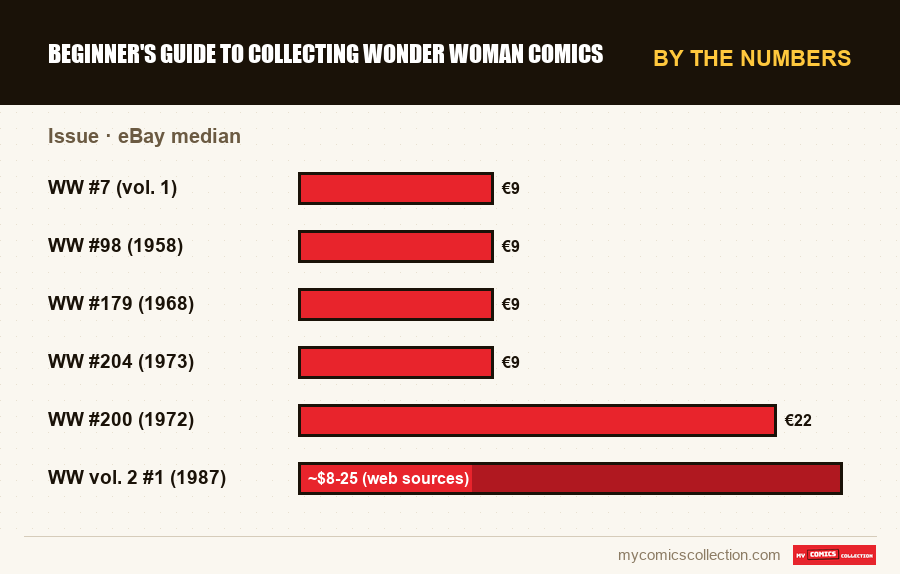
For a reasonable budget, here are the issues that balance historical importance and accessibility, with all-grades eBay data (June 2026):
| Issue | Significance | eBay median | Listings |
|---|---|---|---|
| WW #7 (vol. 1) | Early Golden/Silver Age run | €9 | 96 |
| WW #98 (1958) | Silver Age new origin (Kanigher & Andru) | €9 | 63 |
| WW #179 (1968) | "No powers" era begins (Diana Prince) | €9 | 14: borderline signal |
| WW #204 (1973) | Powers restored, end of mod era | €9 | 28 |
| WW #200 (1972) | Symbolic milestone | €22 | 22 |
| WW vol. 2 #1 (1987) | George Perez relaunch (post-Crisis) | ~$8-25 (web sources) |
Note: WW #179 has only 14 active listings: a borderline signal; do not treat this median as a firm reference.
Silver Age: Wonder Woman #98 and the new origin
Wonder Woman #98 (1958) marks an underrated turning point: Robert Kanigher and Ross Andru rewrote Diana's origin in a distinctly Silver Age style, with lighter adventures and gadgetry. Our estimator returns 63 active listings with a median of €9: a liquid market and a reliable signal. A raw low-grade copy is affordable; a CGC mid-grade steps up in price, but remains far below any Golden Age grail.
Bronze Age: the Diana Prince era and the return of powers
From 1968 to 1973, Wonder Woman went through what fans call the "mod" or "powerless" era: stripped of her abilities in Wonder Woman #179, Diana Prince became a martial-arts-trained civilian agent, under writers Dennis O'Neil and Mike Sekowsky. Her powers were formally restored in WW #204 (1973). Both issues attract Bronze Age collectors, but with only 14 active listings for #179, the eBay median should be taken cautiously. Issue #204, with 28 listings and a median of €9, offers a more solid signal.
Modern Age: the George Perez 1987 relaunch
After vol. 1 ended at #329 (1986), Wonder Woman vol. 2 #1 (February 1987) started fresh with George Perez as both writer and artist. That gatefold-cover issue embedded Greek mythology at the heart of Diana's story and is widely regarded as one of the best character relaunches in comics history. According to web sources (Key Collector Comics), guide values range from approximately $2 to $25 depending on grade: an ideal entry-level piece for starting a Wonder Woman collection without significant outlay. High-grade copies are plentiful enough to find without effort.
Why grades matter so much with Wonder Woman
On Wonder Woman, the gap between low-grade and high-grade copies can span several orders of magnitude: especially for Golden Age issues. A readable, ungraded copy of All Star Comics #8 is already an exceptional object, but a CGC 9.4 realised $1,620,000. For modern keys like vol. 2 #1, the grade premium is much smaller: a NM (9.4) is only marginally more expensive than a Fine (6.0). Grade becomes decisive the moment you target Silver Age or Golden Age keys: which is exactly when a proper free valuation makes sense.
The 2017 film directed by Patty Jenkins and starring Gal Gadot grossed $824 million worldwide, bringing Wonder Woman to audiences well beyond comic readers. That cultural moment strengthened collector demand for key issues across all eras.
Do you own a Wonder Woman comic? Get a free valuation with our tool based on real eBay sales to find its low, median, and high value.
Frequently asked questions
There are two: vol. 1 #1 (1942), an unaffordable grail, and vol. 2 #1 (February 1987, George Perez), the post-Crisis on Infinite Earths relaunch, which is accessible and common. A "#1" listed at a low price is almost surely volume 2.
All Star Comics #8 (December 1941), written by William Moulton Marston and drawn by Harry G. Peter. She then took the lead in Sensation Comics in January 1942, and got her own solo series the same year.
Wonder Woman vol. 2 #1 (1987), Silver Age issues like #98 (new origin by Kanigher and Andru), and the Bronze Age issues #179 and #204. Vol. 2 #1 is the ideal entry point.
In #179 (1968) Diana gives up her powers to become Diana Prince. #204 (1973) restores her powers. #179 has few active listings, so its pricing should be treated with caution.
No: on Golden Age issues, the gap between low and high grade runs to orders of magnitude. On a modern issue like vol. 2 #1, a near-mint copy is worth only slightly more than a good-condition one.