Watchmen (DC, 1986-87, 12 issues) by Alan Moore and Dave Gibbons is one of the most important works in comics history. For the beginner, the real question is not "which issue costs the most": the singles market is too thinly traded to cite a reliable median (9 eBay listings for #1, 4 for #4 or #12), but rather: start with the trade paperback , or hunt a first-print #1 in grade? This guide gives you an honest answer.
Published monthly from September 1986 through October 1987, the Watchmen maxiseries (written by Alan Moore, drawn by Dave Gibbons, colored by John Higgins) deconstructs the superhero genre in the frame of a political detective story. It is a Copper Age / Modern work: there are no Silver-Age or Bronze-Age issues of this series. Issue #1 introduces Rorschach, Doctor Manhattan, Nite Owl (Dan Dreiberg), Silk Spectre, Ozymandias, and the Comedian, characters loosely inspired by the Charlton Comics heroes. The series won the 1988 Hugo Award in the special "Other Forms" category, the first and only comic work ever to receive that honor.
This guide sticks to the verifiable: eBay data from our estimator (eBay.com + eBay.fr, June 2026) and documented auction records. When volume is too thin to cite a precise price, we say so clearly rather than inventing one.
TPB or original singles: the beginner's decision
The first choice every Watchmen collector faces is between two very different paths:
- The trade paperback (TPB). Published first in 1987 by DC and reprinted over 24 times, it is one of the best-selling graphic novels ever made, and the very object that suppressed single-issue liquidity on the secondary market. The original 1987 TPB (ISBN 0-930289-23-4) is itself a collectible, identifiable by its period softcover. It is the ideal entry point: read the whole story, own a quality physical object, and spend a fraction of what a graded single costs. Time magazine named it one of its All-Time 100 Greatest Novels: the only graphic novel on that list.
- The 12 original singles (1986-87). Each issue exists in two variants: the direct market edition (sold through comic shops, without a full UPC barcode: replaced by a promotional box reading "Who Watches the Watchmen?") and the newsstand edition (sold at newsstands, with a standard UPC barcode). For the #1 , the cover price of $1.50 is the quickest authenticity check. The promotional box (direct) vs. UPC barcode (newsstand) in the lower-left corner is the key visual tell.
The singles market: thin by design: be honest with yourself
Our estimator finds 9 active eBay listings for #1, 4 listings for #4, and 4 listings for #12 (June 2026). That volume is too low to produce a reliable headline median. The reason is straightforward: because the series was collected in a massively successful TPB, most readers gravitated toward the album format: leaving few singles in active circulation. That does not mean original issues are worthless; it means their real value lives in high-grade CGC copies, not the raw market.
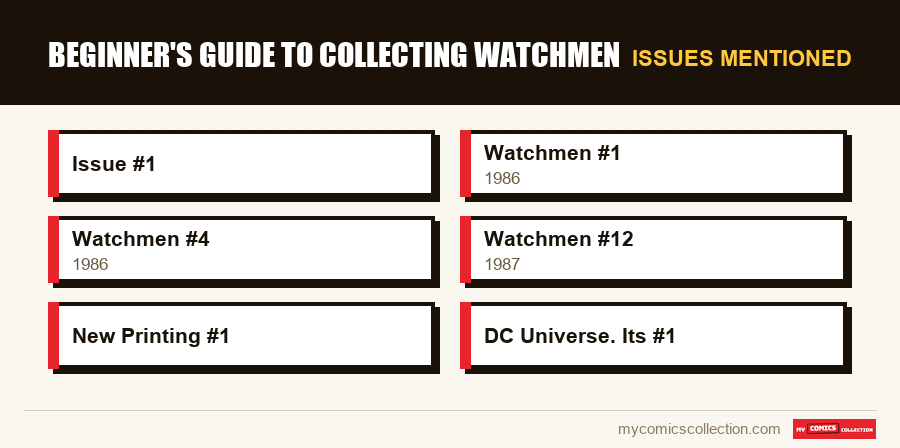
| Issue | Significance | eBay listings (June 2026) | Signal |
|---|---|---|---|
| Watchmen #1 (Sept. 1986) | First appearance of the full main cast | 9 listings | Volume too thin: median not reliable |
| Watchmen #4 (Dec. 1986) | Doctor Manhattan's origin issue | 4 listings | Volume too thin: median not reliable |
| Watchmen #12 (Oct. 1987) | Conclusion of the series | 4 listings | Volume too thin: median not reliable |
Source: mycomicscollection.com estimator, eBay.com + eBay.fr, June 2026.
Watchmen #1 in high-grade CGC: the reference benchmark
For collectors focused on long-term value, CGC grade is the meaningful signal . In August 2025, a Watchmen #1 in CGC 9.8 (Near Mint/Mint) sold for $488 at Landry Pop Auctions: the CGC census at that time recorded over 630 copies at 9.8, with none graded higher. That is the single best-documented sale on record for this grade. A raw copy in strong condition (VF/NM) trades qualitatively for far less, but without sufficient listing volume, treating any raw figure as a precise price would be misleading.
How to identify a first-print #1: the concrete checklist
- Cover price: $1.50 US / $2.00 Canada (issue #1, September 1986).
- Publisher: DC Comics: DC bullet logo in the upper-left corner.
- Direct edition: lower-left corner shows a promotional box reading "Who Watches the Watchmen?": no standard UPC barcode.
- Newsstand edition: standard UPC barcode in the lower-left corner with the issue number printed below it.
- Binding: stapled (standard US format, approx. 6.5 × 10 inches).
- Watch for reprints: DC released a "New Printing #1" and several anniversary editions. On a genuine 1986 original, there is no "reprint" or "new printing" notation anywhere on the cover.
Spin-offs and adaptations (for the completist)
Once you have the original 12-issue run, the completist collector turns to extensions:
- Before Watchmen (2012, DC): seven prequel miniseries with different creative teams for each character: a 37-issue set to hunt raw or in TPB.
- Doomsday Clock (2017-2019, DC): 12 issues by Geoff Johns and Gary Frank, bringing Watchmen characters into the main DC Universe. Its #1 CGC 9.8 is a modern key worth watching.
- Rorschach (2020, DC Black Label): 12 issues by Tom King and Jorge Fornes. Too recent to speculate on, but a handsome object for fans of the character.
- Adaptations: Zack Snyder's film (2009) and Damon Lindelof's HBO series (2019) generated related collectibles (art books, posters) without meaningfully moving the original comic market.
Three-step beginner strategy
- Start with the 1987 TPB. Read the series, understand why it matters. The first-edition TPB is itself a sought-after reading copy among serious fans.
- Target a raw #1 in strong shape. Without spending on CGC grading at first: look for a VF (Very Fine) or NM (Near Mint) copy with white pages, clean cover, and no creasing. Verify the cover price and confirm there is no "reprint" notation.
- If value is the goal, get it graded. CGC grading costs only make sense at high grade (9.4 minimum). Below that, the grading fee typically exceeds the resulting premium.
Own a Watchmen comic? Get a free valuation with our tool based on real eBay sales to find its low, median, and high value.
Frequently asked questions
For reading, the TPB is the natural choice: published from 1987 and reprinted more than 24 times, it is one of the best-selling albums in the world. The 12 singles from 1986-87 suit the collector who wants the period object.
Watchmen has 12 issues, published monthly from September 1986 to October 1987 by DC. The maxiseries is written by Alan Moore, drawn by Dave Gibbons and colored by John Higgins.
The series was massively reissued as a TPB, and readers largely preferred the album format. Few singles are in circulation, too few to establish a reliable median for #1, #4 or #12.
The direct market edition, sold in comic shops, has no full UPC barcode and carries a "Who Watches the Watchmen?" promotional box. The newsstand edition, sold at newsstands, carries a UPC barcode.
No, the series dates from 1986-87: it belongs to the Copper and Modern Age. Watchmen #1 introduces Rorschach and Doctor Manhattan, while #4 tells Doctor Manhattan's origin.