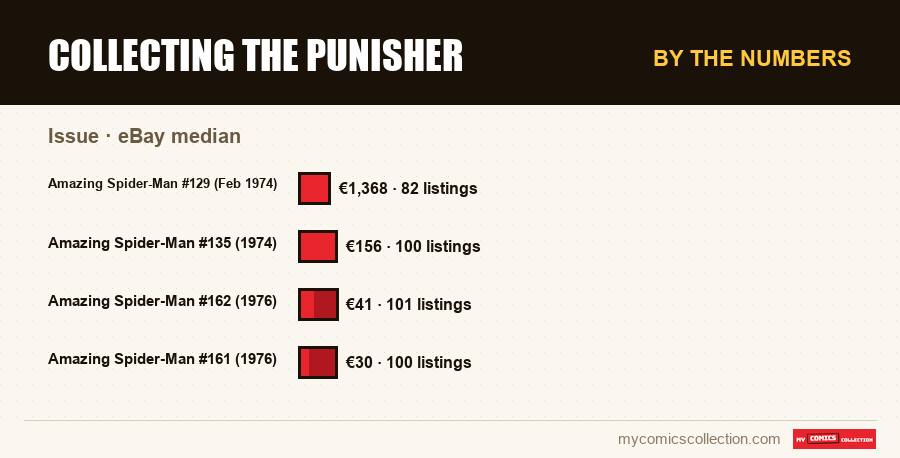
To start a Punisher collection without breaking the bank, skip the first appearance: Amazing Spider-Man #129 (February 1974, first appearance of Frank Castle) carries an eBay median of about €1,368 (82 listings, June 2026) and a documented record of $57,000 in CGC 9.8. The real entry points are elsewhere: Amazing Spider-Man #161 (median €30, 100 listings) and #162 (median €41, 101 listings), followed by the affordable 1980s-1990s solo series in mid-grade. Here's how to begin smartly.
The Punisher is a Bronze Age character: he debuts in 1974, well after the Silver Age ended (around 1970). That means there is no "Silver Age" Punisher issue: be wary of any listing that claims otherwise. All of his foundational books are 1970s (Bronze Age) or later.
This guide sticks to the verifiable: real-time eBay medians (via our estimator, limited to Amazing Spider-Man) and documented sale records. When a precise figure can't be verified, we describe it qualitatively rather than invent it.
The key issues, from priciest to most accessible
Values = median of active eBay listings, all conditions combined (our estimator, eBay.fr + eBay.com). The record is the best documented public sale, usually in high-grade CGC.
| Issue | Significance | eBay median | Documented record |
|---|---|---|---|
| Amazing Spider-Man #129 (Feb 1974) | 1st appearance of the Punisher (and the Jackal) | €1,368 · 82 listings | $57,000 (CGC 9.8) |
| Amazing Spider-Man #135 (1974) | 2nd appearance | €156 · 100 listings | |
| Amazing Spider-Man #162 (1976) | Notable appearance (with Nightcrawler) | €41 · 101 listings | |
| Amazing Spider-Man #161 (1976) | Accessible Bronze Age appearance | €30 · 100 listings |
Medians: mycomicscollection.com eBay estimator. #129 record: ComicConnect sale (CGC 9.8); Heritage documented $33,600 in 2021.
Where to actually start
The beginner's instinct is to chase the first appearance. At a median above €1,300 (and far more in high grade), #129 is not a sensible starting point. Build your collection in layers instead:
- Affordable Bronze Age appearances. #161 and #162 (medians €30 and €41) are the ideal entry points: genuine 1970s issues featuring the character, for the price of a meal.
- The solo series. The first 1986 solo limited series (5 issues, written by Steven Grant and drawn by Mike Zeck), then the 1987 ongoing The Punisher vol. 2 (Mike Baron and Klaus Janson) remain very affordable in mid-grade. The 1987 #1 is the most sought-after of the run.
- The origin. Marvel Preview #2 (1975) tells Frank Castle's first origin in magazine format. Good news for beginners: these Curtis magazines often survived well, so high grades stay more accessible than you'd expect.
Understanding grades
The "grade" is the comic's condition, scored from 0.5 to 10.0. On #129 the spread is staggering: the all-conditions median is €1,368, but the CGC 9.8 record climbs to $57,000. For a beginner:
- Raw: ungraded, sold as-is. This is where the deals are, but also the risk. Study the photos carefully (corners, spine, staples, creases).
- Graded (CGC, CBCS): sealed in a slab with an official grade. Reassuring for an expensive book like #129, but grading costs only make sense on valuable issues.
- Tip: for your first #161/#162 purchases, a raw copy in good shape is plenty. Reserve graded books for pieces where authenticity and condition justify the premium.
Avoiding fakes and traps
- Beware fake "Silver Age" listings. The Punisher doesn't exist before 1974. Any "Silver Age" Punisher listing is a mistake or a scam.
- Tell reprints from originals. A reprint is legitimate but has no collector value. Check the print date in the indicia at the bottom of the first page, and the period cover price.
- On expensive books, demand graded. For #129, favor a verifiable CGC/CBCS slab over a raw copy that's "too good to be true" at a knock-down price.
- Document your collection. Tracking each issue, its condition and its value protects you from duplicates and overpaying.
Starting your Punisher collection? Get a free valuation of your comics with our tool based on real eBay sales to find their low, median and high value.
After the first pieces: series to follow
Once you have the affordable Bronze Age appearances in hand, the rest of a Punisher collection is built by series. Each period has its own flavor, and knowing them avoids blind buying.
The first block is the 1980s. The 1986 solo miniseries, written by Steven Grant and drawn by Mike Zeck, establishes the character as a figure in his own right, and the ongoing The Punisher vol. 2, launched in 1987 by Mike Baron and Klaus Janson, gives him longevity. The second block, in the late 1980s and early 1990s, sees the character multiply titles: The Punisher War Journal (1988) then The Punisher War Zone (1992). The third block, in the 21st century, is Garth Ennis's Punisher MAX, with its adult, uncompromising tone.
Here are some practical tips to move forward without mistakes:
- Check the volume number. There are several The Punisher series and their #1 issues carry different dates: always specify the year before buying, or you may get an issue unrelated to the one you were after.
- Tell the origin from the first appearance. Frank Castle's first appearance dates from 1974, but his origin is told in Marvel Preview #2 (1975), in magazine format. These are two different purchases, with different collecting interests.
- Prefer complete sets for miniseries. For the 1986 miniseries, buying all five issues together avoids hunting down the missing issue one by one.
- Watch the condition of magazines. The magazine format of Marvel Preview is larger than a standard comic: plan suitable storage, since a badly stored magazine bends quickly.
One last marker for the beginner: read before buying in bulk. One or two collections from each period are enough to learn which mood draws you, between the 1980s crime story and the darkness of the MAX period. That way you avoid completing a series that does not speak to you at great expense, and keep your budget for the issues that truly matter, those whose historical value is documented.
One last thought: for each purchase, note the series year, the condition and the price. This lets you spot duplicates, keep track of your progress and stop the collection from growing out of control. It takes only a few minutes per issue and spares you many wrong purchases later.
Frequently Asked Questions
Amazing Spider-Man #129 (February 1974), which also introduces the Jackal. This issue fetches very high prices, and the article advises against making it a starting point for a beginner.
No. The Punisher debuts in 1974, in the Bronze Age, well after the end of the Silver Age (around 1970). Any listing claiming to sell a "Silver Age" Punisher is a mistake or a scam.
Amazing Spider-Man #161 and #162 (1976) are the ideal entry points: authentic 1970s issues featuring the character. #162 has a notable appearance alongside Nightcrawler.
In Marvel Preview #2 (1975), which tells his first origin in magazine format. These magazines often survived well, so high grades are more accessible than you might think.
For #161 and #162, a raw copy in good condition is plenty. Grading only makes sense for pieces where authenticity and condition justify the extra cost, like #129. On expensive pieces, insist on a verifiable graded copy.