The most valuable Flash-related comic is Showcase #4 (October 1956), the first appearance of Barry Allen: a CGC NM+ 9.6 copy realised $900,000 at Heritage Auctions in January 2024: the all-time record for a Silver Age DC comic. But the Flash spans more than 80 years and three generations of speedsters, with accessible entry points at every budget level.
The Flash is one of the very few comics characters to have existed continuously across every major era. Jay Garrick (Golden Age), Barry Allen (Silver Age) and Wally West (Modern Age) have each carried the title and left key issues behind them. The character has also benefited from significant cultural exposure: The Flash on The CW (2014-2023, nine seasons, Grant Gustin as Barry Allen) ran for nearly a decade, while The Flash (2023 film, Ezra Miller) grossed approximately $271 million worldwide against an estimated $200 million budget.
This guide sticks to the verifiable: eBay medians from our estimator (eBay.fr + eBay.com, June 2026) and sale records documented by Heritage Auctions, GoCollect, and specialist sources. One critical caveat: the major Silver Age Flash keys:Showcase #4, Flash #110, #123, #139: return virtually no eBay listings (0 to 1 active listing). For these issues, documented auction records are the only reliable benchmark; no eBay headline price can be cited.
The Flash numbering explained in two minutes: vol.1 and vol.2
Before buying anything, you need to understand the numbering: a frequent source of confusion. The original The Flash series (vol.1) launched with issue #105 in 1959, picking up directly where Flash Comics had left off in 1949. It ran through issue #350 in 1985, closing after Barry Allen's death in Crisis on Infinite Earths #8. In 1987, a new series launched with a fresh #1 for Wally West: that is vol.2 (1987-2009, 247 issues, initially written by Mike Baron and drawn by Jackson Guice). Later relaunches created further vol.3 and vol.4 series. When buying a Flash #1 on eBay, always check the publication year to confirm which volume you are dealing with.
Keys by era: grails and accessible entry points
For the major Golden Age and Silver Age grails, eBay data is absent or too thin to be meaningful. Documented auction records are the reference point.
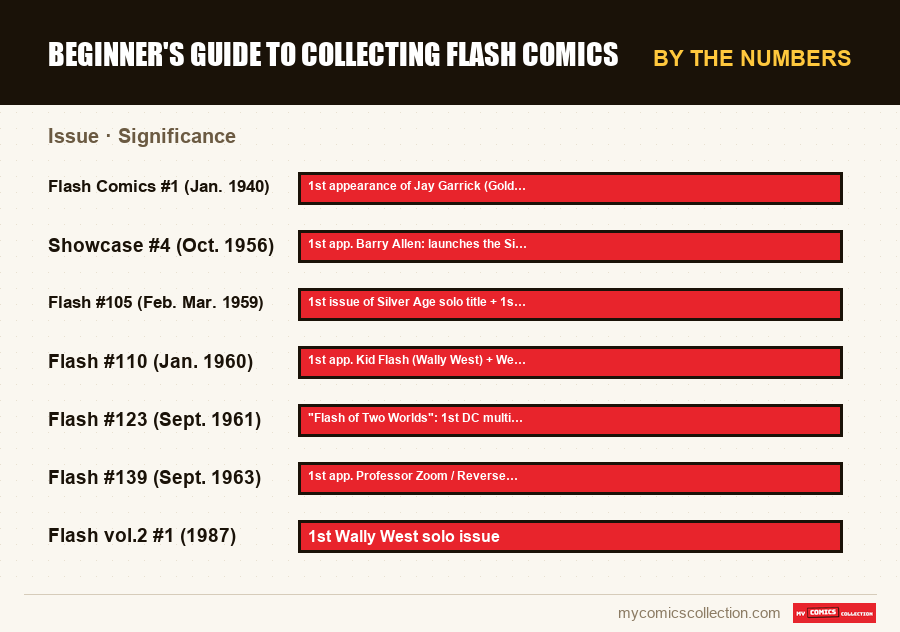
| Issue | Significance | eBay data (all grades) | Documented record |
|---|---|---|---|
| Flash Comics #1 (Jan. 1940) | 1st appearance of Jay Garrick (Golden Age) | Not available (different series) | $450,000 (CGC 9.6 Mile High, Heritage 2010) |
| Showcase #4 (Oct. 1956) | 1st app. Barry Allen: launches the Silver Age | 0 eBay listings | $900,000 (CGC 9.6, Heritage Jan. 2024) |
| Flash #105 (Feb. Mar. 1959) | 1st issue of Silver Age solo title + 1st Mirror Master | 1 listing: signal too thin | ~$16,500 (CGC 9.2, 2012): web source |
| Flash #110 (Jan. 1960) | 1st app. Kid Flash (Wally West) + Weather Wizard | 0 eBay listings | Not publicly documented |
| Flash #123 (Sept. 1961) | "Flash of Two Worlds": 1st DC multiverse | 0 eBay listings | ~$23,000 (CGC 9.4, Heritage 2004): web source |
| Flash #139 (Sept. 1963) | 1st app. Professor Zoom / Reverse-Flash | 0 eBay listings | ~$8,300 (CGC 9.6): web source |
| Flash vol.2 #1 (1987) | 1st Wally West solo issue | Median ~€4 · 14 listings | Affordable at low grades |
Record sources: Heritage Auctions, GoCollect, sellmycomicbooks.com.
Showcase #4: the definitive Silver Age DC grail
Published in October 1956, Showcase #4 is one of the most significant comics ever printed: it launched the Silver Age of superhero comics by introducing Barry Allen, a forensic scientist struck by lightning in his lab who becomes the new Flash. The issue contains two stories (the first scripted by Robert Kanigher, the second by John Broome) both drawn by Carmine Infantino and inked by Joe Kubert, under the editorial direction of Julius Schwartz. The unique CGC NM+ 9.6 copy, the highest-graded example in the census, realised $900,000 at Heritage Auctions in January 2024, setting the all-time record for a Silver Age DC comic. That same copy had previously sold for $179,250 at auction in 2009. Low-grade raw copies can be found for a few hundred dollars, though they rarely surface on eBay.
Flash Comics #1 and the Golden Age
Before Barry Allen, the original Flash was Jay Garrick, created in January 1940 by Gardner Fox (writer) and Harry Lampert (artist). Flash Comics #1 is the starting point: the CGC census records only 48 unrestored copies, making it one of the rarest Golden Age comics in any condition. The Mile High (Edgar Church) pedigree copy, the finest known, is reported to have reached $450,000 at Heritage in 2010. This is a grail well beyond the beginner's reach; it is included here to place the character's history in context.
Silver Age keys: Flash #105, #110, #123, #139
These four issues form the backbone of Silver Age Flash collecting and are all established key issues, but none returns meaningful eBay volume. For a beginner, they represent medium-term targets, best sourced through specialist dealers or conventions:
- Flash #105 (1959): the first issue of the solo series (numbering continued from Flash Comics), introducing the Mirror Master, with art by Carmine Infantino. A CGC 9.2 sold for approximately $16,500 in 2012; raw low-grade copies are accessible for a few hundred euros.
- Flash #110 (1960): the first appearance of Kid Flash (Wally West, Barry's nephew) and the Weather Wizard. A double key for Wally West collectors.
- Flash #123 (1961): "Flash of Two Worlds," scripted by Gardner Fox and drawn by Carmine Infantino: the issue that invented the DC multiverse by bringing Barry Allen face to face with Jay Garrick. A CGC 9.4 Western Penn pedigree copy realised approximately $23,000 in 2004.
- Flash #139 (1963): the first appearance of Professor Zoom, alias Reverse-Flash (Eobard Thawne): Barry Allen's defining nemesis, popularised by the CW series. A CGC 9.6 sold for approximately $8,300.
Accessible entry points: Flash vol.2 and the Wally West era
If Silver Age keys are out of reach for now, the Wally West era offers real entry points. Flash vol.2 #1 (1987) (Wally's first solo issue, written by Mike Baron and drawn by Jackson Guice) shows up with a median around €4 across roughly 14 eBay listings, all grades combined. One caveat: our estimator's query for "flash #1" blends multiple editions and volumes, so always verify the publication year on the listing. The celebrated Mark Waid run starting with vol.2 #62 (1992) and Geoff Johns's run from vol.2 #164 (2000) are both highly readable and widely available as raw copies for a few euros each: an ideal way to discover the character before committing to expensive Silver Age keys.
Grades and practice: tips for beginners
For Silver Age keys, the CGC grade changes value dramatically: a raw Good (2.0) copy of Flash #123 and a CGC VF (8.0) slab are in entirely different price brackets. Learn the Overstreet grade tiers (PR, GD, VG, FN, VF, NM) before committing to any purchase. For modern and Bronze Age Flash issues, raw copies in solid condition remain the most economical approach: CGC slabbing only makes financial sense on Silver Age keys or exceptionally well-preserved copies. Use our estimator to check the real eBay market price before every purchase.
Own a Flash comic? Get a free valuation with our tool based on real eBay sales to find its low, median, and high value.
Frequently asked questions
Flash vol.2 #1 (1987), Wally West's first solo issue, is the real accessible entry point. The big Silver Age keys (Showcase #4, Flash #110, #123, #139) are medium-term goals, rarely available in listings.
The vol.1 series starts at #105 in 1959, picking up the numbering of Flash Comics, which stopped in 1949, and ends at #350 in 1985. Vol.2 restarts at #1 in 1987, then come vol.3 and vol.4: always check the publication year.
Showcase #4 (October 1956), which opens the Silver Age of superheroes. The issue is written by Robert Kanigher and John Broome; Barry Allen is a forensic chemist struck by lightning in his lab.
Flash #123 (1961), "Flash of Two Worlds", written by Gardner Fox and drawn by Carmine Infantino. Barry Allen meets Jay Garrick, the Golden Age Flash.
Flash #110 (1960) has the first appearance of Kid Flash, alias Wally West, and of the Weather Wizard. Flash #139 (1963) introduces Professor Zoom, alias Reverse-Flash (Eobard Thawne), Barry Allen's major antagonist.