To start a Daredevil collection, start with the Bendis/Maleev run (2001-2006, $40-80 in set), add a #158 (early Miller, $30-50 in VG) as the first key issue, and gradually build towards the more expensive numbers (#168 Elektra, #131 Bullseye, then #1).
Daredevil is the ideal character to start a serious Marvel comic collection. Unlike Spider-Man where #1 costs a fortune and the key issues number in the dozens, the Daredevil catalog offers a clear roadmap with achievable objectives for every budget. Five truly essential numbers, accessible full runs, and solid valuation potential.
Ce beginner's guide to collecting Daredevil accompanies you from your first purchase to a structured collection, avoiding classic pitfalls and maximizing your budget.
Step 1: Understand the title structure
Daredevil has had several editorial volumes that must be distinguished:
- Volume 1 (1964-1998): 380 numbers. The original series, from Stan Lee to D.G. Chichester. Contains the Silver Age, Miller and Nocenti eras.
- Volume 2 (1998-2009): 119 numbers + #500-512. Marvel Knights then continuation. The Smith, Bendis, Brubaker runs.
- Volume 3 (2011-2014): 36 numbers. The Mark Waid/Samnee run in New York.
- Volume 4 (2014-2015): 18 numbers. Waid/Samnee Suite in San Francisco.
- Volume 5 (2016-2018): 28 numbers + #595-612. Charles Soule/Ron Garney.
- Volume 6 (2019-2021): 36 numbers. Chip Zdarsky/Marco Checchetto, part one.
- Volume 7 (2022-2024): 14+ numbers. Zdarsky/Checchetto, conclusion.
This multiplicity of volumes may seem intimidating, but it creates natural entry points. Each volume #1 is a new beginning.
Step 2: recommended first purchases (budget $50-100)
Your first month of collections should include:
- A Bendis/Maleev lot (10-20 consecutive numbers): $15-30 on eBay. You discover the character in his most accessible modern incarnation.
- Daredevil #1 (1998, Kevin Smith) in raw NM: $8-12. Your first “key issue” for a modest price.
- Daredevil #1 (2019, Zdarsky) in raw NM: $10-15. A modern key with growth potential.
- Born Again TPB or singles #227-233-$20-40 depending on format. The essential arc to understand the character.
Total budget: $50-100. You already have a solid foundation with meaningful numbers.
Step 3: build around key issues (budget $200-500)
Once your base is established, aim for these acquisitions in order:
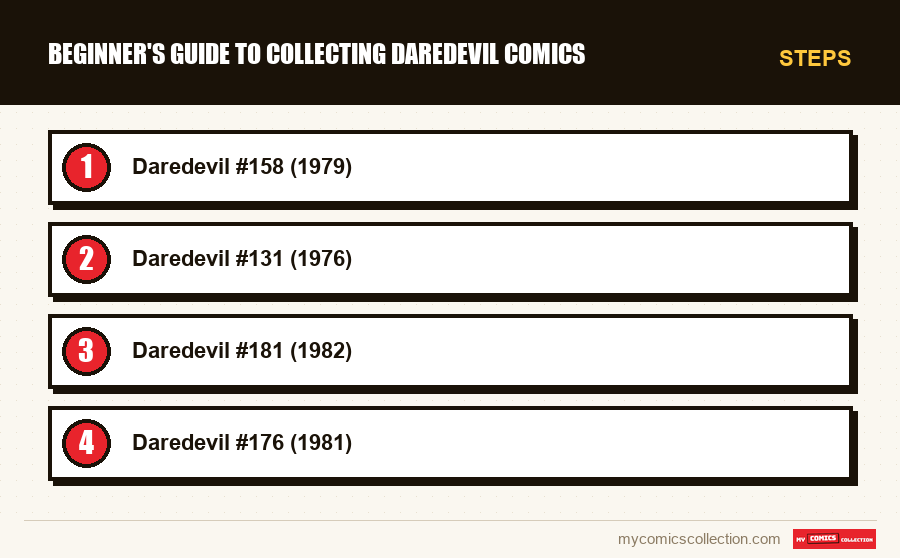
- Daredevil #158 (1979): Miller's beginnings of drawing. In VG (4.0): $25-40. In FN (6.0): $50-80. Your first significant vintage issue.
- Daredevil #131 (1976): first Bullseye. In GD (2.0): $30-45. In VG: $50-80. A major MCU character.
- Daredevil #181 (1982): death of Elektra. In NM: $30-50. Iconic moment of the medium.
- Daredevil #176 (1981): first Stick. In NM: $20-35. Underrated for its narrative importance.
Step 4: The Holy Grail: Daredevil #168 and Beyond
Le Daredevil #168 (first Elektra) is your first “serious” goal. In VG (4.0): $100-150. In FN (6.0): $200-300. Take your time to find the right copy at the right price. Always check:
- No restoration (reglued cover, color touch, etc.)
- Full pages (Marvel Value Stamp coupon is often cut out of 70s issues)
- No significant markings (name, subscriber address)
Beyond #168, the Daredevil #1 (1964) is the ultimate goal. In GD (2.0): $3,000-5,000. This is not a beginner's purchase: plan it as a 2-3 year goal.
Beginner's mistakes to avoid
Buying slabs without understanding grading
A CGC 9.8 of a modern number at $50 is not necessarily a good investment. The cost of the grading itself ($30-50) eats into the margin. Reserve slabbing for numbers that justify it: key issues in high condition, long-term investments.
Neglect the condition to "have the number"
A Daredevil #168 in Poor condition (0.5-1.0) at $30 seems tempting, but its resale value is almost zero and it will never appreciate significantly. Better to wait and buy at least VG+.
Ignoring full runs for key issues alone
A collection consisting only of isolated key issues lacks context. The complete runs (Bendis 65 issues, Waid 54 issues, Zdarsky 50 issues) offer reading pleasure AND collecting depth.
Overpaying for modern newsstand editions
Newsstands from the 2000+ years are not uncommon for Daredevil. Do not pay an excessive premium except for issues from the 80s (Born Again, Miller) where the newsstand/live distinction is significant.
Organize and track your collection
From the beginning, catalog each issue purchased with: title, number, volume, estimated condition, purchase price, date of purchase. This discipline allows you to measure your progress, identify missing items, and evaluate your collection at any time.
Storage: the numbers in bag & board in a short box are enough for 90% of your collection. Reserve toploaders or Mylar for key issues (value > $50). A cool, dry, dark environment is essential: Daredevil covers use a lot of red, a color particularly susceptible to sunfading.
1 year goals for the beginner
- 50-100 issues in your collection
- At least one full run (Bendis or Waid recommended)
- 3-5 significant key issues (#158, #131, #176, #181, a modern #1)
- A target budget identified for your next major key issue (#168)
- A functional tracking system (application or spreadsheet)
Do you own Daredevil comics? Estimate the value of your collection for free to know their current rating.
Frequently asked questions
With a consecutive lot from the Bendis/Maleev period, to discover the character in his most accessible modern version. Add Daredevil #1 (1998, Kevin Smith), the 2019 #1 (Zdarsky) and the Born Again arc (#227-233) as singles or a collected edition.
Seven volumes, from 1964 to today. Every #1 is a fresh start, which creates natural entry points; volume 1 (1964-1998) runs 380 issues.
#158 (Miller's start on art), #131 (first Bullseye), #176 (first Stick) and #181 (death of Elektra). #168 (first Elektra) is then the first serious goal, and the 1964 #1 the ultimate one, to plan over two to three years.
Not necessarily. The cost of grading eats the margin on a modern issue, so keep slabs for high-condition key issues and long-term investments.
No restoration (re-glued cover, color touch), complete pages (the Marvel Value Stamp coupon is often cut out in 1970s issues) and no significant markings. Also avoid Poor condition: resale value is almost nil.