
Collecting comics after 60 combines three distinct advantages: the free time to complete a childhood collection (Silver Age 1956-1970, Bronze Age 1970-1985), a retirement budget that's often comfortable (typically $200-$800/month), and a primary motivation rooted in nostalgia. The practical challenges at 65-75 go beyond buying: collection insurance (often $5,000-$80,000), estate planning, early gifting, and long-term preservation. Succession planning should start 5 to 10 years out.
A 65-year-old senior collector picking up the Strange and Nova issues they bought off newsstands between 1975 and 1985 is doing something fundamentally different from a 35-year-old buyer. The free time reshapes the pace, the retirement income changes every trade-off, and the emotional memory drives every choice. But above all, the time horizon forces decisions a thirty-something never has to face: updating home insurance, planning an estate, talking to heirs, locking down long-term storage. This 1,800-word guide walks through the concrete strategies for collecting after 60: completing a childhood collection, managing a retirement budget, organizing your legacy, and avoiding the conservation mistakes that can wipe out 30 years of patience in six months.
Why the 60+ Collector Profile Changes Everything
Senior collectors stand apart thanks to three structural factors. First, free time: retirees have an average of 5 to 7 hours of unstructured time per day, compared to 1 to 2 hours for a working 40-year-old. Those extra hours change how you hunt for comics: you take the time to compare ten eBay sellers, attend three conventions a year, and actually read through runs instead of just stacking them.
Next, budget. The average U.S. Social Security retirement benefit sits around $1,900/month in 2026, and many private-sector retirees with full careers bring in significantly more. That financial stability makes it realistic to put $200-$800/month toward a collection without straining the household: often three to five times what a collector in their thirties with a family can spare. The article collecting comics on a $500/month budget covers this level of spending in depth.
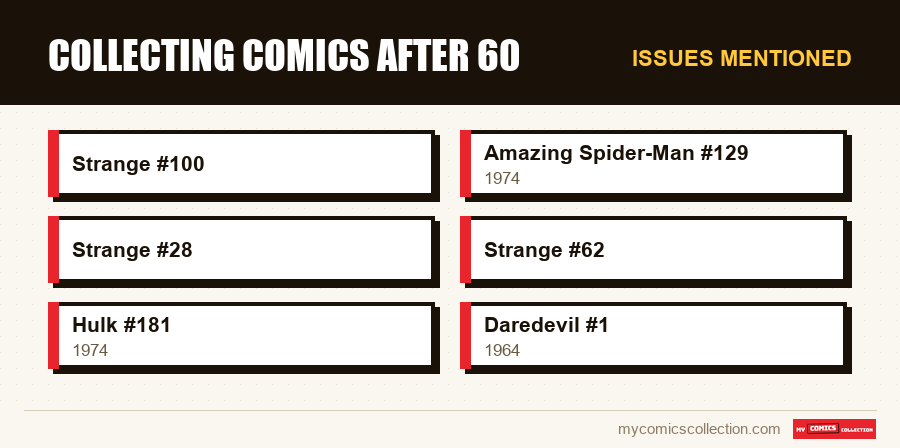
Finally, motivation. At 30, you collect for investment potential, completeness, or aesthetic pleasure. At 65, nostalgia takes over. A senior tracking down their Strange #100-#150 run (Lug edition, 1978-1982) isn't calculating a return: they're buying back a piece of their adolescence. That emotional pull dictates the scope of the collection far more than market prices do. Amazing Spider-Man #129 (August 1974, first appearance of the Punisher) goes for $2,200-$3,800 raw VF today, but for a collector who bought it at age 12 off a local newsstand, it's worth more than any price guide can say.
This generational difference also shapes the hunting ground. Senior collectors primarily target the Silver Age (1956-1970) and Bronze Age (1970-1985): the eras when they were buying comics between ages 8 and 25. The full breakdown of these transitions is covered in understanding the ages of comics.
Completing a Childhood Collection: Hunting Silver and Bronze Age
The core strategy for a senior collector is finishing what they started at 10, 12, or 15. Three profiles dominate: French Lug-Sémic collections from 1969-1989 (Strange, Nova, Titans, Spidey), U.S. Marvel issues brought back from trips or ordered by mail, and DC Comics distributed in French editions by Sagedition or Artima.
For a senior born in 1958 who read Strange between 1972 and 1982, a typical scope covers Strange #28 to #150-122 issues. On the 2026 French market, those issues run from €8 (common issues in average condition) to €220 (first issue in NM, or key numbers like Strange #62 containing the first French-edition appearance of Captain Marvel). Total budget to complete the run: €3,500-€9,000 depending on condition. At €400/month allocated, that's a 9-to-22-month project.
The method breaks down into three steps. Step one: take an accurate inventory of what you already own. Many childhood collections have been sitting in boxes in the attic for 30 years with no list attached. The initial cataloging takes 8 to 20 hours for 300 comics, but it's the necessary first step. The Comics Manager app handles cataloging by barcode scan or title search.
Step two: identify the gaps. The missing comics module compares your list against the complete run and shows exactly what's missing. For Strange, you'll immediately see that you're short issues #45, #67, #89, #102, #134, and #149. That want list becomes your 12-to-24-month roadmap.
Step three: the hunt. At 65 with time on your side, the best channels are eBay France (4,000 to 7,000 active Lug comics listings at any given time), BDFugue conventions, Quai des Bulles, Angoulême, Sunday morning regional comic fairs, and specialized Lug-Sémic Facebook groups. Track prices through the evolution of comics prices 1970-2026.
Conservation tip for seniors: before pulling a collection that's been stored in the attic for 30 years, check the humidity level. Above 60% relative humidity, pages yellow and staples rust within a few months. A $200 dehumidifier installed 6 months before you bring the comics out can prevent a 20-40% loss in value on Strange issues from 1975-1980.
The Retirement Budget: Balancing Without Breaking the Bank
A sound budget framework for a retiree covers three monthly buckets. Fixed expenses (housing, utilities, healthcare, food) absorb 55-70% of income. Contingency funds (out-of-pocket medical, family support, travel) absorb 15-25%. Leisure and hobbies, including comics, should never exceed 15% of net monthly income.
On a $2,800/month net retirement income, that's roughly $420/month for comics: about $5,000/year. At that pace, you finish a Lug run in 18 months, add two or three U.S. key issues per year (an Amazing Spider-Man #129 raw VF at around $2,800, for instance), and still have room for overhead: insurance, CGC grading ($35-$90 per book), and supplies (mylars, backing boards, longboxes at around $25 each).
The classic trap: emotional impulse buying. A senior who spots a Hulk #181 (first appearance of Wolverine, November 1974) raw VF at $4,500 is tempted to burn three months of budget in one shot. That's not necessarily a bad call, but it needs to be made with a clear head and, if finances are shared, with your partner's input. The article comics collecting as a married couple covers joint financial management.
For purchases above $2,000, three checks are mandatory: authenticate the book (CGC certified or a recognized expert), review recent sales of the same issue at the same grade (GoCollect or GPAnalysis), and confirm liquidity: can you resell it quickly if needed? An Amazing Spider-Man #129 in CGC 9.4 sells in 30 to 60 days on eBay or Heritage. A lower-profile, illiquid book might take 6 to 18 months to find a buyer.
Collection Insurance: Protecting $30,000+ in Paper
A senior collector's collection routinely reaches $5,000 to $80,000 in cumulative value, sometimes more. That value is almost never covered by standard homeowners or renters insurance, which typically caps collectibles at $2,500 to $5,000 unless a specific rider is added. Beyond that cap, a water leak, fire, or burglary results in a payout that's a fraction of the actual loss.
The right process has four steps. First, get the collection appraised: either by a professional or through the free valuation tool with a dated, itemized screenshot. That document should list every meaningful book above $100, with grade, condition, and replacement value.
Then, present that file to your insurer. Two options depending on the carrier: a rider added to your homeowners policy (annual premium increase of $80-$250 for up to $30,000 in coverage), or a dedicated collectibles policy (Chubb, HISCOX, AXA Art) for collections over $50,000. Annual premiums typically run 0.5-1.2% of the insured value.
Step three: photograph the entire collection. Every meaningful book gets a front cover and back cover photo, plus its CGC label if graded. Store those photos on an external drive and in the cloud (Google Drive, iCloud). In the event of a claim, that visual record cuts the settlement timeline by a factor of three or four.
Step four: update the appraisal every 18 to 24 months. The comics market moves fast: a Daredevil #1 (April 1964) that was worth $3,500 in CGC 6.0 in 2020 has crossed $7,000 in 2026 based on recent Heritage sales. A policy underwritten on 2020 values now covers only half the actual loss. See the 2025 comics market recap.
Estate Planning: Start 5 to 10 Years Early
Handing down a comics collection is the topic seniors avoid most, and the one that causes the most financial damage to heirs. A 3,000-issue collection valued at $45,000, passed on without documentation, regularly ends up sold in a rush to an antique dealer for $3,000-$8,000: roughly 10-15% of real value.
Planning starts with one simple question asked of your heirs: who wants what? Three scenarios play out. An heir who's a collector themselves: an anticipated gift transfer secures the asset and takes advantage of the annual gift tax exclusion and lifetime exemption. An heir who isn't a collector but cares about the value: prepare a priced inventory and a step-by-step guide to selling in the best conditions. An heir with no interest at all: plan a partial sale while you're alive to convert the asset to liquid cash.
A complete estate inventory has five components. The full list of comics: title, issue number, publisher, date, condition, CGC grade if applicable, estimated value. A table of key issues (top 30 by value) with photos and notes explaining why each is valuable. A contact list for recommended resale channels: Heritage Auctions, ComicConnect, verified eBay sellers, local conventions, French market experts. Insurance contact details and a copy of the latest appraisal. Log-in credentials for the comics collection app where everything is cataloged.
Gradual gifting: for a collector heir, donating targeted batches year over year (200-500 issues per year) makes the transfer smoother. The senior keeps an active slice of the collection, the heir gradually integrates the comics into their own catalog, and the transition at 65, 70, or 75 happens without a hard break. The article inheriting a comics collection lays out the estate planning options in detail.
Selling Partially While You're Still Around: Lighten Up Without Letting Go
Many seniors reach 70-75 with 5,000 to 10,000 comics, and 70% of them no longer hold any emotional weight. Holding everything until you're gone leaves heirs with an unmanageable mountain. Selling a portion while you're alive turns that mountain into usable cash (travel, helping grandchildren, quality of life) while keeping the emotional core of the collection intact.
The method: split the collection into three piles. The core pile (the 200-500 comics tied to childhood: untouchable) stays with the senior. The legacy pile (the 50-200 most valuable books: key issues, CGC-graded) waits for a family decision: pass on or sell. The peripheral pile (everything else: often 2,000-4,000 common or semi-rare issues) goes to market over 18 to 36 months.
Channels for gradual selling include eBay France at a pace of 20-50 comics per month, Sunday fairs for lots of 100-300 issues at bulk prices, and themed lot sales (entire Strange run 1975-1985, all Conan, all 1980s DC) to targeted collectors via Facebook or at conventions. Average prices on these channels come in at 60-80% of individual eBay prices, but the time saved justifies the discount. The article buying and selling comics in France covers the full range of French market channels.
Preservation: Zero Tolerance at 70
Storage becomes critical for a senior collector who wants to hand down the collection in good shape. Mistakes made at 65 rarely show up before 75, but by then, heirs are inheriting a degraded asset. Five things to watch.
Humidity: keep it between 40 and 55% relative humidity, monitored with a $25 digital hygrometer. Above 60%, yellowing and mold set in within 18 to 36 months. Temperature: a steady 60-70°F: avoid unheated basements in winter and attics in summer. Light: zero direct UV. Bronze Age covers lose saturation within 5 to 10 years of even indirect exposure.
Physical protection: Mylites 2 (4-mil Mylar) minimum for comics worth over $100, with full-size backing boards. Cheap poly bags yellow and stick to the paper within 7 to 10 years. The guide protecting your comics covers professional-grade materials.
Vertical storage: comics stacked flat warp under their own weight beyond 50 issues. Archival cardboard longboxes at around $25 each hold 200-250 comics upright, stored off the floor on metal shelving.
Catalog your senior collection in 7 days. Barcode scan or title search, live eBay valuation, missing issues module to finish your runs, and PDF export for insurance and estate planning. 7-day free trial, then a monthly or annual subscription, priced for your country (see pricing).
FAQ
At 65, is it too late to start a comics collection?
Not at all. A senior has the three most important resources: free time, a stable income, and a clear sense of what they want. Starting at 65, you can build a focused 500-to-2,000-issue collection in 5 to 10 years centered on a specific era or character (Lug Strange, Silver Age Spider-Man, Bronze Age DC). The time horizon makes long-term buys perfectly sensible.
What's a reasonable monthly budget for a collector in retirement?
Cap it at 15% of net monthly income. On $2,200/month net, that's $330/month. On $3,000/month net, $450/month. Beyond that, the hobby budget starts eating into healthcare or emergency funds: which becomes a real issue at 75-80 when medical costs rise.
How do I declare my collection to my home insurance?
Get the collection appraised, by an expert or through the free valuation tool, then present the itemized file to your insurer. Add a rider to your homeowners policy ($80-$250/year in additional premium for up to $30,000 in coverage), or take out a dedicated collectibles policy for collections over $50,000. Update the appraisal every 18 to 24 months.
My kids don't want to inherit my comics. What should I do?
Three options. Sell progressively while you're alive to convert the asset to usable cash. Donate to a museum or library (possible tax deduction). Leave the collection to a fellow collector or a club via your will. In any case, don't leave an undocumented collection for heirs who'll sell it for 10-15% of its real value.
Should I have my comics CGC-graded before passing them on?
For key issues worth over $500 raw, yes. CGC grading costs $35-$90 per book depending on the service tier, but it authenticates the book, locks in the grade, and makes future resale by heirs much easier. For common issues under $100, grading has no return on investment. See the CGC grading guide for more detail.
How do I complete a Strange Lug run I started in 1975?
First, catalog what you already have using a comics manager app. Then identify the exact missing issues with the dedicated module. Hunt on eBay France (4,000 to 7,000 active listings), regional fairs, conventions, and specialized Lug-Sémic Facebook groups. Budget €3,500-€9,000 for issues #28-#150 depending on condition, spread over 12 to 24 months.
What storage materials should I choose at 70 for the long term?
Mylites 2 (4-mil Mylar) for comics over $100, polypropylene bags for the rest, full-size backing boards, archival cardboard longboxes at around $25 each (200-250 comics per box). Store off the floor on metal shelving, use a $25 digital hygrometer to maintain 40-55% humidity, keep temperature at a steady 60-70°F, and keep all comics away from direct UV light.
Is it better to sell my collection as a whole or piece by piece?
Piece by piece on eBay for comics over $200 (full market price). In themed lots of 50-300 issues for common and semi-rare books (60-80% of individual price, but the time cost is cut by a factor of ten). Selling the whole collection to a dealer should be a last resort only: expect a 50-70% discount off market value.