Collecting comics on $50 a month (roughly $600 a year) is still viable in 2026: as long as you target undervalued key issues , affordable 1:25 ratio variants , and bargain bins priced $1-3 where hot Modern Age books quietly sit. The method: focus on one or two series per year, buy in bulk with a friend to unlock dealer discounts (10-20% above $100), and flip 30% of your collection annually to upgrade. Avoid speculative variants you have no exit plan for, long runs you're trying to complete (Amazing Spider-Man's 700 issues), and Modern Age purchases without a clear key issue identified.
A $50-a-month budget sounds laughable in a hobby where some CGC-graded covers break $10,000. And yet it describes the majority of collectors under 30: students, entry-level workers, recent grads just getting started. The real question isn't whether you can collect on this budget, but how. At $600 a year over five years ($3,000 total) a disciplined strategy can build a collection of 80 to 120 issues whose theoretical resale value reaches $4,500-$6,000 by 2031. This article lays out the method: six prioritized buying strategies, four traps to avoid, and a concrete monthly breakdown of how to allocate that $50. No magic shortcuts: just the kind of capital allocation discipline you'd apply to any long-term investment.
Why $50 a Month Is Still a Meaningful Budget in 2026
The gap between $50 and $500 a month doesn't translate into a 10× difference in collection quality. The marginal return curve for comics is nonlinear: your first copy of Amazing Spider-Man #129 (first Punisher, 1974) picked up in Fine 5.0 for around $400 adds far more to a collection than a tenth 1:50 ratio variant from an obscure Modern indie series at $250. With a tighter budget, your selection process becomes mechanically more rigorous: which paradoxically improves your return per dollar spent.
The 2025-2026 market also saw a sharp correction in the Modern speculative category: an X-Men #1 Jonathan Hickman (Dawn of X) variant that went for $85 in 2021 is now sitting at $18-25 in 2026. That correction is exactly the window small-budget collectors have been waiting for. Sleeper issues from the 2018-2023 era that originally sold for $4-6 are turning up in bargain bins at $1-3. Allocate $200 of your $600 annual budget here and you can intelligently acquire 70 to 100 issues.
The second lever is the graded-comics premium. A CGC 9.8 on a Bronze Age key can run $800-$4,000 today. The same issue unslabbed in raw VF/NM 8.5 condition often drops below $250. That spread rewards patience and deep market knowledge: two free resources. The undervalued comics 2026 article lists the priority targets for this year.
Third: pooling resources. A solo collector at $50/month is in a fragile position. Two collectors combining budgets at $100/month cross the volume discount thresholds most dealers offer (typically at $80-$100 per order at most specialized retailers). Per-capita return goes up 12-18% with zero extra effort.
Strategy 1: Prioritize Key Issues That Are Still Moving Up
A key issue is any issue containing a major editorial event: a first character appearance, a landmark cover from a soon-to-be-defining artist run, a death or return, a first crossover. These books have structural demand and don't depend on hype cycles. On a $50/month budget, they should form the backbone of your collection: 35-50% of your annual spend, or $210-$300.
Bronze Age keys (1970-1985) remain the most accessible at mid-grades. Some concrete targets for 2026:
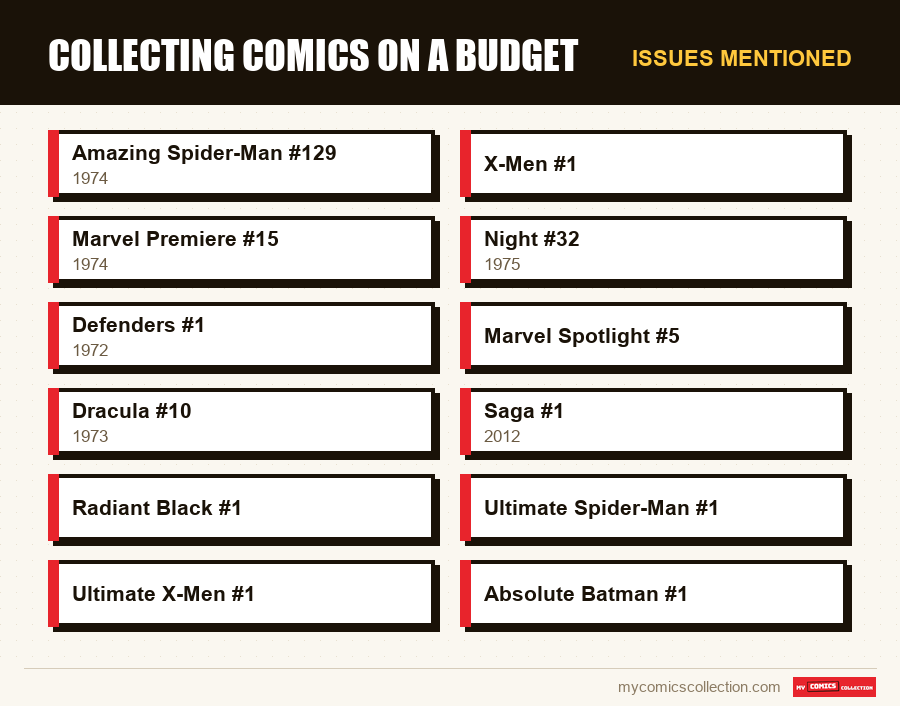
- Marvel Premiere #15 (1974, first Iron Fist) in Fine 6.0: $85-$130
- Werewolf by Night #32 (1975, first Moon Knight) in VG 4.0: $195-$260
- Defenders #1 (1972) in VF 8.0: $120-$160
- Marvel Spotlight #5 in a 1990s reprint edition: $27-$43
- Tomb of Dracula #10 (1973, first Blade) in VG/F 5.0: $215-$300
The key tradeoff: buy one premium piece at $250 (five months of budget) or three secondary keys at $85 each. The rule of thumb for a $600 annual budget: buy a maximum of two pieces above $200 per year. Everything else should stay under $100. This discipline breaks the all-or-nothing paralysis that stalls most small-budget collectors.
For Modern Age keys (post-2000), the same logic applies with a quality filter: only buy keys that have survived at least one full hype-then-correction cycle. Saga #1 (2012) is a genuine key. Radiant Black #1 is still in speculative territory. That time-based filter is free and brutally effective. The comics poised to rise 2026-2027 guide covers 18-month projections.
Strategy 2: Affordable 1:25 Ratio Variants. The Quiet Edge
1:25 ratio variants (one copy printed for every 25 copies of the standard cover) are the most interesting arbitrage zone for a small budget. Their limited print run guarantees built-in scarcity, yet entry prices remain accessible: $16-$65 in 2026 for the vast majority of Modern titles. The 1:25 and 1:100 ratio variants guide breaks down the print mechanics in detail.
The classic mistake is buying a 1:25 on a mediocre series with no key issue inside. Scarcity alone isn't enough: you need an editorial event driving demand. The winning combo: a 1:25 variant on an issue that contains a first appearance or a meaningful death. Three 2024-2025 examples:
- Ultimate Spider-Man #1 Marco Checchetto 1:25 (2024): ~$48, up ~25% since release
- Ultimate X-Men #1 Peach Momoko 1:25: $65, holding steady
- Absolute Batman #1 1:25 (October 2024): $38-$54 depending on variant
On a $600 annual budget, dedicate $150-$200 to 4-6 ratio variants per year, exclusively on first issues of major events or editorial relaunches. Acquisition costs stay low, resale liquidity stays strong (eBay, Whatnot, FR marketplaces), and the risk/reward ratio beats non-key Modern Age books by a wide margin. Avoid 1:25 variants on issue #15 or #34 of any random series: demand collapses once the initial hype passes.
$50/month allocation: recommended monthly breakdown:
- $22 → key issue reserve fund (accumulates over 3-5 months for a bigger purchase)
- $16 → 1:25 ratio variant or hot Modern book of the month
- $11 → bargain bin sourcing (8-12 issues at $1 each)
- $5 → overhead (shipping, bags, boards, storage supplies)
This breakdown produces, by the end of Year 1: 1-2 key issues, 4-5 ratio variants, 60-80 Modern bin-sourced books.
Strategy 3: Bargain Bins and Conventions: Fishing at $1
Bargain bins: boxes priced $1-3 per book: remain the most underused resource for modern collectors. Three places concentrate them: US comics conventions (New York Comic Con, San Diego Comic-Con, C2E2), local comic shops that roll out discount boxes during quarterly sales, and European dealer stock liquidations on eBay.
Working the bargain bins requires preparation. Before any convention, compile a list of 30-50 specific issues to hunt: second-tier keys (minor first appearances not yet in the spotlight), issues immediately preceding an announced character comeback, series with an upcoming Hollywood or streaming adaptation. Update this list monthly using comics newsletters and news sources (Bleeding Cool, ComicBook.com, Comichron), and you'll transform blind digging into targeted hunting.
Documented 2025 finds from Reddit r/comicbookcollecting: Power Pack #1 (1984) pulled from a bin at $2, climbed to $28 after a Disney+ announcement. Hawkeye #1 by Matt Fraction (2012) at $3, flipped for $22 during the Echo buzz. That's the passion-investment sweet spot: you read the $1 books, and when one of them pops, the sale funds 30 more bargain bin scores.
Typical allocation: $10-11/month in bargain bins, roughly $120/year, netting 80-120 issues. Over five years, that's 500-600 catalogued issues acquired at near-zero cost. The buying and selling comics in France guide lists active shops and conventions.
Strategy 4: Sell-to-Upgrade and Progressive Rotation
Collection rotation is the mechanism least understood by small-budget collectors. The idea: sell 25-35% of your collection each year and reinvest the proceeds into higher-quality or rarer pieces. Without rotation, a $50/month collection mechanically plateaus at $600 annual inflow. With rotation, effective buying power climbs to $900-$1,100.
In practice: from the ~80 issues you acquire in Year 1, identify 20-25 books to sell in Year 2. Criteria for what to move: impulse buys that don't fit any theme in your collection, unintentional duplicates, Modern Age books whose hype has faded, runs you started and abandoned. Sell via eBay (13% fee), Whatnot (live selling, 8-10% fee), Facebook Marketplace/local meetups (no fee, slower), or specialized Discord servers (zero commission, but slower velocity).
The proceeds, typically $250-$400 on 25 well-sourced issues, add to your $600 budget baseline. With $850-$1,000 in buying power in Year 2, you cross the psychological threshold for keys in the $300-$500 range. That's the lever that builds a coherent, focused collection over 4-5 years instead of a random pile. Track your progress with comic collection tracking.
A note on taxes: regular comic resales above $5,000/year may trigger reporting requirements depending on your jurisdiction. Below that threshold you're typically in private-individual territory. Keep a simple log: date purchased, purchase price, date sold, sale price. The comic collection manager handles this tracking automatically.
Strategy 5: Group Buying With a Fellow Collector
Group buying is the solo collector's blind spot. Two collectors at $50/month pooling budgets reach $100/month effective: $1,200/year. Three concrete benefits:
Dealer discounts: most shops offer 10% off at $80 and 15% off at $150 (a threshold two people hit easily). On eBay International, shared shipping from Germany or the UK cuts per-person logistics costs in half.
Indivisible lots: Facebook Marketplace or similar platforms often list lots of 50-200 comics for $85-$160. Solo, that feels like too much upfront relative to the sorting work. Together, you split the lot by interest (DC for one, Marvel for the other, or a 50/50 draw on contested books).
Thematic diversification: a solo Batman collector at $50/month stays locked into one valuation universe. A Batman + X-Men duo diversifies across market cycles (Batman keys often move out of phase with mutant keys). See single-character focus collecting: Batman for the mechanics of specialization.
Formalize the arrangement: a shared Google Sheet with columns for date, vendor, total paid, each person's share, and final attribution is enough. Without a written record, group buys break down by the third or fourth purchase.
Strategy 6: Dealers, Volume Discounts, and Subscriptions
Physical comic shops have been running informal loyalty programs since 2023. Many offer 5-10% off for regular identified customers. US-based mail-order shops offer another path: specialized retailers commonly offer 20-50% off new comics if you commit to a monthly pull list. Bundled international shipping runs $25-$35/month for 15-25 books: roughly $4-5 per issue on titles that retail at $6-8 at the newsstand. On a $50/month budget, a mail-order subscription at ~$30/month (shipping included) nets around 12 new issues, including 1-2 variants. The remaining $20 goes to bargain bins or your key issue reserve.
The trap: a rigid monthly subscription eats all your budget flexibility. If a rare opportunity appears mid-year at $250, you have no reserve left. Rule: subscriptions should never exceed 50% of your monthly budget. Beyond that, your collection becomes passive Modern Age consumption rather than a curated strategy.
Track Your Comics Budget Down to the Dollar
My Comics Collection logs every purchase with price, date, and seller. The Budget module shows your cumulative monthly spend, your current portfolio value, and the cost-of-acquisition vs. market-value ratio. For a $50/month budget, it's the tool that turns a scattered buying history into a strategy you can actually steer. Available on iOS, Android, and web. Free trial up to 100 issues.
The Four Traps to Avoid at All Costs
On a tight budget, a single strategic error costs months of progress. Four traps deserve maximum vigilance.
Trap 1: Speculative variants with no exit plan. Buying a 1:50 variant from an unknown series at $130 because a YouTube hype video recommended it is essentially buying a small-cap stock on a rumor. If the series doesn't pop in six months, the variant sits at $30 tops. On a $600 annual budget, that kind of mistake burns 20% of your year. Rule: no variant above $65 without a triple check: 90-day eBay sold listings, estimated print run, concrete editorial signal.
Trap 2: Trying to complete a long run from the start. Amazing Spider-Man Vol. 1 runs 700 issues. At $50/month, completing that run is mathematically impossible. Better to target 5-8 keys from the run (ASM #129, #194, #238, #252, #298, #300, #316) than scatter your money across 80 filler issues at $4 each that never appreciate. The Amazing Spider-Man key issues guide covers the priorities.
Trap 3: Modern Age books with no key issue identified. The biggest mistake new collectors make: buying 10 new comics off the rack every month with no filter. Over 12 months, 120 issues enter the collection, costing $600. Five years later, 80% of those issues are worth less than their cover price. Without a key issue (a first issue of a relaunch, a first appearance, a star writer's defining run) a Modern Age book is a consumable, not a collectible.
Trap 4: Ignoring hidden costs. Shipping, bags and boards ($0.30/issue minimum), long boxes ($16-$27 per 250-issue box), home insurance once your declared collection value exceeds $3,000. These costs typically eat 8-12% of real budget. A nominal $50/month becomes effectively $43-$44 in actual buying power. Build that line into your allocation from day one.
Suggested annual calendar for a $600/year budget:
- January-March: post-holiday caution mode. Keep all $50/month in bargain bins and hot Modern books only.
- April-May: spring conventions. Deploy the $100-$150 key issue reserve you've been building.
- June-August: summer market lull: private sellers are often willing to negotiate 15-25% off.
- September-October: fall convention season and hot variant releases. Hold a $200 reserve for one major piece.
- November-December: Black Friday deals at US shops (30-50% off), good timing for an annual subscription.
FAQ
Can you really build a valuable collection on $50 a month?
Yes, but over 5-8 years, not 18 months. At $600/year, a well-sourced collection can theoretically reach $4,500-$6,000 in value after five years, provided you stick to the allocation (35-50% keys, 25% 1:25 variants, 20% bargain bins, 5% opportunistic reserve) and rotate 25-35% of the collection annually.
Should I buy CGC-graded comics on this budget?
No: with rare exceptions. Getting a comic graded in the US and shipped back runs $65-$100 per book once you factor in shipping. On $50/month, that's more than a month of budget to slab a single issue. Stick to raw books in VF 8.0 to VF/NM 9.0, and only submit for grading when you've identified a key with a profit margin above $200. See getting your comics graded: the CGC guide.
Bargain bins vs. eBay: where are the best deals for small budgets?
They're complementary. Bins for volume at $1-3 (manual digging, 80-120 issues/year); eBay for targeted sourcing of specific $30-$150 books using exact issue searches and price filters. Time-to-result favors eBay for anything above $40, and bins for everything under $5.
Should I focus on Marvel, DC, or independents on this budget?
Independent sleepers offer the best risk/reward ratio. Marvel keys are solid but often require $85+ entry tickets. DC is more volatile (tight Batman/Joker cycles). A 50% Marvel / 25% DC / 25% indie (Image, BOOM! Studios, Dark Horse) allocation covers all three market cycles without overexposure. See the history of Image Comics: 30 years.
How do I resist speculative variants I have no plan for?
Enforce a simple rule: 48 hours between discovering a hyped variant and buying it. During those 48 hours, check eBay closed sales from the past 30 days, estimated print run on Comichron, and whether there's a concrete editorial event driving demand (movie announcement, TV series, character return). If any one of those three is missing, don't pull the trigger.
Is group buying with a friend legally reliable?
Between private individuals for personal use, yes: no legal obligations involved. Formalize it with a simple signed document covering who pays what and how final attribution is decided. If you sell jointly and proceeds exceed reporting thresholds per person, declare accordingly. See buying and selling comics: the tax framework.
Is it better to spread $600 across 12 months or spend it all at one convention?
Monthly spreading is better for 80% of collectors. Dropping $600 at a single convention creates decision pressure that pushes you toward impulse buys, overpaying, and overlooking condition. The monthly cadence gives you time to research opportunities. Reserve the convention for one exceptional piece you've been accumulating toward over 3-4 months ($200-$300).
What free tools track market prices?
GoCollect (free tier limited to 5 lookups/day), Heritage Auctions Archives (free, historical data), Key Collector Comics (free app with 50,000+ keys), eBay sold filter (with grade-specific search). For the collection itself, the comics collection app integrates live eBay valuations continuously.