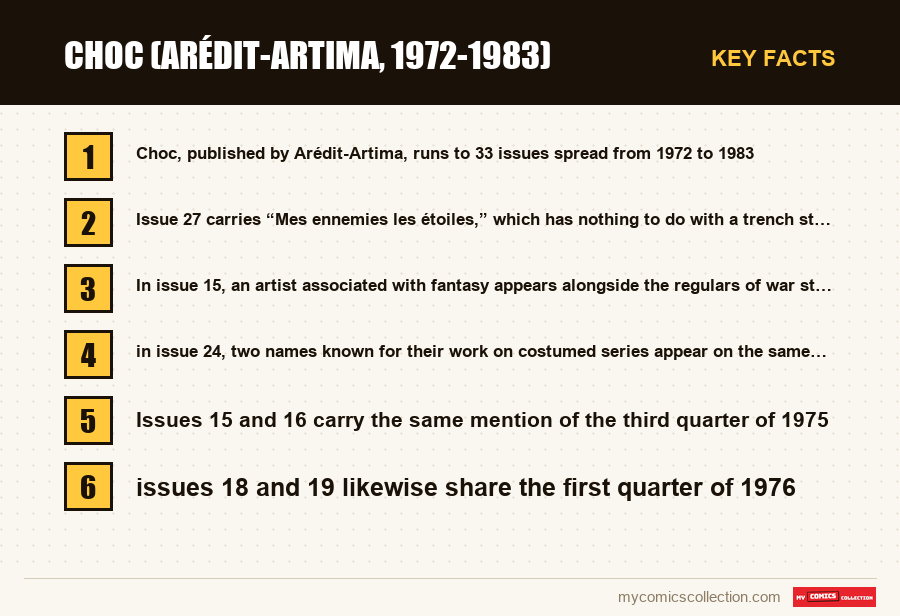
Choc, published by Arédit-Artima, runs to 33 issues spread from 1972 to 1983. The series reads in two blocks separated by an interruption of nearly three years, with a numbering that does not restart at zero but a creative team that is entirely renewed at the relaunch. The contents belong to war and espionage stories. The title is a very common word, which makes searching listings unreliable: the printed issue number remains the marker to verify before any purchase.
A collector who comes across a stack of Choc at a flea market dealer has in front of him a short series, easy to take in at a glance, and yet one of the hardest to assemble cleanly. Not because of its rarity, but because its title blends into an everyday word, and because its publication stopped halfway through, which splits the hunt into two searches that have almost nothing in common. Knowing this before buying avoids duplicates, badly spotted gaps and listings that do not mention this magazine at all.
As always on this guide, only verified information (creators, issue numbers, dates) is stated as fact; the analysis is our own, with no reproduction of panels or protected dialogue.
What the contents of Choc reveal about the editorial line
The titles recorded in the catalog sketch out a clear territory. “Flash Espionnage” opens the first issue, and the sequence continues with “En cour martiale,” “Opération Berlin,” “Gestapo contre fleurs,” “Dum Dum Dugan en face de la cour martiale,” “Nul n'en réchappera,” and “La guerre est un enfer.” The Second World War, seen from the side of the commando and the military tribunal, occupies the heart of the magazine. For a collector, this is a sorting clue: if a listing describes a superhero or fantasy magazine while quoting this title, doubt is warranted.
This dominant theme is not exclusive, however. Issue 27 carries “Mes ennemies les étoiles,” which has nothing to do with a trench story, and issue 26 is announced by a call-out formula in the register of the strange and the horrific. Readers therefore found, in some issues, stories that spilled beyond the military framework. The magazine published several episodes per issue, and the catalog keeps only one: the rest of the contents must be checked on the copy, page by page.
Two issues confirm this mix through their credits. In issue 15, an artist associated with fantasy appears alongside the regulars of war stories; in issue 24, two names known for their work on costumed series appear on the same list. If you are looking for a specific page, start from the copy and not from a reconstructed table of contents: the available data does not cover all of the content.
A quarterly that does not always keep to the quarter
The first year sets the tempo: four issues, two dated by quarter, two by month (August, then November). This quarterly rhythm broadly holds until the mid-1970s, but it experiences accelerations that matter for anyone sorting their series. Issues 15 and 16 carry the same mention of the third quarter of 1975; issues 18 and 19 likewise share the first quarter of 1976.
The immediate practical consequence: the date printed on the cover is not enough to order the issues. Two copies can show the same quarter without being the same number, and a seller acting in good faith who describes his lot by dates will produce an ambiguous list. Always sort by number, and ask for the number when a listing gives only a period.
Another irregularity to know about: five issues are dated only by year, with no month or quarter. These are scattered across the whole run of the series, from 1973 to 1981. You will therefore not be able to reconstruct a complete calendar, and there is no point in looking for a precision that does not exist in the available sources.
The break, and the fresh start announced inside the issue
This is the structuring fact of this collection. Issue 24 is dated the third quarter of 1977; the next carries the first quarter of 1981. Nearly three and a half years separate two issues whose numbers follow one another. The numbering, however, does not restart at zero, which rules out at the outset any risk of confusion between two issues bearing the same number.
Issue 25 itself announces this restart: the formula recorded in the catalog speaks of a collection taking a fresh start. In other words, the relaunch is not a historian's deduction, it is printed in the issue. For a buyer, this presentation page is a useful marker: its presence places the copy on the relaunch side, not in the first cycle.
The second block is also more tightly compressed in time. From the relaunch to the end, the magazine lasts barely three years, with a rhythm that shortens toward the end: issue 32 appears in February 1983, the last in April of the same year. A series that ends two months after its previous issue rarely stops as planned, and this shows on the final issue, which we return to below.
The creators, the best marker for dating an issue
If a cover is so damaged that the date can no longer be read, the credits in the contents are a better guide than an estimate by eye. The first cycle opens with a tight partnership: the same writer signs the first five issues, along with an artist whose presence also stops at the fifth. From the seventh, another artist takes over and becomes the backbone of the first block, present on almost every issue up to the twenty-fourth, often paired with the same writer.
The second block changes team, and it changes all at once. A writer absent from the entire first cycle appears at issue 25 and stays through the final issue; around him, artists specializing in military stories, whom the first cycle did not employ. One detail will amuse attentive readers: the artist of the first five issues reappears in the second era, but credited for the script.
This break in the credits is a sorting tool. An issue whose credits mix names from the first block with those of the relaunch deserves a second look: either the list is incomplete, or the listing confuses two copies.
Searching for a title made of a very common word
The word choc belongs to everyday French. Typed alone into a listings search engine, it brings up household appliances, car parts, press titles and publications with no connection at all that carry this word in their name. This is a concrete problem, not a quibble: most copies for sale will never appear in a search phrased this way, and those that do will be buried.
So always build your search by adding a second, discriminating term. The publisher's name, Arédit or Artima, is the best one; the collection name, which appears on the presentation pages of issues 14 and 25, also works well. Combining the title with a specific number finally gives the cleanest results, especially if you are only looking for one or two gaps.
Set up several alerts worded differently, since sellers write their listing titles in very different ways. Also accept browsing lots described in general terms, without issue-by-issue detail: that is where the good deals are, and where you have to know how to check for yourself.
Checking the right issue from a listing photo
Since the title discriminates nothing, the photo becomes the decisive piece. Ask for a clear view of the whole cover, not a tight crop on an illustration: the number and the period mention are read on the cover, and they are what identify the copy. A listing that refuses to show the top of the cover leaves the question open.
Then ask for a view of the last page when the purchase concerns an issue from the very beginning. The catalog notes for the first issue an artist's signature placed on the last page, which makes it a rare control point that can be verified without prior knowledge. For other issues, the first story page and its credits let you compare what you see with what you expected.
Finally, beware of group photos showing a row of spines lined up side by side. With a title of a single word, nothing guarantees that they all belong to the same series, and a lot announced as complete may mix two homonymous publications: have the list of issues confirmed in writing before paying.
Do you collect this series?
Track what you own, what you are missing and what your collection is worth. 7-day trial.
Start my trial →
What to look for on the copy itself
Two checks are specific to this series. The first concerns the collection's presentation pages, which the catalog notes as the first element of issues 14 through 19. They have sometimes been torn out, and their absence goes unnoticed by a buyer who only leafs through the artwork.
The second concerns serialized stories. The final issue carries a second part in its contents, which means the story begins in an earlier issue that the data does not name. Buying issue 33 on its own is therefore buying half a read, and that is a reason not to treat the end of the series as an isolated piece.
The traps specific to this series
The first trap is the publication gap mistaken for a gap in the collection. A seller offering a run that stops at issue 24 is not hiding anything: the magazine had indeed stopped there. Conversely, a listing promising annual continuity describes badly what it is selling.
The second trap concerns issues whose credits are missing. An issue from the early 1970s has no recorded title or creator, and two issues from the middle of the series have a title with no author name at all. These gaps are gaps in the documentation, not defects of the copy, and a seller cannot be held responsible for filling them.
The third trap is subtler. An issue of the first cycle displays credits that resemble none of its neighbors, neither on writing nor on art. This signals a contents list of a different origin, and nothing more can be concluded without opening the issue. It is exactly the kind of case where a match with a foreign edition would be tempting to assert: the available data does not allow it, and it is better to say so than to invent it.
Completing the series: which block to start with
Treat the quest as two twin series. The first cycle, from the origins to 1977, circulates in older lots and is often completed in batches; the relaunch of the early 1980s is found in other hands, often those of collectors who followed the collection toward its end. Searching for both with the same keywords and the same sellers is the best way to get stuck.
In order of efficiency, start with a lot covering a long continuous stretch, even with a few duplicates, then deal with the gaps one by one. Isolated issues cost proportionally more than runs, and the extra cost of duplicates is generally offset by the time saved. Keep your duplicates: they serve as trade stock with other collectors, and it is often through them that the last two or three issues are found.
Finally, aim for the final issue early in your hunt. The endings of short series rarely appear in lots put together by early buyers, and this one came right after an issue published two months earlier.
What moves the value of a copy
No fixed price holds for a series like this one. What weighs, in order of importance, is the real condition of the cover, membership of the first cycle or the relaunch, the page-by-page completeness of the issue, and whether the title sits in a coherent lot rather than standing alone. Two copies of the same issue can trade at a ratio of one to several depending on these criteria alone.
Reason in ratios rather than in sums. An early issue, clean and complete, sells for more than its equivalent from the relaunch. Conversely, a continuous run from the relaunch can be worth more than the sum of its parts, because it solves in one go the most painful problem of this collection.
Keeping track of your series without getting lost
With thirty-three entries and two disjoint blocks, a written record is not a luxury. For each issue, note three things: the number, the condition as you have observed it with your own eyes, and the period mention printed on the cover. This third column will spare you from reclassifying twice the issues that share a quarter, and it will serve as proof when a listing describes a copy by its date alone.
Keep this list up to date before buying, not after. On a title that search engines do not distinguish, decisions are made quickly, often on a listing that will not stay online, and knowing in three seconds whether the proposed issue is one you are missing is worth all the alerts in the world. Readers who follow artists rather than titles will find other leads in our pages on Captain America and Thor.
Frequently asked questions
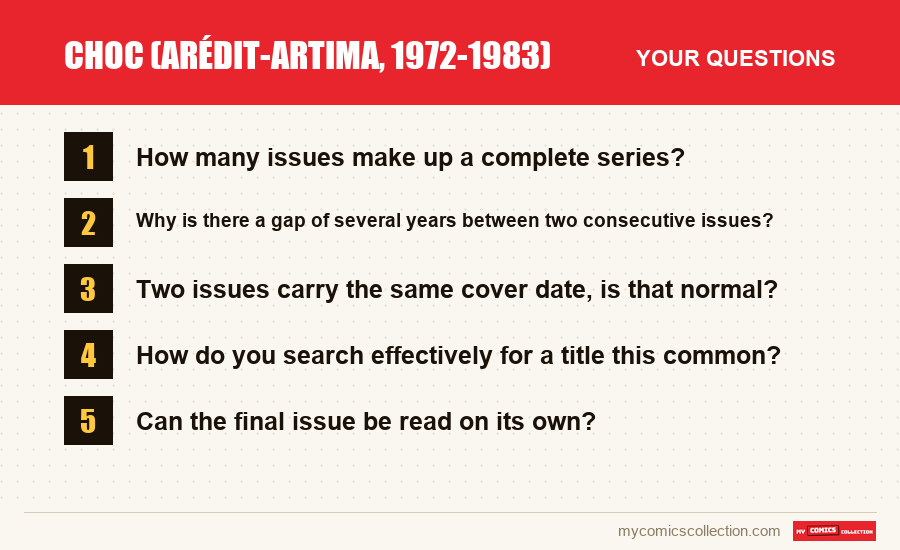
Thirty-three issues, numbered without restarting at zero, from the first quarter of 1972 to April 1983. Because the numbering is continuous despite the publication interruption, a set running from the first issue to the last without gaps is complete, even though the cover dates leave a void of several years in the middle.
Issue 24 is dated the third quarter of 1977 and issue 25 the first quarter of 1981. The magazine therefore stopped, then restarted, picking up the numbering where it had left off. The relaunch issue announces this new start itself in its presentation pages.
Yes. Two issues share the third quarter of 1975 mention and two others the first quarter of 1976. Quarterly dating was therefore not strictly observed. Sort your collection by number rather than by date, and always ask for the number when a listing gives only a period.
Never on its own. Combine the title with the publisher's name, Arédit or Artima, with the collection name noted on the presentation pages, or directly with the number you are missing. Set up several alerts worded differently, and always check on the cover photo that it is indeed this publication.
Not entirely. Its contents include a second part of a story, whose beginning appeared in an earlier issue that the available sources do not identify. If reading matters as much to you as the collection, plan to acquire the end of the series as a run rather than buying this issue alone.