Le premier numéro de Cerebus is the only one of the entire work to be worth anything, and one in four announcements concerns a reprint. Asking prices observed on August 29, 2026 on the American market: median of 25 $in raw copy on 58 advertisements, including 15 explicitly indicate a reprint. The range is from $1.99 to $2,500. In other words, two very different objects have the same number on their cover, and nothing on the cover allows them to be distinguished.
This is the clearest case that can be found of this trap, because the difference in value is maximum and the information is the most difficult to obtain.
This article explains where these reprints come from, how to identify what you are buying, what the different categories are really worth, and why this issue alone concentrates all the collectible interest of the work.
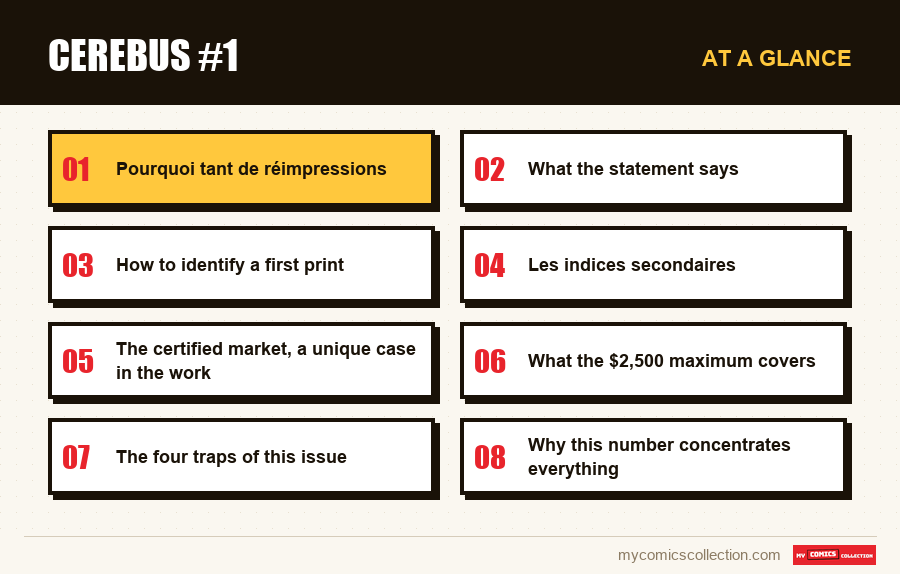
Pourquoi tant de réimpressions
The mechanism is that of any successful self-published publication, and it is entirely rational.
In 1977, no one knew that this series would last twenty-six years. The first issue was therefore printed at a cautious print run, financed by its author, without certainty that it would sell.
A few years later, the series was established and new readers arrived. These readers wanted the beginning. An author who controls his own printing then has two options: leave them with nothing, or withdraw.
He withdrew, several times. It was the right commercial and editorial decision: it allowed thousands of readers to access the beginning of the story, and it created, forty years later, a market where the original is drowned in its own copies.
What the statement says
The volume of offers
58 ads in raw copy. This is little compared to later issues of the series, some of which exceed 170 announcements.
This relative rarity is what sets this issue apart from the rest of the work.
The share of reprints
15 ads out of 58 explicitly indicate a reprint. This is a floor: nothing obliges a seller to specify it, and many ignore it.
The certified market
37 ads at $139 median. It is the only number in the entire work to have a marked market: the others have zero.
The amplitude
De $1.99 to $2,500 in raw copy. A report of more than a thousand, which obviously does not describe the same object.
How to identify a first print
This is the central question, and the answer is disappointing in its simplicity: you have to open the booklet.
The notice appears on the inside credits page, usually in small print, with the year and sometimes the rank of the print run. She never appears on the cover, which is the heart of the problem.
A frontal photograph, the only shot offered by almost all ads, is therefore structurally incapable of answering the question. A seller in good faith can describe “the first issue” without lying and without knowing which print run he is talking about.
The only approach that works is to explicitly request a photograph of this page before purchasing. This is an unusual question, which makes it effective: it concerns the only information that decides the price.
A seller who refuses or evades tells you as much as a seller who responds. On an object whose value difference reaches two orders of magnitude, this reluctance is information in itself.
Les indices secondaires
In the absence of access to the credits page, several signs provide guidance: without ever being proof, and this must be stated clearly.
The asking price itself. A seller who has a first print almost always knows this and mentions it, because it is his selling point. A silent ad at $25 most likely describes a reprint.
L'état apparent. A 1977 example in very good condition is statistically improbable; a well-preserved reprint copy is much less so. A cover that is too fresh invites caution rather than enthusiasm.
La qualité d'impression. Successive removals of a small structure are not always carried out under the same conditions. Impasto blacks or a thickened line may indicate a later generation.
These clues sometimes converge, and they never replace verification. On this specific number, a purchase without having seen the credits page is a bet, regardless of the apparent seriousness of the announcement.
What to decide before looking. Do you want the story, the subject, or the first print? These are three different purchases, at three price points, and confusing the last two is the most costly mistake on this work.
To read this beginning, the collection costs a few dollars. To own the number, a $25 reprint does the trick. For the first draw, you have to search, verify and pay accordingly.
The certified market, a unique case in the work
This issue is the only one in the entire series to have a noted market, and this exception is worth understanding.
Thirty-seven certified copies for sale, at a median of $139, while the other issues noted, including those which mark turning points in the story, include none.
Certification here precisely solves the problem described above: a copy rated by a third party has its edition and its condition documented once and for all. Elle transforme une information difficile à obtenir en donnée opposable, which explains why it developed on this issue and nowhere else.
This does not mean that you have to buy certified. This means that the market has responded to a real difficulty, and that a buyer who refuses this route must take responsibility for the verification themselves.
What the $2,500 maximum covers
This figure comes up in discussions and deserves to be put in its place, because it is misleading.
It does not describe « ce que vaut un premier numéro ». It describes what a seller asks for a copy located at the intersection of two rarities: a first printing et an exceptional condition for a stapled piece almost fifty years old.
These two conditions rarely combine. A 1977 booklet printed by a small organization on ordinary paper, read, transported, stored away for decades, is almost always marked.
The median at $25 therefore describes the reality of what we find: reprints and tired first prints. The top of the range describes a separate segment, which does not concern an ordinary buyer and should not be used as a reference.
The four traps of this issue
The cover photo says nothing
This is the only shot that almost all ads offer, and it is structurally incapable of providing information on the print run.
The seller doesn't always know
An honest description can be wrong. Many sellers have never opened the booklet to the page that counts.
Good condition arouses suspicion
A 1977 copy that is too fresh is statistically suspect. What reassures about a recent object must here cause hesitation.
The odds quoted mix everything up
The figures circulating sometimes relate to a first printing, sometimes to a reprint, without the distinction being made.
Collecting this series?
Track what you own, what you are missing and what your collection is worth. 7 day trial.
Start my trial →Why this number concentrates everything
One fact of the survey deserves to be underlined: this number is the only one in the work which justifies active research.
The others (including the one that opens the most celebrated arc, including the one where the second designer arrives) ask between $5 and $12, with abundant offers and no certified market.
The reason is purely material. These issues were printed when the series was already running, at comfortable print runs, and they still circulate widely. No narrative twist creates rarity: only the prudence of an old print does it.
For a collector, the consequence is simple and liberating: out of three hundred issues, only one requires attention. The rest is acquired over time, without strategy or verification.
The case of readers who already own something
A common situation deserves to be addressed: that of someone who has a copy at home without knowing what it is.
The verification takes thirty seconds: open the booklet on the credits page, look for the year and the print run. That's it, and it's often the owner's first time looking.
Two possible outcomes. If it is a reprint, the copy is worth what a reprint is worth, a few dozen dollars, and remains perfectly satisfactory for anyone who wanted to own this issue.
If it is a first print, the question of its conservation immediately arises. A 1977 staple stored upright and squeezed among others is slowly deteriorating; the same one flat, in a rigid pouch, no longer moves.
What this case teaches beyond this work
The configuration described here is found throughout the self-published segment, and knowing how to recognize it avoids costly mistakes elsewhere.
The pattern is always the same. An unknown title is printed cautiously. He meets his audience. Its author, who controls its printing, withdraws to satisfy newcomers. Twenty years later, the reprints are more numerous than the originals and resemble them perfectly.
What this implies is counterintuitive: the more successful a self-published series has been, the harder its first issue is to identify. Failure preserves clarity: a title that has never been withdrawn has only one possible state.
This suggests a reflex applicable to any old independent title: before asking a price, ask how many printings have existed. The answer determines whether the price question has one meaning or multiple meanings.
This is also what distinguishes this segment from the series of major publishers, where the issues are rarely withdrawn and where the number is generally sufficient to identify the object.
What to record
On this specific number, three pieces of information are worth recording, and they do not overlap with what an ordinary inventory carries.
The draw, in full. Not “first issue” but “first printing” or “reprint, year X”. It is the only mention which distinguishes two identical objects from the front, and it is never reconstituted without reopening the copy.
The source of this information. Note if you saw it yourself on the credits page, or if the seller affirmed it. It's not the same thing, and the distinction matters on the day you resell.
Storage conditions. On a staple almost fifty years old, it is the field which decides its state in ten years. Writing it down requires you to think about it once, which is usually enough.
An inventory that bears these three fields answers the only question that matters about this object: do I own the rare thing, or its perfectly honorable copy?
Frequently asked questions
By asking the seller for a photograph of the interior credits page. This is the only place where the mention appears, and a cover photo cannot structurally address it. A seller who evades this request tells you as much as a seller who responds to it.
Not at all, as long as you know what you're buying and pay for it accordingly. A reprint contains the exact same story and perfectly fulfills the purpose of owning this issue. The mistake isn't buying one, it's buying one at the price of a first print.
Because certification precisely resolves the difficulty it poses: it documents the print run and the condition once and for all, transforming information that is difficult to obtain into enforceable data. The other numbers in the work do not pose this problem: they are abundant and unambiguous.
No, and citing it as a reference value is misleading. He describes a copy located at the intersection of two rarities: a first printing and an exceptional condition for a stapled piece almost fifty years old. The $25 median describes what we actually find: reprints and tired first prints.
None warrant active research. The others ask for between five and twelve dollars with abundant offers, including those which mark the turning points of the story: because they were printed when the series was already running. Out of three hundred numbers, only one demands attention.
Seen yourself, or stated by the seller
On an object whose value difference reaches two orders of magnitude, the source of the information counts as much as it does.