
Captain America Comics #1-78 (Timely, 1941-1954): The original series spanned 78 issues spanning World War II and the post-war period. #1 (Simon/Kirby) is worth up to $3.12M, #2-10 between $5,000 and $80,000 depending on grade. The series moved from warrior patriotism to horror/crime before its cancellation in 1954. Only 267 copies of #1 listed by CGC all grades combined.
Captain America Comics #1-78 (March 1941 - February 1954) constitutes the entire first series of the character, published by Timely Comics (future Marvel). These 78 issues cover the character's creation during the rise of Nazism, his patriotic adventures during the war, the post-war decline and the failed attempt at anti-communist revival of the 1950s.
This analysis covers the complete editorial history of the first series, the creators involved, the evolution of the character and title, and the current value of each segment to the collector. This is the definitive guide for anyone interested in Golden Age Captain America.
The Simon/Kirby Era: Captain America Comics #1-10 (1941)
Joe Simon and Jack Kirby created Captain America in a pre-war context: the United States did not officially enter the war until December 1941, nine months after the publication of #1. The cover showing Cap punching Hitler is a bold political act that generates both excitement and death threats for the creators.
The first 10 issues establish everything: Steve Rogers, the serum, Bucky Barnes, Red Skull (from #1), and the patriotic format. Simon and Kirby left after #10 over a contract dispute with Martin Goodman: their departure marks the end of the initial creative golden age.
Current values (CGC):
- #1: CGC 9.4: $3,120,000 | CGC 6.0: $384,000 | CGC 3.0: $96,000 | CGC 1.0: $25,000-35,000
- #2: CGC 7.0: $30,000 | CGC 5.0: $12,000 | CGC 3.0: $5,000
- #3: CGC 6.5: $25,000 | CGC 4.0: $8,000
- #5-10: CGC 5.0: $5,000-8,000 each
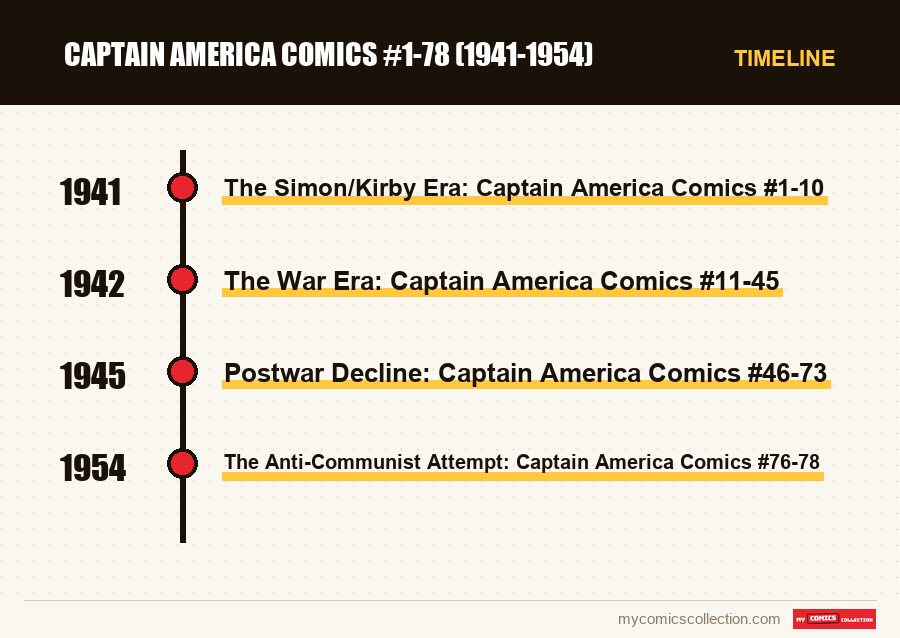
The War Era: Captain America Comics #11-45 (1942-1945)
After the departure of Simon and Kirby, a succession of artists kept the series going during the war. The quality fluctuates but the title remains one of Timely's bestsellers. The scenarios are patriotic and Manichean: Cap and Bucky fight Nazis and Japanese in formulaic but effective adventures.
Notable artists include Al Avison, Syd Shores and Don Rico. The Red Skull appears regularly, as do other villains like Bucky creating a modest rogue's gallery. War covers (bondage covers, war atrocity covers) are sought after by collectors of “good girl art” and war comics as much as by Captain America collectors.
Typical values: CGC 5.0 between $2,000 and $5,000 depending on the number. Covers with spectacular war scenes or Red Skull appearances command a 30-50% premium. Issues #22, #25 and #37 (particularly violent covers) are among the most sought after from this period.
Postwar Decline: Captain America Comics #46-73 (1945-1949)
With the end of the war, Captain America lost his editorial raison d'être. The title attempts successive reorientations (romance, humor, horror) without finding a stable audience. Martial patriotism no longer resonates, and the title goes from 15 cents to 10 cents in an attempt to maintain sales.
Starting with #59, the title changed its name to "Captain America's Weird Tales" for two issues (#74-75, horror genre) before returning to the superhero format for the final issues. This period is the least sought after by collectors, but paradoxically, certain issues are the rarest because print runs had dropped significantly.
Typical values: CGC 5.0 between $800 and $2,500. The horror issues (#74-75, "Captain America's Weird Tales") are more expensive due to cross-genre demand from pre-Code horror collectors.
The Anti-Communist Attempt: Captain America Comics #76-78 (1954)
In 1954, Atlas Comics (formerly Timely) relaunched Captain America, Human Torch and Sub-Mariner in an anti-communist format. Cap becomes "Captain America... Commie Smasher!": a McCarthyite vigilante who fights Soviet spies. The series only lasted 3 issues before permanent cancellation.
These issues are important for continuity: it is this Captain America from the 1950s that Steve Englehart will reveal as a fanatical imposter in Captain America #153-156 (1972). Retro-continuity transforms an editorial embarrassment into brilliant narrative material.
Values: CGC 5.0 between $2,000 and $4,000. Rare because the 1954 print run was minimal. #76 (first of the return) is the most sought after at around $4,000 in CGC 5.0, $8,000 in CGC 7.0.
Rarity and CGC census
The absolute rarity of this series cannot be overstated:
- #1: 267 CGC copies recorded. 3 copies above 9.0.
- #2-10: between 80 and 150 copies recorded per number.
- #11-50: between 30 and 100 copies per issue.
- #51-73: often in 50 registered copies per number.
- #74-78: between 40 and 80 copies per issue (small print runs).
Wartime paper (1941-1945) is structurally fragile: high acidity, wood pulp, lack of intentional conservation. Surviving copies in readable condition are rare; copies in high condition are almost miraculous.
Tips for Collecting This Series
Collecting Captain America Comics #1-78 in its entirety is a decades-long, multi-hundred-thousand-dollar project. Realistic approaches:
- Curated selection: target the 10 most significant numbers (#1, #2, #3, #16 first Red Skull on the cover, #22, #37, #46, #59, #74, #76) in accessible grades (CGC 2.0-4.0).
- War era partial run: #20-45 are the most "accessible" ($1,500-3,000 per issue in modest condition) and offer the most spectacular war covers.
- Single entry trophy: a single copy of #1 in modest grade (CGC 1.0-2.0, $25,000-50,000) as a centerpiece.
Do you own Captain America comics? Estimate the value of your collection for free to know their current rating.
Frequently Asked Questions
It has 78 issues, published by Timely Comics (the future Marvel) from March 1941 to February 1954. It runs through the Second World War, the postwar decline and then a failed anti-communist relaunch in 1954.
Joe Simon and Jack Kirby establish everything there: Steve Rogers, the serum, Bucky Barnes, Red Skull (from #1) and the patriotic format. They leave the series after #10 following a contract dispute with Martin Goodman.
Issue #1 appeared nine months before the United States officially entered the war in December 1941. The cover showing Cap punching Hitler is a bold political act, which earned its creators both enthusiasm and death threats.
In 1954, Atlas Comics relaunched Captain America in an anti-communist format: a vigilante fighting Soviet spies. The series lasted only three issues (#76-78). Steve Englehart later revealed this 1950s Cap as a fanatical impostor in Captain America #153-156 (1972).
Wartime paper is structurally fragile (high acidity, wood pulp, no deliberate preservation). Issue #1 has only 267 copies recorded by CGC across all grades, three of them above 9.0, and many later issues have fewer than 50 recorded copies.