
A diversified comics portfolio spreads risk across eras, publishers, and character types while focusing capital on genuinely scarce key issues. Whether you are starting with $500 or $10,000, the principles are the same: buy quality over quantity, diversify across ages and genres, and track your holdings methodically.
Building a comic book portfolio is not so different from building a stock portfolio. You need diversification to manage risk, a clear strategy to guide purchases, and discipline to avoid emotional decisions. The difference is that comics combine financial returns with the tangible joy of collecting: something no index fund can match. This guide walks you through portfolio construction at every budget level, from your first $500 to a serious $10,000 investment.
Portfolio theory applied to comics
Harry Markowitz won a Nobel Prize for demonstrating that diversification reduces portfolio risk without sacrificing expected returns. The same principle applies to comics. A collection consisting entirely of Spider-Man first appearances is concentrated in a single character: if Spider-Man fatigue hits the cultural zeitgeist, your entire portfolio suffers. Spreading your capital across eras, publishers, characters, and price tiers protects you from any single downturn.
The four axes of diversification
- Era diversification: Golden Age, Silver Age, Bronze Age, and select Modern Age keys each respond differently to market conditions.
- Publisher diversification: Marvel and DC dominate, but independent publishers (Image, Dark Horse, Valiant) offer overlooked opportunities.
- Character diversification: Do not put all your capital into one character or franchise. Spread across heroes, villains, and teams.
- Grade diversification: A mix of high-grade showcase pieces and mid-grade affordable keys gives you both upside potential and attainable entry points.
The $500 starter portfolio
With $500, you are building a foundation. The goal is to acquire 3-5 genuine key issues in respectable condition rather than 50 random comics. Quality over quantity is the cardinal rule at every budget level, but especially here.
Recommended allocation
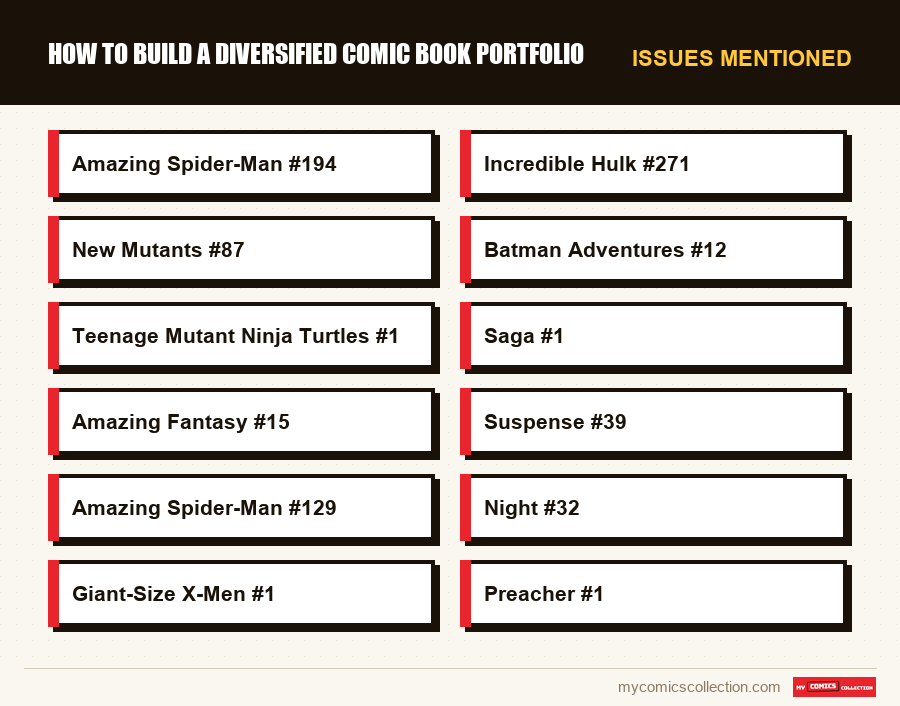
- $150-200: One Bronze Age key: Amazing Spider-Man #194 (first Black Cat, CGC 6.0-7.0, ~$150), or Incredible Hulk #271 (first Rocket Raccoon, CGC 8.0+, ~$100-150).
- $100-150: One Modern Age first appearance: New Mutants #87 (first Cable, CGC 9.4+, ~$80-120), or Batman Adventures #12 (first Harley Quinn, raw VF, ~$150).
- $80-100: One indie or undervalued key: Teenage Mutant Ninja Turtles #1 (later printings, ~$80-100), or Saga #1 (CGC 9.8, ~$80).
- $50-80: One speculative play: A first appearance of a character rumored for upcoming media adaptation.
- $50: Supplies and protection: Acid-free bags, boards, and a proper storage box. Protecting your investment is not optional.
What to avoid at $500
Do not buy low-grade copies of expensive keys thinking you are getting a bargain. A coverless Amazing Fantasy #15 for $500 might seem appealing, but severely damaged copies appreciate at a fraction of the rate of mid-grade copies. You are better off buying the best grade you can afford of a slightly less expensive key issue.
The $2,000 intermediate portfolio
At $2,000, you can build a genuinely diversified collection that spans multiple eras and includes at least one anchor piece with strong long-term potential.
Recommended allocation
- $600-800: One Silver Age anchor: Tales of Suspense #39 (first Iron Man, CGC 3.0-4.0, ~$700), or Amazing Spider-Man #129 (first Punisher, CGC 6.0-7.0, ~$600-800).
- $400-500: Two Bronze Age keys: Werewolf by Night #32 (first Moon Knight, CGC 5.0-6.0, ~$250-300) plus Giant-Size X-Men #1 (CGC 4.0-5.0, ~$200-250).
- $300-400: Two-three Modern keys: Spread across Marvel, DC, and independents. Preacher #1 (CGC 9.6+, ~$150), Ultimate Fallout #4 (first Miles Morales, CGC 9.4, ~$150-200).
- $200: Speculative positions: Two or three calculated bets on upcoming media adaptations or undervalued characters.
- $100: CGC grading for one raw key: Getting your best raw comic graded can immediately add value and protect your investment.
The $10,000 serious portfolio
At $10,000, you are building a serious collection that can function as a legitimate alternative investment. The focus shifts to fewer, higher-quality pieces with proven track records of appreciation.
Recommended allocation
- $3,000-4,000: One trophy Silver Age key: Incredible Hulk #181 (first Wolverine, CGC 6.0-7.0, ~$3,500), or Amazing Spider-Man #129 (CGC 9.0+, ~$3,000-4,000).
- $2,000-2,500: Two strong Silver Age keys: X-Men #1 (CGC 3.0-4.0, ~$1,200-1,500) plus Journey into Mystery #83 (first Thor, CGC 3.0-4.0, ~$1,000-1,200).
- $1,500-2,000: Three-four Bronze Age keys: House of Secrets #92 (first Swamp Thing), Marvel Spotlight #5 (first Ghost Rider), Iron Fist #14 (first Sabretooth).
- $1,000-1,500: Modern Age keys: Five to seven high-grade first appearances with strong fundamentals.
- $500-1,000: Speculative and emerging: Calculated bets on undervalued characters, indie keys, or pre-announcement speculation.
- $500: Grading and storage: Professional grading for unslabbed keys, archival storage supplies.
Portfolio management: the ongoing discipline
Building the portfolio is only half the job. Managing it over time is what separates successful collector-investors from accumulators who never realize their gains.
Quarterly portfolio review
- Track current values: Use recent eBay sold listings and auction results to update your estimated portfolio value every quarter.
- Rebalance when needed: If one comic has appreciated to become an outsized portion of your portfolio, consider selling part of the position to redistribute.
- Evaluate new opportunities: Each quarter, research what new keys or undervalued comics could strengthen your portfolio.
- Check condition: Inspect raw comics for any storage-related deterioration. Replace bags and boards annually.
When to sell
Having a sell discipline is as important as having a buy discipline. Consider selling when:
- A comic has reached your target return and the risk-reward ratio has shifted unfavorably.
- You have an opportunity to upgrade within the same key issue: selling a CGC 6.0 to buy a CGC 8.0 at a favorable spread.
- Market fundamentals have changed (character killed off permanently, publisher bankruptcy, cultural relevance declining).
- You need to rebalance your portfolio after a particular holding has grown disproportionately.
Mistakes that destroy portfolio returns
- Buying quantity over quality: Fifty $10 comics will almost never outperform five $100 key issues.
- Chasing trends: By the time a comic is trending on social media, the best buying opportunity has usually passed.
- Neglecting storage: A $1,000 comic that degrades from 8.0 to 6.0 due to poor storage loses $300-500 in value.
- Ignoring transaction costs: Auction premiums, eBay fees, grading costs, and shipping all eat into returns. Factor them into every buy and sell decision.
- Emotional buying: Buying a comic because you love the character rather than because it fits your portfolio strategy.
Alternative portfolio structures
The "character franchise" portfolio
Instead of diversifying across random keys, some investors build portfolios around complete character ecosystems. For example, a Spider-Man franchise portfolio might include Amazing Fantasy #15, Amazing Spider-Man #129 (Punisher), #194 (Black Cat), #238 (Hobgoblin), #252 (black costume), #300 (Venom), #361 (Carnage), and Ultimate Fallout #4 (Miles Morales). This creates thematic coherence while maintaining diversification across decades and price points.
The "era specialist" portfolio
Another approach is to become a specialist in a single era and build deep expertise that gives you a pricing edge over generalists. A Bronze Age specialist who knows every key issue, print run, and census detail for 1970-1983 can spot undervalued books that generalist collectors overlook. The trade-off is higher concentration risk if that era falls out of favor.
The psychology of portfolio building
The biggest obstacle to building a profitable comics portfolio is not money: it is emotional decision-making. Collectors are emotionally connected to their comics in ways that stock investors are not connected to their shares. This creates predictable biases that hurt returns.
Biases that hurt portfolio performance
- Nostalgia bias: Overpaying for comics from your childhood because of personal attachment rather than investment merit.
- Confirmation bias: Seeking out information that supports a purchase you already want to make, ignoring data that suggests otherwise.
- Endowment effect: Valuing a comic you own more highly than the market does, simply because you own it. This prevents timely selling.
- Herd mentality: Buying what everyone else is buying because it feels safe. By the time the herd arrives, the best prices are gone.
- Loss aversion: Holding a declining comic to avoid recognizing a loss, tying up capital that could be deployed more productively.
How to overcome emotional investing
- Separate your reading collection from your investment portfolio. Keep your emotional favorites in a personal collection. Apply cold financial logic only to your investment portfolio.
- Set buy and sell rules before you need them. Define your maximum price, target return, and stop-loss for every purchase at the time of acquisition.
- Review decisions in writing. Before buying any comic over $200, write down your thesis in three sentences. If you cannot articulate why it is a good investment, reconsider.
Insurance and estate planning
A portfolio worth $2,000 or more deserves formal protection and planning.
- Specialized collectibles insurance from providers like Collectibles Insurance Services typically costs $10-15 per $1,000 of coverage annually: far cheaper than replacing lost or damaged comics.
- Document everything: Maintain a detailed inventory with photos, grades, purchase prices, and current valuations. Update annually.
- Estate planning: Ensure someone in your family or estate knows the value of your collection and how to sell it properly. Too many valuable collections are sold for pennies on the dollar because heirs did not understand what they had.
- Consider a trust: For portfolios above $50,000, placing comics in a trust can provide tax advantages and ensure proper stewardship.
Frequently Asked Questions
You can start with as little as $200-300 and still acquire one or two genuine key issues in respectable condition. The key is to buy fewer, better comics rather than many cheap ones. Even at a modest budget, focus on recognized first appearances in the best grade you can afford.
Not necessarily. Raw comics in verifiably good condition can be excellent values, especially if you plan to have them graded yourself. Buying raw and grading can save 20-30% compared to buying pre-slabbed, though it requires skill in assessing condition. For comics valued over $200, CGC grading is strongly recommended for both authentication and preservation.
Review your portfolio quarterly and make adjustments annually unless market conditions demand more frequent action. Unlike stocks, comics are illiquid: you cannot sell instantly at market price. Rebalancing should be gradual and opportunistic, selling into strength rather than forcing sales at unfavorable prices.
Absolutely. Independent publisher keys like Teenage Mutant Ninja Turtles #1, Bone #1, Saga #1, and Walking Dead #1 have delivered outstanding returns. Indie keys often fly under the radar of mainstream collectors, creating buying opportunities. Include 10-15% indie allocation for diversification.