
The eBay median for Fantastic Four #52, the first appearance of Black Panther (July 1966), sits at €9 across all editions combined (89 listings, June 2026). That figure is misleading: it is dragged down by reprints, facsimiles, and very low-grade copies. A CGC 9.0 original clears $10,000. Before you buy, you need to know which edition you're actually looking at.
Fantastic Four #52 (July 1966) by Stan Lee and Jack Kirby is one of the most reprinted Silver Age grails in the Marvel back-issue market. Its historical weight, the first appearance of a Black superhero in mainstream American comics, generated decades of official reprints, facsimiles, and distribution variants. The problem for collectors: these editions look alike and trade on the same platforms, mixed in with the original.
This guide covers every known edition, how to tell them apart, and what each one is actually worth. Every figure here comes from our real-time eBay estimator or from documented sale records (Heritage, ComicConnect). Where a precise figure cannot be verified, we describe it qualitatively rather than invent it.
Why the €9 eBay median is misleading
Our estimator aggregates every eBay listing under the same title and issue number: the 1966 original, but also 1970s reprints, modern facsimiles, and heavily worn copies. Of the 89 active listings, the majority do not correspond to a collectible-grade original. In high CGC grade, documented prices are in an entirely different league:
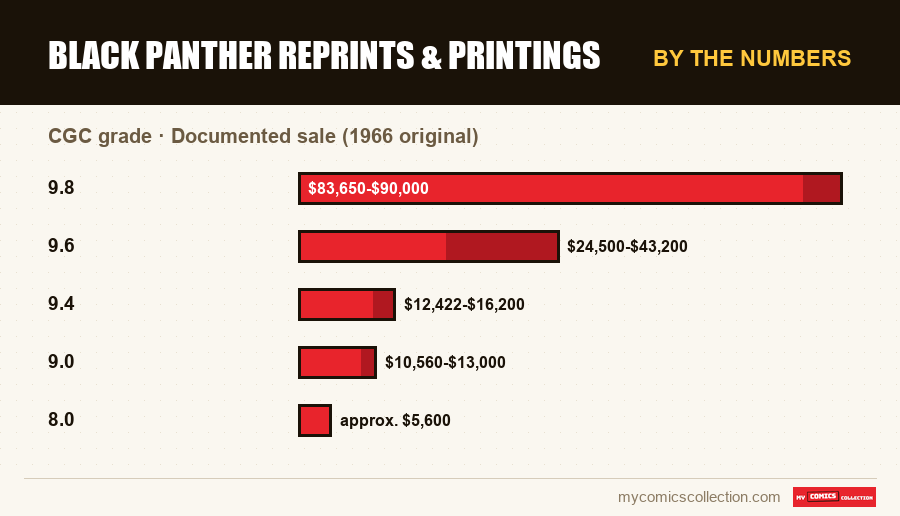
| CGC grade | Documented sale (1966 original) | Source |
|---|---|---|
| 9.8 | $83,650-$90,000 | Heritage / ComicConnect |
| 9.6 | $24,500-$43,200 | Heritage / SellMyComicBooks |
| 9.4 | $12,422-$16,200 | ComicConnect / Heritage |
| 9.0 | $10,560-$13,000 | Heritage / SellMyComicBooks |
| 8.0 | approx. $5,600 | SellMyComicBooks |
All records above are public and verifiable. The near-black cover of FF #52 makes high-grade copies exceptionally scarce: a CGC 9.0 copy is already a recommended target on the market.
A breakdown of every known edition
1. The original (July 1966, 12-cent cover price)
Printed by Marvel in July 1966, this copy carries the Marvel masthead banner, an almost entirely black cover, and the editorial code in the indicia. The clearest confirmation: period advertisements (toys and cereals from the 1960s). If the ads are modern, you do not have the original.
2. The Marvel's Greatest Comics #39 reprint (1972)
Marvel reprinted the content of FF #52 in Marvel's Greatest Comics #39, a budget reprint anthology series. This edition is easy to spot: it carries the "Marvel's Greatest Comics" logo, a redesigned or re-cropped cover, a 25-cent cover price, and an indicia that clearly names the reprint series. It is worth only a few dollars.
3. The official Marvel facsimile edition (November 2022)
Marvel published a near-exact facsimile of FF #52 on November 23, 2022, complete with period ads, at a cover price of $3.99. A new printing of that same facsimile was released on January 28, 2026. How to identify it: the words "FACSIMILE EDITION" appear on the cover and in the indicia, and a modern barcode is present. This facsimile has no collector value in the grail sense, but it is the right way to read the story without risking a 60-year-old comic.
FF #53: same logic, same trap
Fantastic Four #53 (August 1966) introduces Klaw and deepens Black Panther's origin. Our estimator shows a median of €9 across 100 listings: identically depressed by reprints. Documented high-grade records run substantially higher, though this issue trades at a modest discount to #52, reflecting Klaw's lower profile compared to Black Panther's debut issue itself.
The solo series: newsstand vs. direct edition
The newsstand / direct edition distinction does not apply to FF #52 (1966, predating the direct market system). It becomes relevant for the solo series:
- Black Panther #1 (1977, Jack Kirby): the first solo title. This issue came out at the very dawn of the direct distribution system. Some copies carry a standard UPC barcode (newsstand); early direct editions of this period typically show a barcode crossed with a diagonal slash. The value difference is qualitative rather than precisely quantifiable for this specific issue: CGC slabs are strongly recommended over trying to seek out a specific distribution variant.
- Black Panther #1 (1998, Christopher Priest and Mark Texeira): the Marvel Knights relaunch. Our estimator shows a median of €17 across 91 listings for "Black Panther #1" (all editions combined, which may also include the 1977 issue). For this late-1990s run, newsstand copies are genuinely scarce: Marvel Knights was distributed primarily through the direct market. A newsstand copy of this issue in CGC 9.8 can command a documented premium of roughly 2x to 5x over an equivalent direct edition copy, consistent with the general 1993-1999 newsstand rarity bracket.
How to quickly identify which edition you have
- Check the indicia (page 1, bottom). The 1966 original does not state it is a reprint. Any other printing will say "Facsimile Edition," name a reprint series, or show a later copyright date.
- Look at the advertisements. A copy of FF #52 with ads for modern products is a facsimile or reprint.
- Check for a UPC barcode. The 1966 original has no UPC barcode (Marvel introduced them in 1974). Its presence on a copy of FF #52 immediately indicates a later edition.
- For 1977-2000 issues: count the barcode digits. 14 digits (2 on the right) = newsstand; 17 digits (5 on the right), or a diagonal slash through the barcode = direct edition.
Collector strategy
- Never buy a raw FF #52 remotely without careful verification. The €9 median masks originals in low grade mixed with reprints; only a confirmed edition identification allows you to buy with confidence.
- CGC is your insurance policy. A slabbed copy identifies edition, grade, and authenticity without ambiguity. For a budget approach to the 1966 original, a CGC 6.0-7.0 copy is achievable well below the high-grade record prices.
- The 2026 facsimile is the right reading copy. It does not replicate the original's collectible value, but it lets you hold the story without risking a 1966 comic.
Own a Black Panther comic and unsure which edition you have? Get a free valuation with our tool based on real eBay sales to find its low, median, and high value.
Frequently asked questions
Because it aggregates every listing with the same title and issue number: the 1966 original, 1970s reprints, modern facsimiles and heavily damaged copies. The latter drag the figure down and do not reflect the value of an original in collectable condition.
It carries the Marvel logo in a banner, an almost entirely black cover and the code "1-MARVEL" in the indicia. Period advertisements are the simplest confirmation, and it has no UPC barcode, which Marvel introduced in 1974.
It is a 1972 reprint of the content of Fantastic Four #52 in a series of inexpensive reprints. Its cover is redrawn or cropped, the "Marvel's Greatest Comics" logo is visible and the indicia states the title of the series.
The words "FACSIMILE EDITION" appear on the cover and in the indicia, and a modern barcode is present. Marvel published it on 23 November 2022 and issued a new printing on 28 January 2026: it lets you read the story without risking a 1966 copy.
Count the digits of the barcode: 14 digits (2 on the right) indicate a newsstand copy, 17 digits (5 on the right) or a diagonal bar a direct edition. This distinction does not apply to Fantastic Four #52, which predates the direct system.