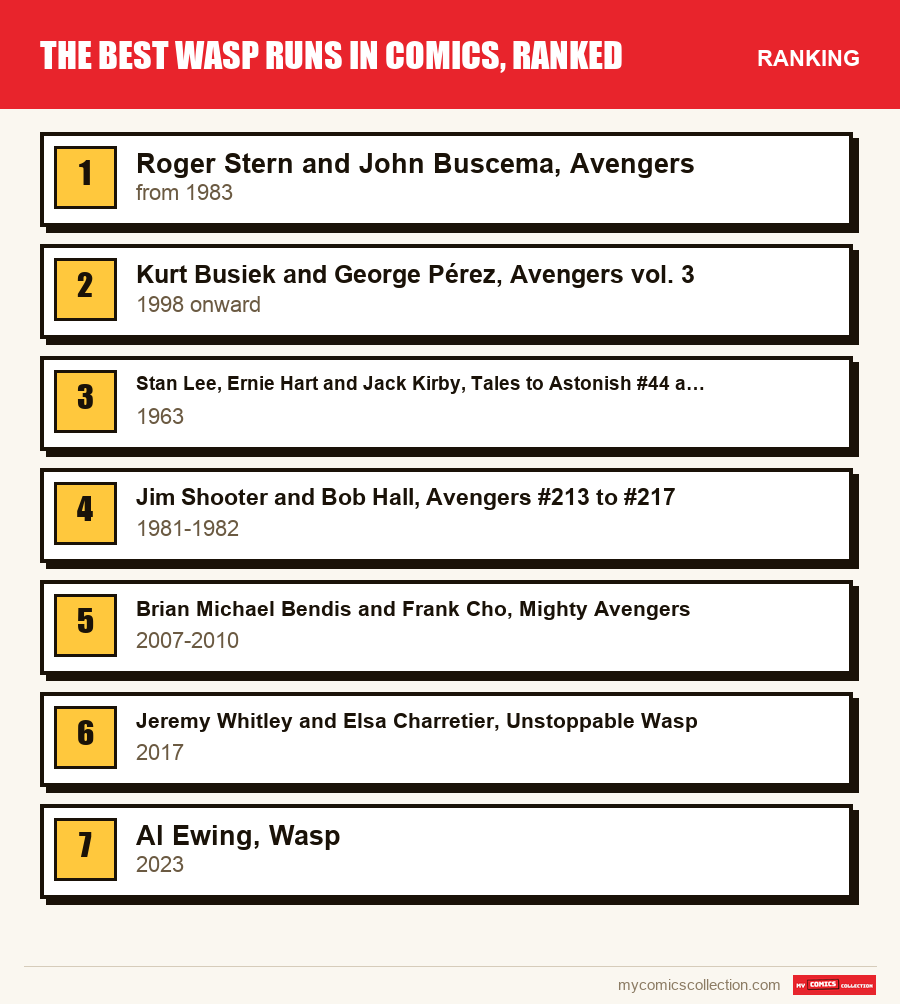
To discover Janet van Dyne, open Avengers first, in the era when Roger Stern writes and John Buscema draws (from issue 227, in 1983); next come Kurt Busiek and George Pérez on the third series (1998), then the founding 1963 issues by Stan Lee and Jack Kirby. Seven sets are ranked, from the birth of the Wasp to Al Ewing's miniseries, each with the recommended format.
The Wasp has long lived in other characters' pages: Tales to Astonish, then the Avengers, then late miniseries. She had no lasting monthly series under her own name before the 21st century, and even then, the most famous one carries Nadia's name. Ranking her "runs" means pointing to the periods when Janet truly matters to the story, not lining up complete series. Here is our selection and the reason for each placement.
As always in this guide, only verified information (creators, issue numbers, dates) is stated as fact; the analysis is our own, with no reproduction of protected art or dialogue.
How we ranked these runs
For a character who has almost never had a regular series, one question really separates the candidates: does Janet act, or does she merely go along with someone else's plot? So we favored the periods when she makes decisions, leads, invents or survives a choice that is her own. Two filters apply on top: the story must be readable without having followed twenty years of continuity, and it must exist in a format that a present-day reader can actually get hold of.
The rank reflects how good the story is for Janet, not the market value of the issue. The Wasp is the perfect example of a character whose narrative importance far exceeds the price of the issues: that gap is covered at the end of the article, once the reading is sorted out.
Top 1: Roger Stern and John Buscema, Avengers (from 1983)
Roger Stern takes over the Avengers series from issue 227 and gives it a rare balance: a large team, plots that unfold over several months, personal subplots that matter. With John Buscema on art, the Wasp is a full member here, treated as an adult, with a humor and an authority she had not always been given. The most famous saga of this period, "Under Siege," pits the team against Baron Zemo and his new Masters of Evil.
This run takes first place because Janet is not the scenery for another hero here: she is a figure the team listens to. That is what has earned her a reputation, ever since, as one of the best chairs in Avengers history, even if sources disagree on the exact length of her terms. It suits any reader, including one who has never opened an Avengers book.
For collecting, the early-1980s single issues turn up in quantity and in decent condition, which makes tracking by number reasonable. The chronological omnibuses of the period settle the question of continuous reading.
Top 2: Kurt Busiek and George Pérez, Avengers vol. 3 (1998 onward)
After the "Heroes Return" interlude, which relaunches the series in 1998, Busiek and Pérez build a modern golden age: dense issues, dozens of characters, a memory of the team's history embraced on every page. Janet appears resourceful and ironic. The "Ultron Unlimited" saga is its high point, with a threat touching the whole world and an active role for the Wasp.
It counts because it gives Janet one of her finest modern periods: she is a protagonist here, funny and useful, and her look moves toward more clearly insect-like features. It is aimed at the reader who likes sprawling teams, and it is surprisingly welcoming for a beginner. Pérez's signature, meticulous to the point of saturation, gives every wide shot a depth few artists match.
These 1998 to 2002 single issues are still easy to find. Read them in collected form; original copies are filled in out of a taste for completeness, not calculation. Our article on the best Avengers runs places this period within the team's history.
Top 3: Stan Lee, Ernie Hart and Jack Kirby, Tales to Astonish #44 and Avengers #1 (1963)
Everything begins in 1963. In Tales to Astonish #44 (June cover date), the young Janet van Dyne loses her father, turns to Henry Pym and becomes the Wasp. A few months later, in Avengers #1 (September cover date), she is among the founding members and, according to the team's established lore, she is the one who suggests the name. The series is credited to Stan Lee and Jack Kirby, with Ernie Hart associated with the creation of the character.
These are not the richest stories on the list, and the 1963 tone feels dated. Top 3 rests on their founding role: everything later writers have done with Janet starts from these two issues, and the first sets up the pairing with Hank Pym, glimpsed from the anthology onward. They are aimed at the reader curious about history, ready to read a heroine written with the conventions of her day.
For collecting, these are the issues with the highest stakes on the list. Our entry on Avengers #1 and the one on the first appearance of Hank Pym help place these pieces before any purchase. For reading, a reprint collection or an omnibus is enough.
Top 4: Jim Shooter and Bob Hall, Avengers #213 to #217 (1981-1982)
This stretch is not a run in the strict sense, but it matters more than an entire run. Avengers #213 (November 1981) contains the scene where Hank Pym strikes Janet, one of the most discussed moments in the publisher's history. A few issues later, Avengers #217 (March 1982) makes Janet the team's chair. The sequence thus goes from humiliation to taking power in five issues.
It ranks fourth because it explains why Janet will be written differently afterward: the character's emancipation passes through this turn. The reading is emotionally demanding, and it benefits from a critical eye on how the episode was received. It is aimed at the adult reader who wants to understand the Pym and van Dyne couple beyond the romantic image of the early days. Our article on Avengers #213 details the editorial context.
On format, it is a small set of issues, easy to follow as single copies. If you are discovering it, prefer to read it in a collected edition, and keep the #213 single issue if the piece interests you for its place in the couple's mythology.
Do you collect this series?
Track what you own, what you're missing and what your collection is worth. 7-day trial.
Start my trial →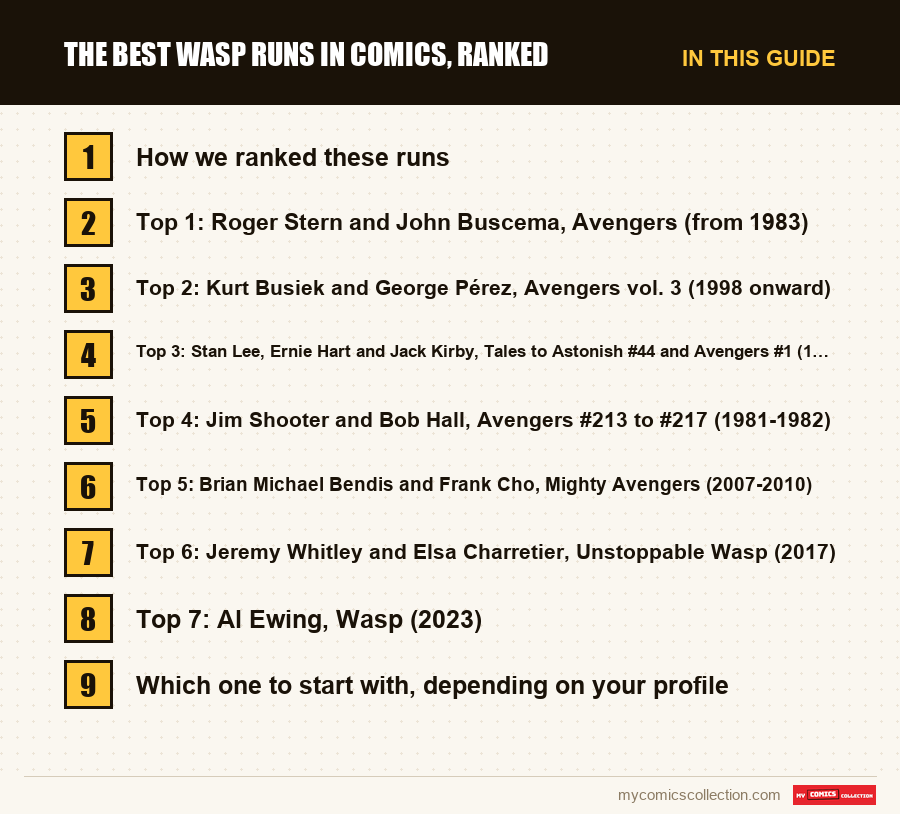
Top 5: Brian Michael Bendis and Frank Cho, Mighty Avengers (2007-2010)
Bendis's Mighty Avengers series, first drawn by Frank Cho, puts Janet at the heart of a team rebuilt after the crisis of the previous period. It culminates in the Secret Invasion event (2008), by Bendis and Leinil Francis Yu, whose final chapter stages a sacrifice that seems to cost the Wasp her life. The whole serves as a turning point: Janet disappears, and her absence feeds everything that follows.
It earns its spot in this ranking because it gives Janet a leading role again in a big spectacle story, after years in the background. It suits the modern reader, familiar with large-scale events, though Secret Invasion requires knowing what the Skrulls are, those shapeshifting aliens. How the series is split into phases varies by source, so no issue boundaries are given here.
For collecting, the event was printed in large quantities, and the final issue remains the milestone to keep. The collected edition is enough for reading, and it is more reliable than hunting every chapter scattered across several titles.
Top 6: Jeremy Whitley and Elsa Charretier, Unstoppable Wasp (2017)
The series follows Nadia Van Dyne, a young scientist trained in Russia, who takes up the name of the Wasp and founds a lab of women inventors. Janet is a mentor and an anchor there, present without stealing the spotlight from the heir. The tone is cheerful, the spirit scientific, and Elsa Charretier's line gives the story an energy that reads at a glance.
It finds its place here because it extends the name of the Wasp without betraying it: the character becomes an idea that can be handed down, more than a single person. It is aimed at a very wide audience, and at anyone looking for a light, optimistic read. The first series runs eight issues; a longer follow-up, Unstoppable Wasp: Unlimited, takes over afterward.
These 2017 issues are recent, so their market value is not settled. What will move it comes down to Nadia's place in upcoming films and series, which we cannot predict, and to the possible scarcity of print runs, which we do not quantify. The collected edition is the simplest way to read.
Top 7: Al Ewing, Wasp (2023)
Al Ewing's Wasp miniseries, published in 2023, brings Janet back to the center, solo, with a story that departs from the expectations of a team heroine. It comes out just as the character has returned to the cinema with Ant-Man and the Wasp: Quantumania, and it carries forward the idea of a Wasp who redefines herself alone.
It closes the ranking because it is the most recent and the least tested: we do not yet know what it will leave to later writers. It is aimed at readers who have already made a tour of the earlier periods and want to see where the character is heading. Our history of the Wasp supplies the frame.
The 2023 miniseries does not yet have an established market value. The character's lifespan in adaptations, the scarcity of print runs and possible alternate covers are the factors to watch, none of which can be quantified today. For reading, the collected edition does the job.
Which one to start with, depending on your profile
If you don't know the Avengers, start with Stern and Buscema: the story is welcoming and Janet is at her best. If you like big, richly detailed teams, move on to Busiek and Pérez. If your interest is historical, read Tales to Astonish #44 and Avengers #1 in a collected edition first, then the Shooter stretch. For a short, cheerful, present-day story, Unstoppable Wasp. And for the modern event, Mighty Avengers and then Secret Invasion. If you also like Hank Pym, read the ranking of Ant-Man runs alongside, which covers the other half of the duo.
What these runs are worth as collectibles
The picture is sharply contrasted. The two 1963 issues carry almost all of the demand and are judged grade by grade; this market is studied in our feature on the value of Wasp comics. The 1980s and 1990s are abundant: the price of a single issue there depends mostly on condition, and a collected edition often costs less than the complete run. The 2017 and 2023 releases are too recent to have a market value. To place a 1963 copy, rely on completed sales rather than listings, separating certified copies from raw ones, then follow the same number at identical condition over several months. The single issue and the collected edition that reprints it make up two distinct lines of inventory.
Frequently asked questions
With the Avengers of Stern and Buscema, from issue 227: Janet is among the central figures there and no prior knowledge is needed. For a short, recent format, Unstoppable Wasp, by Jeremy Whitley and Elsa Charretier, serves as a very accessible entry point.
Not before the 21st century. She first lives in the pages of Tales to Astonish, then in the Avengers. The series bearing her name are recent: Unstoppable Wasp in 2017, centered on Nadia, and Al Ewing's Wasp miniseries in 2023, devoted to Janet.
Not for most of the runs in this ranking. The link with Hank Pym matters mainly for Tales to Astonish and for the Avengers #213 to #217 period. The stories by Stern, Busiek or Whitley can be read without knowing Ant-Man's history.
This November 1981 issue, by Jim Shooter and Bob Hall, shows Hank Pym striking Janet, a scene that has become a negative landmark in the team's history. It is useful for understanding the character's turn toward autonomy, but reading it takes some distance and a critical context.
For reading, an omnibus or a collected edition settles the order of the issues. The original single issue only makes sense in two cases: the 1963 pieces, which are collector's items, and issue 213, which many readers keep for its place in the couple's history.
Do you have a Tales to Astonish or an Avengers from the Stern era and want to pin down its condition before choosing between single issue and omnibus?
Estimate my comic