
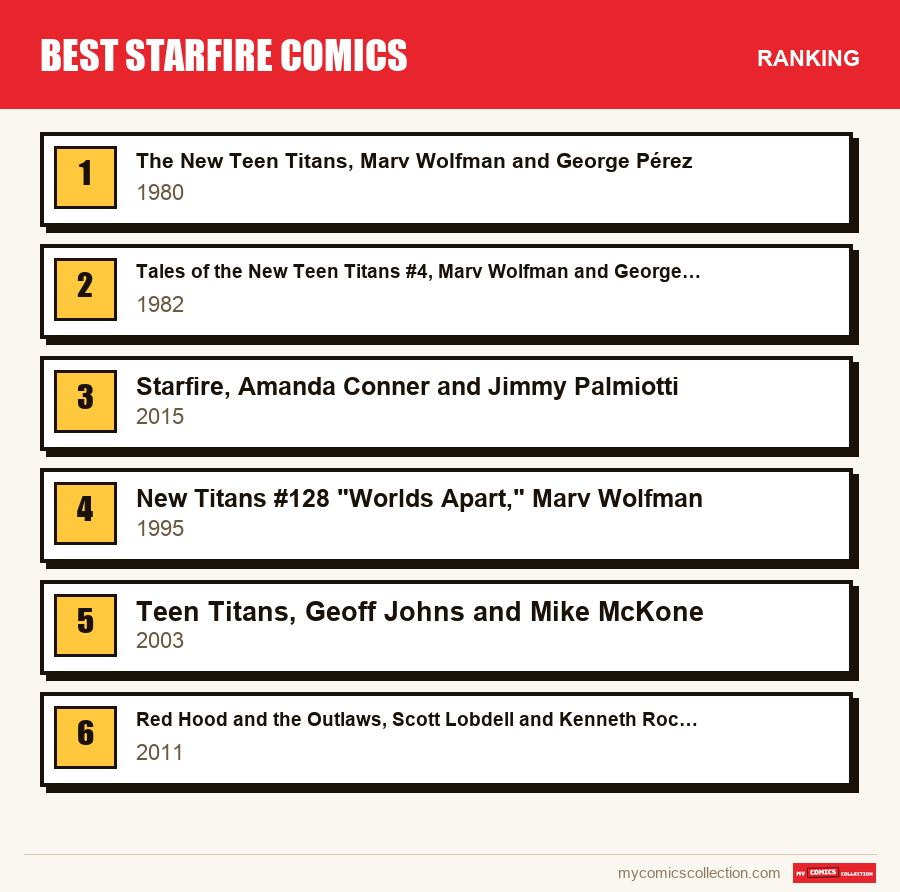
The best Starfire comics begin with The New Teen Titans, the 1980 series written and drawn by her creators Marv Wolfman and George Pérez, then Tales of the New Teen Titans #4 (September 1982), devoted to her origin. Move on to her 2015 Starfire series by Amanda Conner and Jimmy Palmiotti. Her first appearance, and the key issue to chase, is the preview insert in DC Comics Presents #26.
Koriand'r, princess of Tamaran, is one of the three creations that gave the Titans their 1980s identity, along with Cyborg and Raven. She has been rewritten several times since, sometimes happily, sometimes at the price of a real debate among readers. This guide ranks six reads to separate the original version from its reinterpretations.
As always in this guide, only verified information (creators, issue numbers, dates) is stated as fact; the analysis is our own, with no reproduction of protected panels or dialogue.
Her first appearance
Koriand'r debuts in DC Comics Presents #26 (October 1980), through a preview insert announcing the new Teen Titans lineup. Marv Wolfman and George Pérez are her creators, and the same insert introduces Cyborg and Raven. The host issue is a title built around team-ups between heroes, and the inserted story is what matters to collectors.
The The New Teen Titans series follows the next month, with a #1 dated November 1980 that brings the team together. Her name is a Wolfman wordplay on coriander, and Pérez drew on Red Sonja for her look, the long hair streaming like a flame coming from a suggestion by Joe Orlando. So keep two landmarks in mind: the October preview for the first appearance, the November #1 for the first story of the ongoing series. Our Teen Titans reading guide places this arrival in the team's history.
1: The New Teen Titans, Marv Wolfman and George Pérez (1980)
The ongoing series launched in November 1980 is the baseline read. Wolfman writes, Pérez draws: the same creators who made Starfire give her her voice, her codes, and her place here in a group where Dick Grayson is still Robin. Her relationship with him takes up an important place in the early years, and it carries on in the stories where he becomes Nightwing.
What this read gives Koriand'r: a complete character, with a foreign culture, a complicated family on Tamaran, and a way of approaching Earth that looks like no other member of the team. It is for everyone, with no prerequisites. The first issues set up the group's dynamic; a trade paperback from the start of the series saves you from hunting scattered single issues.
This series also gathers the team's first adversaries: issue 2, dated December 1980, brings in Deathstroke, whom our guide to that #2 presents in detail. Starfire therefore debuts in a series that already sets up its lasting enemies, and that is one of the reasons these issues are best read in one go rather than piecemeal.
In 1984, Tales of the Teen Titans #44 concludes the The Judas Contract saga and turns Dick Grayson from Robin into Nightwing. For Starfire, this change of identity in her partner matters, since their relationship runs through the following years. Read it as a team milestone, not as a story centered on her.
2: Tales of the New Teen Titans #4, Marv Wolfman and George Pérez (1982)
This origins miniseries gives Starfire an entire issue. Issue #4, titled "Starfire" and dated September 1982, is written by Wolfman, drawn by Pérez, and inked by Ernie Colón. It tells what the reader had only seen in fragments: her past, her planet, and what binds her to her own people.
The contribution is crucial: this is where the character gains her depth. It speaks to anyone who has already read the monthly series and wants to understand Koriand'r rather than merely follow her adventures. One evening is enough, provided you have read a few issues of the monthly series beforehand.
For anyone hesitant to open an older series, the logic is simple: start with the milestone that makes you want to read. If the 1980s atmosphere puts you off, jump straight to the 2015 series and come back to the 1982 #4 once the character has won you over. The reverse order works too, and it offers a useful contrast between a team story and a solo adventure.
3: Starfire, Amanda Conner and Jimmy Palmiotti (2015)
The 2015 solo series is the best modern way in. It runs twelve issues, published from August 2015 to July 2016. Amanda Conner and Jimmy Palmiotti write; Emanuela Lupacchino draws, with Ray McCarthy on inks for the first seven issues, Sean Parsons on #7, then Elsa Charretier on issues #8 to 12.
What the series offers: a brighter tone, built on what makes the heroine endearing, her curiosity and her frankness. It is for those who do not want a long backstory to catch up on, and for readers who prefer short stories. Two trade paperbacks collect the series: Welcome Home in 2016, then A Matter of Time in 2017.
The three inkers of Starfire (2015) give the series a shifting visual identity: Elsa Charretier, who inks and then handles the full art on certain issues such as #9, from April 2016, titled "Approaching the Abyss," brings a line different from Lupacchino's. If you collect single issues, keep the whole series rather than a few isolated numbers: twelve issues fit in a single box.
4: New Titans #128 "Worlds Apart," Marv Wolfman (1995)
In this issue dated December 1995, Wolfman writes the destruction of Tamaran and the death of Koriand'r's parents. Starfire is at the heart of the drama, since it strikes her planet and her family.
The read brings out the dark side of the character: the one who seemed luminous now carries the mourning of a whole world. It is for advanced readers, who already know the heroine and are willing to read a standalone chapter, outside its immediate context. The issue can be understood alone thanks to its subject, but it takes on another dimension after reading the 1982 origin: compare the two to gauge what Tamaran represented. The neighboring issues of New Titans fill out the picture.
Do you collect this series?
Track what you own, what you are missing and what your collection is worth. 7-day trial.
Start my trial →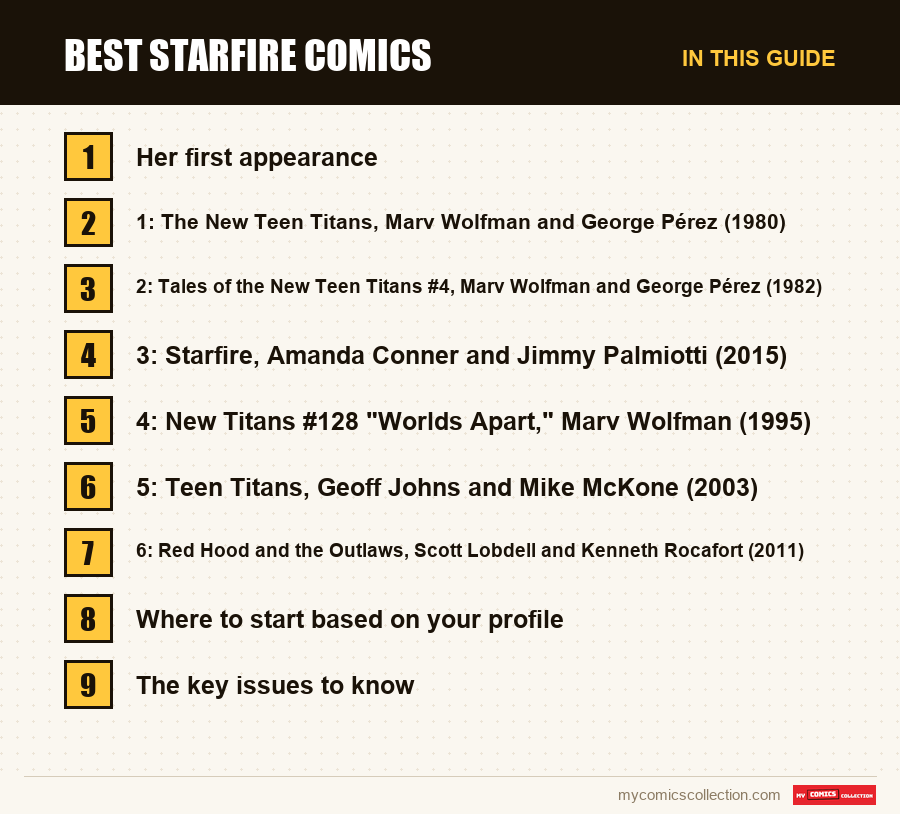
5: Teen Titans, Geoff Johns and Mike McKone (2003)
Issue #1 is dated September 2003. Geoff Johns relaunches the team with Mike McKone on art, and Starfire is part of the lineup assembled for the occasion, alongside Cyborg, Raven, Beast Boy, Robin, and several young heroes. This is an entry to treat as a team read, where she is not the only star.
She finds her place there as a veteran in a group that includes younger members, which shows how the character has matured. This entry is for readers coming from the animated series, who will find the Cyborg, Raven, Beast Boy, and Starfire crew there. You will find the analysis of the run in our ranking of Teen Titans runs, and the page on Geoff Johns to track down the rest of his work.
6: Red Hood and the Outlaws, Scott Lobdell and Kenneth Rocafort (2011)
In the 2011 relaunch, Starfire joins the Red Hood and the Outlaws series from #1, dated November 2011. Scott Lobdell writes, Kenneth Rocafort draws the first issues. She forms a trio there with Jason Todd and Roy Harper, far from the Titans.
This version divided readers, because it reinterprets the character differently from the historical version. What makes it worth knowing is that it marks a stage in Starfire's publishing history and still sparks debate. It is for readers who want to compare eras. A trade paperback, Red Hood and the Outlaws: The Starfire, came out in 2013; read it as a document of the 2011 relaunch rather than as an introduction to the character.
These six entries cover four eras of the same heroine: the creators' era (1980 and 1982), the tragedy of Tamaran (1995), the relaunches (2003 and 2011), and the solo series (2015). The Wolfman and Pérez version serves as the reference, and it is the one you need to have read to judge the others. With each relaunch, the creators moved a dial: sometimes the warrior, sometimes the sister or the princess in exile, sometimes the most open friend in the group.
Where to start based on your profile
- You are after the creators' version: the 1980 Wolfman and Pérez series, followed by the 1982 origin story.
- You prefer a short, recent story: Starfire by Conner and Palmiotti, twelve issues in two trade paperbacks.
- You come from the animated adaptations: Geoff Johns's Teen Titans brings together the lineup that those versions borrow.
- You want to understand her tragedy: New Titans #128, after reading the origin.
- You like reader debates: Red Hood and the Outlaws, keeping in mind that it is a reinterpretation.
One last lead, if you like stories that extend a character through other hands: the graphic novel I Am Not Starfire, by Mariko Tamaki and Yoshi Yoshitani (August 2021), follows Mandy, Starfire's daughter. Starfire does not have the lead role there; it is a story for young readers that reads separately, outside any continuity you would need to catch up on.
To keep going on the Titans side, the Nightwing reading guide follows the man who becomes her partner in many stories.
To spread the reading over time, here is a reasonable progression: two evenings for the 1980 series and the 1982 origin, a pause, then the 2015 series in one block. Save New Titans #128 for the end, when you know Tamaran well enough for its destruction to carry weight. As for the 2003 and 2011 relaunches, read them when you want to compare.
The key issues to know
- DC Comics Presents #26 (October 1980): first appearance of Starfire, in the Titans preview insert.
- The New Teen Titans #1 (November 1980): launch of the ongoing series and the first issue where the team comes together.
- Tales of the New Teen Titans #4 (September 1982): Starfire's origin story.
- New Titans #128 (December 1995): the destruction of Tamaran.
- Red Hood and the Outlaws #1 (November 2011): entry into DC's relaunch.
- Starfire #1 (August 2015): opening of her solo series.
On method, tell apart three objects that look alike: the host issue of the preview, the team's first series, and the trade paperbacks. For DC Comics Presents #26, make sure the preview insert is actually present in the copy, since it is the part that contains the appearance. Then compare completed sales for the same grade, and check the back cover and the spine, where most of the defects in these 1980s issues hide.
Frequently asked questions
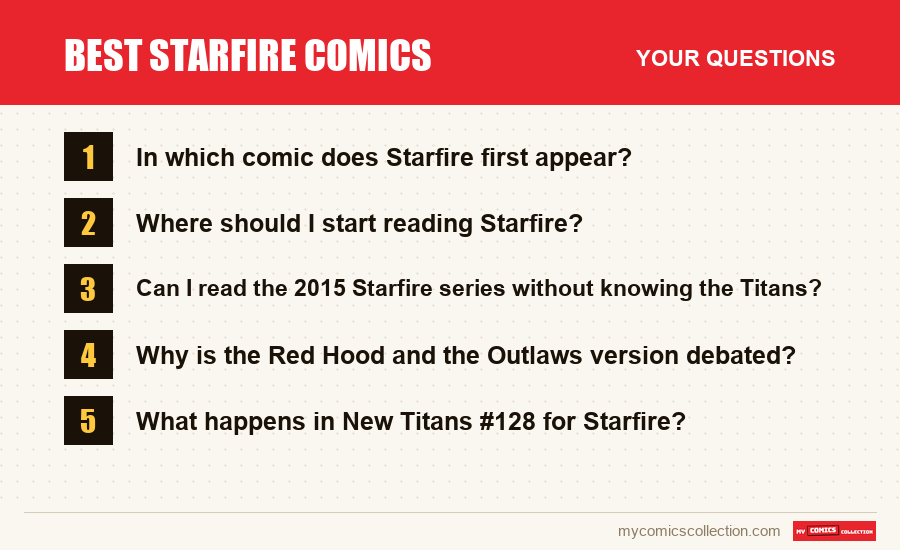
In a preview insert bound into the twenty-sixth issue of DC Comics Presents, in October 1980, conceived by Marv Wolfman and George Pérez. The The New Teen Titans series begins the following month, with a #1 dated November 1980.
With the 1980 Wolfman and Pérez series, then with the 1982 origin issue, the fourth of the Tales of the New Teen Titans miniseries. If you prefer a recent, short story, the 2015 Starfire series by Amanda Conner and Jimmy Palmiotti runs twelve issues.
Yes, it is designed to be accessible. Conner and Palmiotti write it with Emanuela Lupacchino on art, across twelve issues published from August 2015 to July 2016. Knowing the character helps, but no prerequisite is needed, and two trade paperbacks collect it.
Because the 2011 relaunch, written by Scott Lobdell, reinterprets Starfire differently from the Wolfman and Pérez version. Many readers prefer the original version; read it more as a record of that period at DC than as an entry point.
This December 1995 issue, titled "Worlds Apart" and written by Marv Wolfman, sees the destruction of Tamaran and the death of Koriand'r's parents. It is best appreciated after reading her origin, told in Tales of the New Teen Titans #4.
Do you own an issue from the early Titans, such as DC Comics Presents #26? Have its condition and value appraised in a few minutes.
Appraise my comic