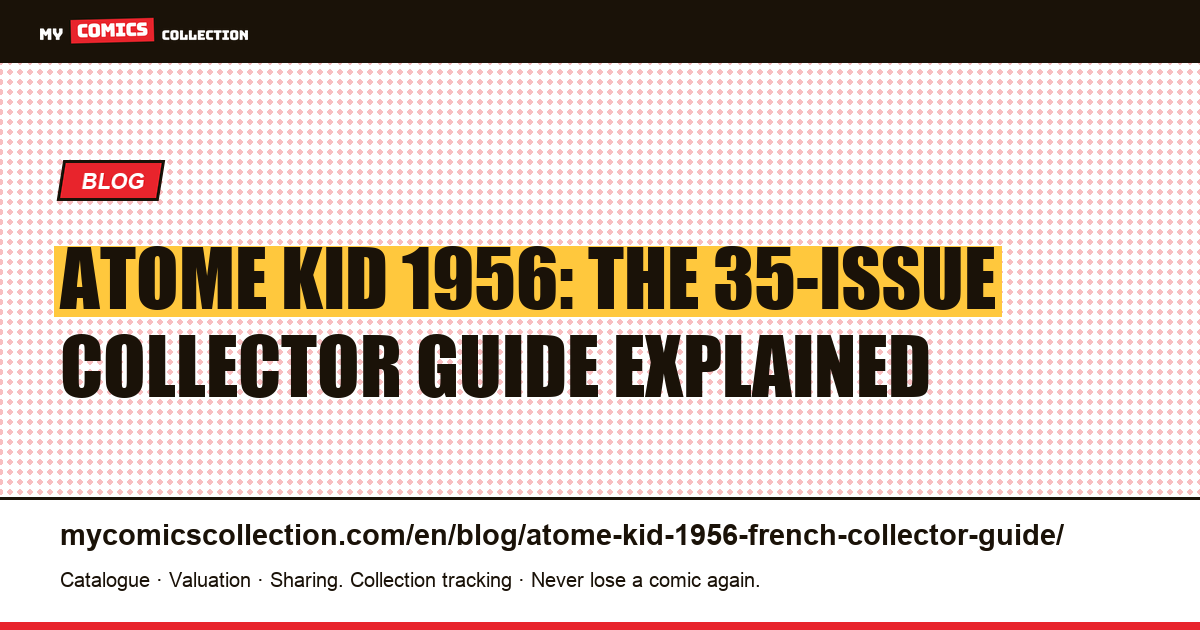
Atome Kid runs from November 1956 to September 1959 and counts 35 issues, one per month with no interruption. The catalog credits Bayo with the art across the whole title, but names a writer only on the first two issues. Three late issues do not even have a recorded story title. Collecting this series therefore means hunting for booklets older than most of the great costumed-hero magazines, and documented very unevenly.
You open a box bought at a flea market and one booklet carries a cover date from 1956. For a French comics collector, this is no ordinary find: most of the magazines people fight over today did not yet exist, and their first readers were not born. Atome Kid belongs to that earlier stratum, the one you rarely see in the bins because it had fifteen or twenty more years to disappear. Knowing what the series contains, how many issues you need to gather, and where the documentation stops will spare you from paying an ordinary booklet's price for a difficult piece, and the reverse.
As always on this guide, only verified information (creators, numbers, dates) is stated as fact; the analysis is our own, with no reproduction of panels or protected dialogue.
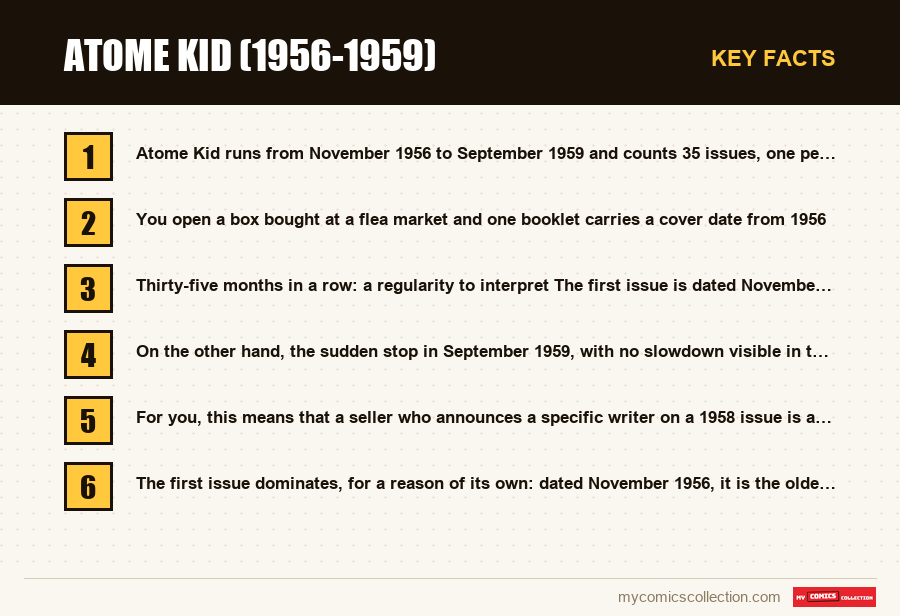
What the story titles reveal about the editorial line
The catalog keeps a story title for thirty-two of the issues. Read in sequence, they draw a very tight line: space-age anticipation, with rockets, satellites and planets. Mars returns three times, opening with "Infiltration martienne", then through "Le grand désert de Mars" and "Les habitants de Mars". This spaced return to the same destination indicates a series building a recurring setting rather than a catalog of interchangeable adventures.
The second vein is planetary catastrophe. "Le nouveau déluge", "La Terre s'enfonce", "Bombardement d'astéroïdes" and "Le soleil s'éteint" form a quartet that threatens not a hero but the whole world. For someone looking for an issue to read rather than to shelve, these are the obvious candidates: they carry the most spectacular promise of the lot.
A third surprise, and the most useful to know: roughly a quarter of the recorded titles never leave Earth. "L'impératrice des Incas", "Les hommes des neiges", "La ville morte du sahara" or "Le peuple sous la mer" belong to exotic exploration, not to space. If you buy at a distance on the strength of a title, know that "Atome Kid" does not guarantee a rocket story, and that the actual contents remain to be checked on the copy.
Thirty-five months in a row: a regularity to interpret
The first issue is dated November 1956, the last September 1959. Between the two, the cover dates follow one another month after month with not a single month missing: thirty-five issues for thirty-five months. No change of rhythm, no suspension, no double issue. This is unusual, and it has a direct consequence for your search.
A series that never changed its cadence does not produce "accidentally rare" issues. Where a title interrupted and then relaunched leaves behind booklets printed in fewer copies, Atome Kid was presumably printed at a steady level from start to finish. In other words, the scarcity you will find on the market does not come from the print run but from survival: what sets one issue apart from another is the seventy years that have passed, not a publisher's decision.
This reading changes how you build a complete series. There is no point hunting for a "ghost issue": there is none. On the other hand, the sudden stop in September 1959, with no slowdown visible in the dates, suggests an ending that was decided rather than endured, and the very last issues therefore did not enjoy the word of mouth that circulates the booklets of an established series.
One artist everywhere, a writer almost nowhere
This is the most telling anomaly in the record. Bayo is credited with the art on all thirty-five issues, without exception, the second issue also mentioning unidentified contributors. On the writing side, the catalog names Bañolas on the first issue, then a double attribution on the second, and nothing after that: thirty-three consecutive issues with no identified writer.
This imbalance is not a gap in modern documentation; it is the trace of a practice. The line was recognized by eye and signed; the text, for its part, could be supplied, adapted or rewritten without anyone deeming it worth recording. For you, this means that a seller who announces a specific writer on a 1958 issue is asserting something the sources do not support, and you should ask where the information comes from.
Note also that the names recorded are not French names. The catalog does not say where the pages were produced, so we will not assert any origin or any match with a foreign publication: the sources diverge on these supply circuits, and a confident attribution here would be an invention.
The issues that really matter
In a series with no known variants and no renumbering, the hierarchy rests on very little. The first issue dominates, for a reason of its own: dated November 1956, it is the oldest booklet in our whole record of French comics magazines. It is also the only one to carry two full credits, art and script, which makes it the best-documented copy of the series.
The second issue deserves a separate mention, because it is the only one where the art credit is not reduced to a single name. That singularity is of interest to whoever looks into how the title was made.
Finally, one issue is worth a detour for a calendar reason: "Le satellite ambulant" carries a cover date of March 1957, several months before the launch of the first artificial satellite. A booklet that puts a satellite on its cover before the word has entered world news is a dated curiosity, and it is the kind of argument that holds up in front of a serious buyer.
Recognizing the edition and avoiding title confusion
The numbering runs from 1 to 35 in one continuous sequence, which spares you the puzzle of series restarted at zero: an issue announced as "Atome Kid 17" can only designate one booklet, the one of March 1958. Check that the number and the month announced match, since that is the fastest control. If the seller gives a number and a date that do not follow one another in the monthly chronology, one of the two is wrong.
Vigilance shifts elsewhere. A title sold forty or fifty years after publication has often been rebound, redistributed or mixed with other booklets of the same format. Ask for a photo of the spine and the lower cover edge, not just the front: that is where traces of later assembly show, and across a series of thirty-five uniform booklets, it is the only detail that tells you what you are actually buying.
Three issues without a recorded story title, and what that changes
The catalog keeps no story title for three booklets: those of February 1959, July 1959 and September 1959. All three fall in the last year, and the final issue of the series is one of them. The documentation weakens exactly where the title fades.
The immediate practical consequence: for these three booklets, you cannot confirm an identification by story title. You must go through the cover number and the date, and accept that you will not know in advance what the copy tells. If you own them, recording their actual title is a useful contribution, and it is the kind of verification that only a collector holding the object can make.
Do you collect this series?
Track what you own, what you are missing and what your collection is worth. 7-day trial.
Start my trial →
Traps specific to a title this old
The first trap is the date slip. The issues of the series spread across four years, 1956 to 1959, and a seller who announces "1950s" with no more precision may offer you indifferently an issue from the first or the last season. Demand the month: it is printed on the object and it removes all ambiguity.
The second trap concerns attribution. Since the art is credited uniformly across the whole series, a sales argument based on the artist does not distinguish any issue from the other thirty-four. If a listing puts this name forward to justify a premium, it is selling a trait common to the entire title.
The third trap is the incomplete lot presented as a series. Thirty-five issues are rarely gathered in one go, and a set of twenty-eight or thirty booklets remains a partial set, even when it looks impressive in a photo. Count the numbers one by one before you commit.
Completing all thirty-five issues
Approach the series in blocks by year rather than issue by issue. The year 1957 and the year 1958 each supply twelve booklets, and they are the two blocks that most often turn up grouped, because a regular reader kept a whole season together. The two booklets of 1956 and the nine of 1959 trade more often as single units: they are the bookends, and bookends always disperse first.
Set yourself a priority order that fits this imbalance: first secure the first issue and the end of 1959, which are the segments least likely to come back around, then let the middle of the series arrive in lots. A collector who starts with the center ends up with a fine set and two unfindable ends, which is the worst configuration for resale value.
Keep a written record with, for each issue, the expected month. Compare it with the listing before you buy, and this simple column will spare you the duplicates that pile up when you buy lots that overlap. The other guides on the site apply the same method to more recent series.
The price today, and what moves it
On a title from this period, the gap between a damaged copy and a well-kept one is wider than on any magazine of the following decades, because the proportion of survivors in good condition is small. Reason therefore in ratios and not in absolute levels: the difference in condition weighs more here than the difference in issue number, except for the first.
The second factor is the completeness of the lot. A continuous set covering a full year is worth more than the sum of its booklets taken separately, because it solves a search problem for the buyer all at once. Conversely, a single issue from the middle of the series trades at its base level, whatever its story title.
The third factor is proof. On a series whose documentation stops at one artist and two writers, anything you can show that is verifiable (number, month, legible title) supports the price.
Tracking the collection over time
A series of thirty-five monthly booklets is easy to manage in a structured inventory: one line per issue, the cover month, the story title when known, the condition and the provenance. The three issues without a recorded title deserve a notes column, because that is where you will log what you have checked yourself on the object.
This tracking serves two purposes. It tells you at any moment what is missing, and therefore what you are really looking for at the flea market, and it forms the supporting document that will travel with the series if it changes hands. For a title that predates the great costumed-hero magazines, with a thin paper trail, your own record ends up being the best documentation available.
Conclusion: the oldest series in the record
Atome Kid comes down to one strong fact and one accepted weakness. The strong fact is a perfectly regular monthly run from November 1956 to September 1959, which makes it the oldest title in our French comics record and a series whose list to assemble is short and free of surprises. The weakness is an attribution reduced to one ubiquitous artist and two writers named at the very beginning.
For a collector, this asymmetry is an opportunity rather than an obstacle: the thirty-five issues can be identified without ambiguity, and anything you document beyond that adds to the whole. If science fiction interests you as a thread, the hubs devoted to characters from space, including this one, show how the genre later shifted into the superhero.
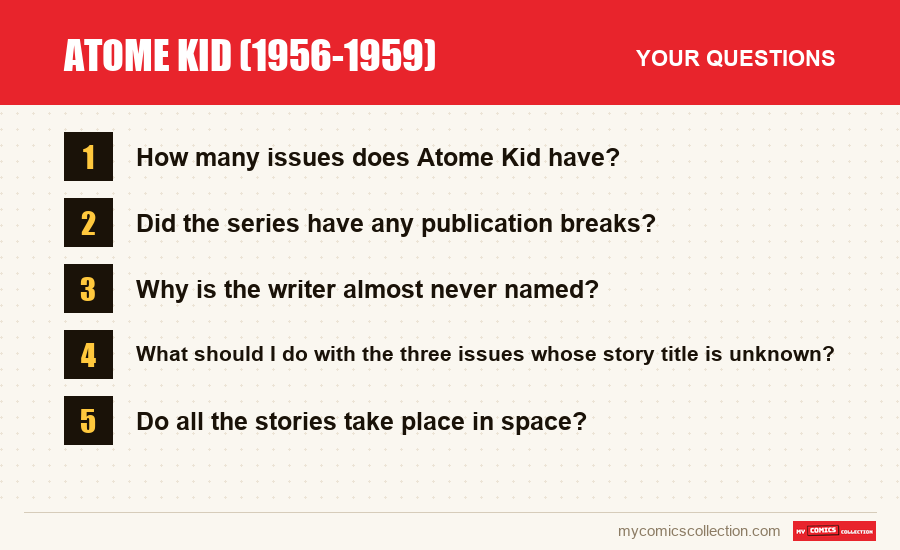
Frequently asked questions
Thirty-five, numbered from 1 to 35 without interruption or renumbering. The first carries a cover date of November 1956, the last September 1959. Since the numbering is continuous, an announced number can only designate one booklet, which greatly simplifies assembling a complete series.
No. The cover dates follow one another month after month from start to finish, with no missing month and no double issue. This regularity means that no issue is rare because of a small print run: the differences you will find on the market come from conservation and dispersal, not from an editorial accident.
The catalog names a writer only on the first two issues, whereas the artist is credited on all thirty-five. The line could be recognized by eye and was signed; the text, often supplied or adapted, did not receive the same care. Be wary, then, of a listing that asserts a writer on a later issue.
They all fall in 1959, and one of them is the last issue of the series. Identify them by the cover number and the month, since the title cannot serve as a check. If you have them in hand, record their actual title from the copy: it is information the existing documentation does not provide.
No, and this is a common mistake. About a quarter of the recorded titles remain on Earth, among lost cities, ocean floors and deserts. The file also keeps only one title per issue, so the full contents of a booklet must still be checked on the object before you make any claim about it.