Watchmen (DC Comics, 1986-1987) is the work of three British artists: writer Alan Moore , artist Dave Gibbons , and colorist John Higgins. This 12-issue maxiseries is the only graphic novel to have won a Hugo Award (1988) and to appear on Time magazine's list of the 100 Best English-Language Novels (2005). On the market: with fewer than 10 active eBay listings per issue, volume is too thin to quote a reliable price median: documented auction records are the reference for serious buyers.
Published from September 1986 to October 1987, Watchmen follows a group of masked vigilantes in an alternate 1980s America teetering on the edge of nuclear war. The series deconstructs the superhero genre with narrative depth and graphic sophistication unlike anything that had come before. It belongs to the Copper Age / Modern era: there are no Silver-Age or Bronze-Age issues of this series.
This profile sticks to the verifiable: confirmed biographies, documented editorial facts, real sale records, or qualified as insufficiently attested. No figure is invented.
Alan Moore: the architect of deconstruction
Born on 18 November 1953 in Northampton, England, Alan Moore began his career in the British alternative press before joining 2000 AD. In 1983, DC Comics hired him to write Swamp Thing, where he invented John Constantine and redefined what a comic book could say. It was from this position that he pitched Watchmen to DC: the story was originally to use characters acquired from Charlton Comics, but he ultimately created originals (Rorschach, Doctor Manhattan, Nite Owl II (Dan Dreiberg), Silk Spectre II (Laurie Jupiter), Ozymandias and the Comedian) each inspired by a Charlton counterpart. Moore is also the author of V for Vendetta , From Hell , The League of Extraordinary Gentlemen and Batman: The Killing Joke. He has long refused royalties from adaptations of his work and publicly opposed DC's spin-offs, which were authorized without his consent.
Dave Gibbons: the nine-panel grid as a language
Born on 14 April 1949, English artist David Chester Gibbons trained in the British industry as a letterer for IPC Media before joining 2000 AD from its first issue in 1977. For Watchmen , he imposed a strict nine-panel grid: a deliberate choice he described as having "authority": that gives the narrative its relentless, clockwork rhythm. Gibbons lettered his own pages throughout, allowing him to control information density without ever sacrificing the artwork. In 2014, he was appointed the United Kingdom's first Comics Laureate, serving as an ambassador for comics and their potential to improve literacy. His book Watching the Watchmen (2008) remains the definitive reference on the creative process behind the series.
John Higgins: color as a third narrative layer
Born in 1949 in Liverpool, John Higgins is the often-overlooked third member of the founding trio. Trained in technical illustration, he entered comics through 2000 AD and Judge Dredd . For Watchmen, he deliberately rejected the primary-color palette typical of superhero comics in favor of secondary tones: sickly purples, oranges and greens: that give the world its bruised, uneasy texture. He calibrated color based on light sources (neon, natural light, surface reflections) with a discipline closer to photography than traditional comics coloring. This work earned him the Harvey Award for Best Colorist in 1988. Higgins returned to the Watchmen universe by drawing the backup feature Curse of the Crimson Corsair that ran through every issue of Before Watchmen (2012-2013).
The spin-offs: who carried the torch?
DC authorized several extensions without Moore's agreement, fueling a persistent editorial controversy.
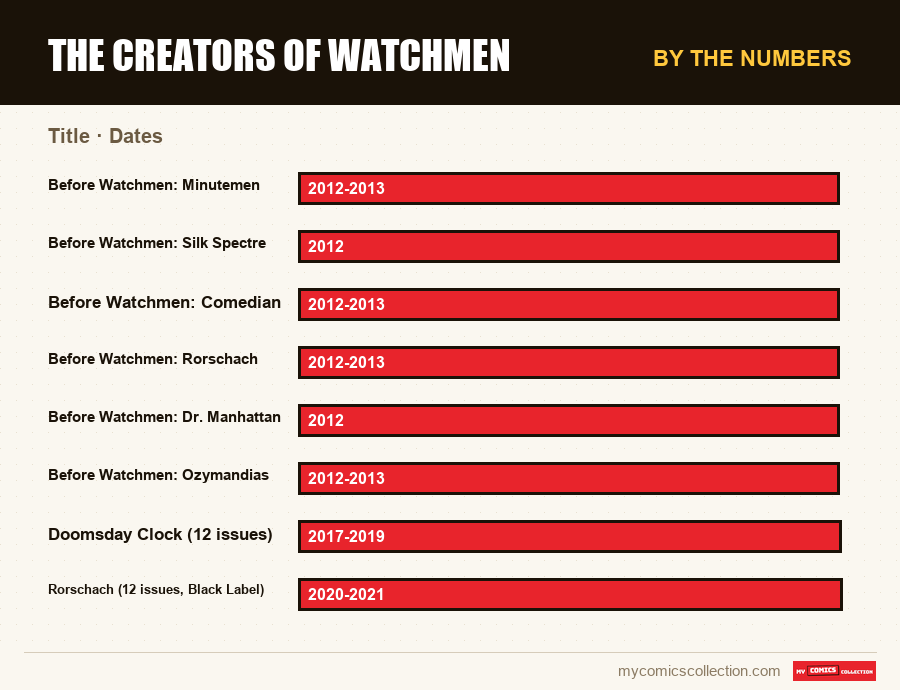
| Title | Writer | Artist(s) | Dates |
|---|---|---|---|
| Before Watchmen: Minutemen | Darwyn Cooke | Darwyn Cooke | 2012-2013 |
| Before Watchmen: Silk Spectre | Darwyn Cooke | Amanda Conner | 2012 |
| Before Watchmen: Comedian | Brian Azzarello | J.G. Jones | 2012-2013 |
| Before Watchmen: Rorschach | Brian Azzarello | Lee Bermejo | 2012-2013 |
| Before Watchmen: Dr. Manhattan | J. Michael Straczynski | Adam Hughes | 2012 |
| Before Watchmen: Ozymandias | Len Wein | Jae Lee | 2012-2013 |
| Doomsday Clock (12 issues) | Geoff Johns | Gary Frank | 2017-2019 |
| Rorschach (12 issues, Black Label) | Tom King | Jorge Fornés | 2020-2021 |
Darwyn Cooke (1962-2016), who died of cancer in May 2016, produced Minutemen: widely regarded as the critical standout of the Before Watchmen project. Geoff Johns, one of DC's most prominent writers (co-creator of Blackest Night and Infinite Crisis ), and Gary Frank, known for his precise, highly detailed linework, turned Doomsday Clock into the first official crossover between the Watchmen universe and the mainstream DC Universe: with Superman and Doctor Manhattan as its central figures. The series holds an average critical score of 8.5 out of 10 on Comic Book Roundup. Tom King (former CIA officer, author of Mister Miracle and Batman ) and Jorge Fornés produced a standalone Rorschach under DC's Black Label imprint (2020-2021), using the masked vigilante as a lens on political polarization.
Adaptations: film and HBO series
Zack Snyder's 2009 film faithfully translates Gibbons's visual grammar: most notably the nine-panel grid, transposed directly into storyboards. The HBO limited series created by Damon Lindelof (2019) chose sequel over adaptation: set in 2019, it incorporates the 1921 Tulsa Race Massacre and introduces new characters. It received 26 Emmy nominations and won 11, including Outstanding Limited Series, Outstanding Lead Actress (Regina King) and Outstanding Writing (Lindelof and Cord Jefferson).
Original issues for the collector
The 12 original Watchmen issues (1986-1987) are Copper Age comics. Active eBay listing volume is very thin across the entire series (fewer than 10 per issue for the key numbers (#1, #4, #12)) making any median price unreliable as a standalone figure. Several factors explain this low liquidity: the series has been continuously reprinted in collected form since 1987, and collector value concentrates on high-grade CGC first prints, which circulate more readily through specialist auctions than on eBay. If you own a copy in strong condition, getting it assessed is worthwhile: the gap between a raw copy and a CGC 9.8 is considerable.
Own an issue of Watchmen? Get a free valuation with our tool based on real eBay sales to find its low, median and high value.
Frequently asked questions
Watchmen (DC Comics, 1986-1987) is the work of three British artists: writer Alan Moore, artist Dave Gibbons and colorist John Higgins. The maxiseries has 12 issues, published from September 1986 to October 1987.
Gibbons imposes a rigid grid of nine panels per page, a deliberate choice he calls "authoritarian". It gives the story its inexorable clockwork rhythm, and he letters his own pages to control narrative density.
Higgins, often forgotten in the trio, rejects the usual primary palette of superheroes in favor of secondary hues such as mauves, oranges and sickly greens. This color work earned him the Harvey Award for best colorist in 1988.
DC authorized Before Watchmen (2012-2013), Doomsday Clock by Geoff Johns and Gary Frank (2017-2019), then Rorschach by Tom King and Jorge Fornés under the Black Label imprint (2020-2021). These extensions were published without Alan Moore's agreement, which fuels a lasting editorial controversy.
No, the series belongs to the Copper Age / modern era: there is no Silver or Bronze Age issue. Since the series has been massively reprinted in collected form, collector value concentrates on high-grade first printings.