The Walking Dead is a 2003 Image Comics creation. Its visual identity rests on three main artists: Tony Moore (issues 1-6), Charlie Adlard (issues 7-193), and graytone artist Cliff Rathburn . Writer Robert Kirkman is the co-creator and sole editorial driver of all 193 issues.
Launched in October 2003, The Walking Dead is an independent series published by Image Comics, born from a collaboration between writer Robert Kirkman and artist Tony Moore. The two had known each other since middle school in Kentucky and had already co-founded the small-press label Funk-O-Tron to publish Battle Pope in 2000. When they turned to the zombie genre, then barely represented in mainstream comics, their editorial ambition was clear: a long-form survival story focused on human psychology rather than on the undead themselves.
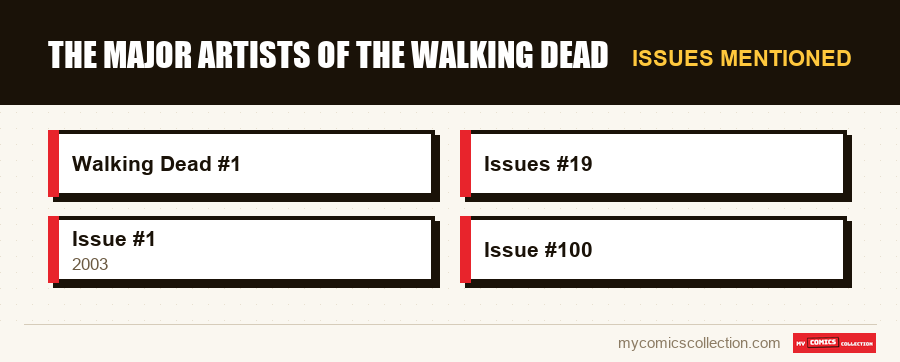
This guide sticks to the verifiable: eBay medians from our estimator (eBay.fr + eBay.com, June 2026) and records documented by auction houses and specialist press. One critical warning: our tool returns a median of €12 for The Walking Dead #1 across 101 listings, but those listings are overwhelmingly dominated by reprints and later printings. That figure in no way reflects the value of the first print of October 2003, whose initial run was approximately 7,500 copies. Issues #19, #27, #92, and #100 each have fewer than 15 active listings: no eBay median is cited for those issues.
Robert Kirkman: writer, publisher, architect of the series
Born in 1978 in Richmond, Kentucky, Robert Kirkman is one of the rare independent comics creators to have built a global franchise. Before The Walking Dead , he had written Battle Pope with Tony Moore and Invincible for Image Comics. With TWD, he imposed an unusual narrative rhythm on the medium: long arcs, permanent character death, and psychology that took precedence over action. He authored all 193 issues of the series (2003-2019) without interruption. In 2010, he founded Skybound Entertainment to develop his intellectual properties beyond comics: including the AMC television series, the Telltale Games video game adaptations, and several spin-offs. He is also a partner at Image Comics, serving as COO.
Tony Moore (issues 1-6): the original art, the founding aesthetic
Tony Moore shares co-creator credit with Kirkman. Born in the same year as his collaborator, also in Kentucky, he establishes the aesthetic of TWD across the first six issues: a realistic line, dynamic compositions, horror that never wallows in gratuitous gore. Issue #1 (October 2003) (first appearance of Rick Grimes, his wife Lori, their son Carl, and Officer Shane Walsh) is drawn entirely by Moore. It is that issue which has become one of the most sought-after independent comics of the modern era.
Moore left interior duties after issue #6 but continued to provide cover art through issue #24, and drew the covers for the first four collected volumes. He received two Eisner Award nominations for his work on the series: Best New Series (2004) and Best Cover Artist (2005). A legal dispute with Kirkman over rights was settled out of court in September 2012.
Charlie Adlard (issues 7-193): the artist who carried the series to the end
British artist Charlie Adlard took over from issue #7 and never left the series until the final issue (#193, July 2019): 187 consecutive issues. His vigorous black-and-white line, more economical than Moore's, proved ideally suited to the monthly schedule and to the series' increasingly dark tone. Under his pen were born the series' most iconic characters: Michonne (issue #19, June 2005), the Governor (issue #27, April 2006), Negan and his bat Lucille (issue #100, July 2012), and Glenn's death at Lucille's hands (issue #100, July 2012).
Issue #100 deserves special mention: published in July 2012 at the height of the AMC show's popularity, it was released with no fewer than sixteen variant covers, signed by artists including Todd McFarlane, Sean Phillips, Frank Quitely, and Bryan Hitch. It is one of the best-selling issues in Image Comics history. Adlard signed all main series covers from issue #7 onward and built a visual iconography that is immediately recognizable.
Cliff Rathburn: the graytones, a unique visual signature
If Adlard is the visible artist, Cliff Rathburn is the invisible one: the person without whom the series would not have its distinctive character. From issue #7, he applied the gray tones over Adlard's inks: a technique that gives TWD its cinematic atmosphere, hard contrasts, and deep shadows. This aesthetic choice (publishing in black, white, and gray rather than full color) was a deliberate statement by Kirkman, a way to set the series apart from the colorful superhero output of the time. Rathburn is not a simple grayscale colorist: he builds the visual mood panel by panel, in close collaboration with Adlard.
The Walking Dead #1 (2003): the first print, a modern-era grail
The first-print copy of issue #1 from October 2003 is the series' absolute grail. With approximately 7,500 copies printed, it is scarce by nature. It is identifiable by the phrase "First Printing, October 2003" in the indicia (inside front cover) and the absence of any "Second/Third Printing" notation on the cover. The proliferation of reprints (Image reissued this issue many times, especially from 2010 onward in the wake of the AMC show) makes authentication essential before any purchase.
Our estimator returns a median of €12 across 101 listings for The Walking Dead #1, but that figure is entirely dominated by reprints and common later printings. It must never be read as the value of the first print. In high grade, a CGC 9.8 first-print copy trades between €25,000 and €35,000 based on documented 2025-2026 sales (source: mycomicscollection.com guide / Heritage Auctions). One CGC 9.8 copy realized $24,200 at Heritage Auctions in March 2022; another exceeded $32,000 in 2024.
The AMC television series and its impact on values
The broadcast of The Walking Dead on AMC (2010-2022, 11 seasons) transformed a modest-circulation independent comics series into a global cultural phenomenon. The show's reach multiplied demand for key issues, particularly #1, #19 (Michonne), #92 (Jesus), and #100 (Glenn's death). Several spin-offs have extended the franchise: Fear the Walking Dead (2015-2023), Dead City (2023-present), Daryl Dixon (2023-present), and The Ones Who Live (2024). The television adaptation played a central role in driving key-issue values: issues that traded for a few dollars before 2010 saw their prices rise substantially in the years that followed.
Own a copy of The Walking Dead? Get a free valuation with our tool based on real eBay sales to find its low, median, and high value.
Frequently asked questions
Robert Kirkman wrote all 193 issues. Tony Moore drew issues 1 to 6, Charlie Adlard drew issues 7 to 193, and Cliff Rathburn applied the gray tones from issue 7 onward.
Tony Moore, co-creator of the series, drew issue 1 (October 2003) in its entirety. He went on to sign the covers through issue 24.
It is a deliberate choice, claimed by Kirkman as a way to set the series apart from the colorful superhero output of the time. Cliff Rathburn builds the visual mood with his gray tones, panel by panel, working closely with Adlard.
It carries the line "First Printing, October 2003" in the indicia and no "Second/Third Printing" mention at the bottom of the cover. Only about 7,500 copies were printed, which is why identifying it correctly matters before any purchase.
Issue 19 (Michonne), 27 (the Governor), 92 (Negan and his bat Lucille) and 100, in which Glenn dies at Lucille's hands. The latter was published with sixteen variant covers in July 2012.