Spawn began as one man's work: Todd McFarlane, who created the character and launched Spawn #1 in May 1992 (Image Comics): an issue printed in roughly 1.7 million copies, still the unbeaten record for the best-selling independent comic. But its legend also rests on the prestige guests of 1993: Alan Moore (#8), Neil Gaiman (#9, who created Angela), Dave Sim (#10) and Frank Miller (#11), then on artist Greg Capullo, present from #16. Here's who shaped Spawn, with real values for the issues involved.
Born in 1992 (Modern/Image era), Spawn belongs to neither the Silver nor the Bronze Age: it's an independent, studio-built creation that built its reputation on the talent of its authors as much as on its character. Knowing who wrote and drew what helps you spot the issues that truly matter.
This guide sticks to the verifiable: real-time eBay medians (via our estimator) and documented facts about the creators. When a precise figure can't be verified, we state it qualitatively rather than inventing it.
Todd McFarlane, the creator and the boss
Todd McFarlane created Spawn (Al Simmons) after leaving Marvel, where he had redefined Spider-Man. Spawn #1 (May 1992) launched Image Comics with unmatched commercial success: around 1.7 million copies sold, still making it the best-selling creator-owned comic in history (source: Wikipedia / Comichron). McFarlane wrote, drew and inked most of the early issues, and kept editorial control of the series for the long haul.
As for value, that first issue stays very accessible despite its colossal print run: an eBay median of €15 across 102 listings (June 2026, all editions and grades combined). The huge print run explains the restraint: a historic grail, but not a rare one.
The prestige guests of 1993 (#8 to #11)
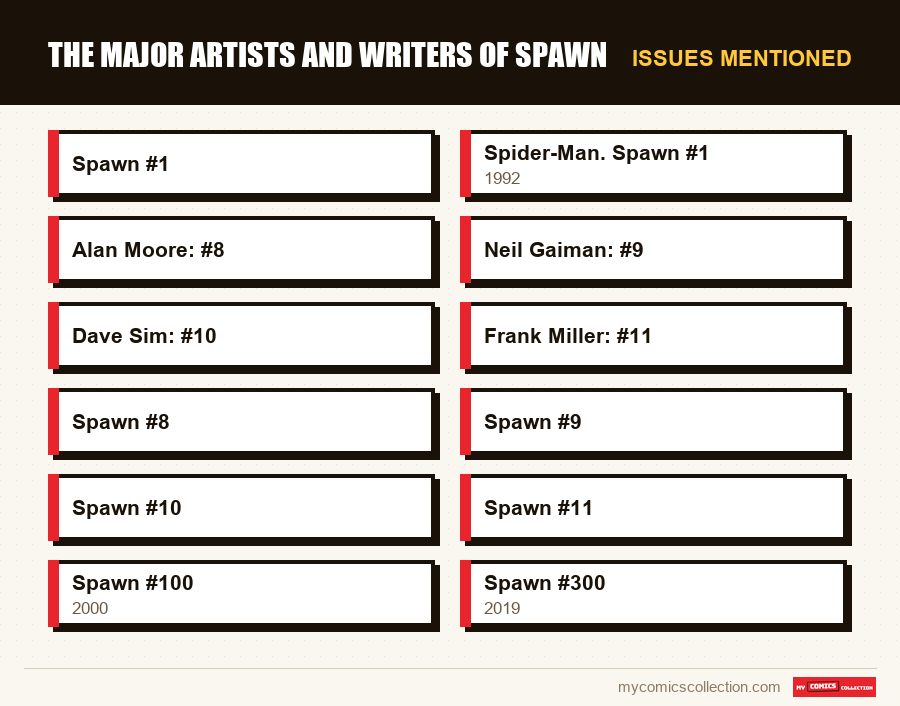
Over McFarlane's art alone, the standout event of the second year was a run of star writers across four consecutive issues. A rare move in comics history that durably lent Image credibility:
- Alan Moore: #8. The Watchmen author opened the run. He later returned on Spawn: Blood Feud and #32.
- Neil Gaiman: #9. The series' most important issue after #1: Gaiman created Angela here, an instant fan favorite. Its current value is a €13 median across 100 listings (June 2026, all editions combined).
- Dave Sim: #10. The Cerebus creator delivered a meta issue, Spawn's first inter-publisher crossover, gleefully breaking the fourth wall.
- Frank Miller: #11. The Sin City author closed the guest run with a street-level Spawn and a brutal aesthetic.
| Issue | Guest creator (1993) | Key fact | eBay median (June 2026) |
|---|---|---|---|
| Spawn #8 | Alan Moore (writer) | First star guest on the series | |
| Spawn #9 | Neil Gaiman (writer) | First appearance of Angela | €13 · 100 listings |
| Spawn #10 | Dave Sim (writer) | Meta issue, inter-publisher crossover | |
| Spawn #11 | Frank Miller (writer) | Street-level Spawn |
Sources: GoCollect, EBSCO Research Starters.
The Gaiman-McFarlane feud over Angela
Gaiman's creation of Angela in #9 led to one of the longest legal disputes in comics history, pitting Neil Gaiman against Todd McFarlane over the character's rights (litigation stretching from the 2000s into the 2010s). The outcome: Gaiman retained his rights, and Angela eventually moved to Marvel in 2013, where she was folded into Thor's corner of the universe (sources: The Hollywood Reporter, GoCollect). A textbook case on creative ownership in creator-owned comics.
Greg Capullo, the artist of longevity
When McFarlane eased off the pencils, Greg Capullo took over. He appeared from #16 (1993), then became the regular penciler from #26, building a long presence on the series (roughly 1993-2000, then a return in 2003-2004) (source: Wikipedia). Capullo, later the artist of Scott Snyder's Batman at DC, forged Spawn's durable visual identity after its creator stepped back from the art.
Grant Morrison, sometimes listed among the guests, came to the series a little later (issues #16 to #18): not in the #8-#11 guest salvo, contrary to a common belief.
And the later editorial milestones
McFarlane stayed the backbone of the series over the very long term, all the way to the anniversary issues:
- Spawn #100 (2000): a pivotal issue, and the highest-valued on this list: an eBay median of €47 across 17 listings (June 2026). With only 17 listings, the volume is thinner than for #1 or #9: treat this as an indicative value to re-check before any purchase.
- Spawn #300 (2019): the milestone issue for the longest-running creator-owned superhero comic, with Greg Capullo returning to pencils (#300-301). An eBay median of €25 across 30 listings (June 2026).
Own a Spawn issue by McFarlane, Gaiman or Capullo? Get a free valuation with our tool based on real eBay sales to find its low, median and high value.
Frequently asked questions
Spawn #1 (May 1992, Image Comics) sold around 1.7 million copies. It is still the record for the best-selling independent comic. That huge print run explains why the issue remains very affordable: a historic grail, but not a rare one.
Four writers followed one another on four consecutive issues: Alan Moore (#8), Neil Gaiman (#9), Dave Sim (#10) and Frank Miller (#11). This run lastingly boosted Image's credibility. Grant Morrison comes later (#16 to #18), not in this guest run.
It is Spawn #9, written by Neil Gaiman, who creates Angela in it, an instantly cult character. It remains highly sought after despite a large number of copies on the market.
A long legal dispute over the rights to the character pitted them against each other, stretching from the 2000s to 2010. Gaiman kept his rights, and Angela joined Marvel in 2013, folded into the Thor universe. It is a textbook case of creative ownership in creator-owned comics.
Greg Capullo appears from #16 (1993), then becomes the regular artist from #26. His run spans roughly 1993 to 2000, with a return in 2003 and 2004. He also comes back on pencils for #300 and #301.