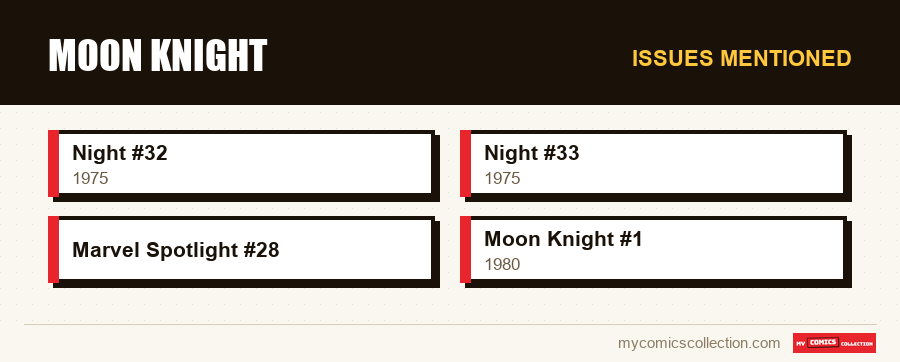
Moon Knight is a Bronze Age creation: he first appeared in Werewolf by Night #32 (August 1975), written by Doug Moench and drawn by Don Perlin. There are no Silver Age Moon Knight issues: the character was created in 1975, full stop. The highest documented record for Werewolf by Night #32 is a sale at $31,200 (CGC 9.8, Heritage Auctions, March 2020). The story of Moon Knight is then told through a succession of landmark creative runs: Bill Sienkiewicz (1980-1983), Warren Ellis & Declan Shalvey (2014), Jeff Lemire & Greg Smallwood (2016-2018).
Moon Knight was born in the pages of a horror comic. In 1975, Doug Moench needed a credible antagonist for Jack Russell, the werewolf at the centre of Werewolf by Night. His answer: a mercenary hired to capture the werewolf, armed with silver weapons and dressed in an all-white costume. Don Perlin designed that costume deliberately in black and white so it would stand out on a colour page. The reception was immediate: the struggling series stabilised. The character returned in Werewolf by Night #33 (September 1975), then received his first solo stories in Marvel Spotlight #28 and #29 (June-August 1976), still written by Moench and drawn by Perlin. In 1980, Moon Knight finally got his own dedicated series.
One important methodological note: our eBay estimator does not cover the Werewolf by Night , Marvel Spotlight , or Moon Knight series: it returns "invalid parameters" for these titles. Every figure in this guide comes exclusively from documented web sources (Heritage Auctions, sellmycomicbooks.com, CGC). Where no public record exists, we stay qualitative.
Doug Moench & Don Perlin: the creators (1975)
The Moench-Perlin partnership is the root of everything. Moench, then the regular writer on Werewolf by Night, conceived Marc Spector as a functional antagonist before recognising the character's broader potential. Perlin's decision to dress him entirely in white, a radical aesthetic choice in a medium where heroes wore colour, created maximum contrast on the page. The Khonshu mythology (the Egyptian moon god who resurrects Spector after he is left for dead in the desert) was established in those first appearances, along with the multiple identities: Marc Spector the mercenary, Steven Grant the millionaire, Jake Lockley the taxi driver. That psychological framework, set in place in 1975, survives intact in every adaptation that followed.
| Issue | Significance | Documented record |
|---|---|---|
| Werewolf by Night #32 (Aug. 1975) | 1st appearance of Moon Knight (Bronze Age) | $31,200 (CGC 9.8, Heritage Auctions, Mar. 2020) |
| Werewolf by Night #33 (Sep. 1975) | 2nd appearance of Moon Knight | Not publicly documented in high grade |
| Marvel Spotlight #28-29 (1976) | First solo stories (Moench & Perlin) | Not publicly documented in high grade |
| Moon Knight #1 (Nov. 1980) | First issue of the solo series (Moench & Sienkiewicz) | $2,150 (CGC 9.8, Sep. 2022: market peak) |
Sources: Heritage Auctions, sellmycomicbooks.com, CGC. Our eBay estimator does not cover these series.
Bill Sienkiewicz: the artistic revolution (1980-1983)
The first Moon Knight series (1980-1984) was written by Doug Moench and drawn by Bill Sienkiewicz, and it is Sienkiewicz who transformed it into an art object. He began in a style close to Neal Adams but evolved rapidly toward something entirely different: oil painting, photomontage, abstract expressionism, mimeograph. He abandoned the standard panel grid, experimented with page structure, and blurred the boundary between graphic illustration and sequential art. Over thirty issues (from #1 to #30, 1980-1983), he forged a singular visual identity for Moon Knight: a character whose dissociative psychology now read through the page design itself. Comics historians see this run as a direct precursor to the Vertigo revolution and the early Image era. Sienkiewicz returned briefly to the title after Moench departed, but the 1980-1983 period remains the absolute benchmark.
Warren Ellis & Declan Shalvey: six issues that became a landmark (2014)
In 2014, Warren Ellis and Declan Shalvey relaunched Moon Knight for Marvel with a radically minimalist approach: six self-contained issues, each with its own graphic register, free of heavy continuity. Shalvey and colourist Jordie Bellaire imposed a stark palette (black, white, grey, with functional colour) echoing the logic of Perlin's original white costume. Ellis reintroduced the "Mr. Knight" identity (white three-piece suit), deployed in investigative contexts. That Mr. Knight persona was carried directly into the 2022 Disney+ series. Despite the run's brevity, just six issues, critics immediately ranked it among the best Marvel series of the decade, alongside Fraction and Aja's Hawkeye. It remains the most frequently cited entry point for new readers of the character.
Jeff Lemire & Greg Smallwood: the fractured psyche (2016-2018)
The 2016 series (14 issues) pushed Moon Knight's identity logic to its limit. Jeff Lemire placed Marc Spector inside a psychiatric institution: is he really Moon Knight, or is the whole thing a delusion? and Greg Smallwood responded visually by fracturing the page according to each alter ego: Marc Spector, Steven Grant, Jake Lockley, and a fourth identity, each with distinct graphic codes, distinct grids, and distinct artistic collaborators (Wilfredo Torres, Francesco Francavilla, and James Stokoe each handled separate segments). It is a graphic rendering of dissociation, an approach few superhero comics have attempted. The run was praised as one of the most fully realised in the character's history, placing Moon Knight among the most ambitious superhero comics of the decade.
The Disney+ series and its impact on key issue values (2022)
The Moon Knight series on Disney+, launched on March 30, 2022 with Oscar Isaac in the lead role, sent a wave of new collectors toward the key issues. Werewolf by Night #32 had already hit its documented peak at $31,200 (CGC 9.8, Heritage Auctions, March 2020), before the series aired. At the time of the Disney+ launch, prices spiked again before correcting significantly. The CGC Census logged over 11,000 submitted copies of Moon Knight #1 (1980): a sign of the submission rush during the media moment. The series also embedded Ellis and Shalvey's Mr. Knight permanently into mainstream popular culture. The Khonshu mythology, the alters, the Egyptian iconography: everything that creators had built between 1975 and 2014 finally stood in front of a global audience.
Own a Moon Knight comic? Get a free valuation with our tool based on real eBay sales to find its low, median, and high value.
Frequently asked questions
In Werewolf by Night #32 (August 1975), by Doug Moench and Don Perlin. He is a mercenary hired to capture the werewolf Jack Russell, wearing a white costume deliberately chosen to stand out against the coloured page.
No. The character is a Bronze Age creation dated 1975. Anyone offering a Silver Age key for Moon Knight is mistaken: it does not exist.
Bill Sienkiewicz, on the first series (1980-1984) written by Doug Moench. From #1 to #30 he moves from a Neal Adams-like style to oil painting, photomontage and a fragmented page layout.
The Warren Ellis and Declan Shalvey run in 2014: six self-contained issues that reintroduce the Mr. Knight identity. And the Jeff Lemire and Greg Smallwood run (2016, 14 issues), where each identity (Marc Spector, Steven Grant, Jake Lockley) has its own layout style.
Yes. Launched on 30 March 2022 with Oscar Isaac, it drew a wave of collectors toward the key issues, with a peak followed by a correction. Grading submissions of Moon Knight #1 (1980) also surged at that time.