Harley Quinn was born in 1992 , created by writer Paul Dini and artist Bruce Timm. Her first comic appearance is The Batman Adventures #12 (September 1993), with a 2024 reference value of approximately $3,250 in CGC 9.8 (regular edition) and up to $5,280 for the newsstand variant at the same grade (SellMyComicBooks, 2024). Three decades later, DC publisher Jim Lee calls her the company's "fourth pillar": after Superman, Batman, and Wonder Woman.
Very few comics characters can have their birth timed to the minute. Harley Quinn is one of them: she first appeared on screen on September 11, 1992, in the episode "Joker's Favor" from Batman: The Animated Series, intended for a single episode. Her immediate popularity sealed her future. What makes her editorial history unusual among major DC icons is that she is an entirely modern creation: born in the Copper/Modern Age, with no roots in the Golden Age, Silver Age, or Bronze Age. Her collectible keys begin in 1993. Unusually, each major milestone in her history is also tied to a clearly identifiable creative team.
This guide traces the contribution of each artist or writer who fundamentally shaped the character, and identifies the resulting comics of interest to collectors.
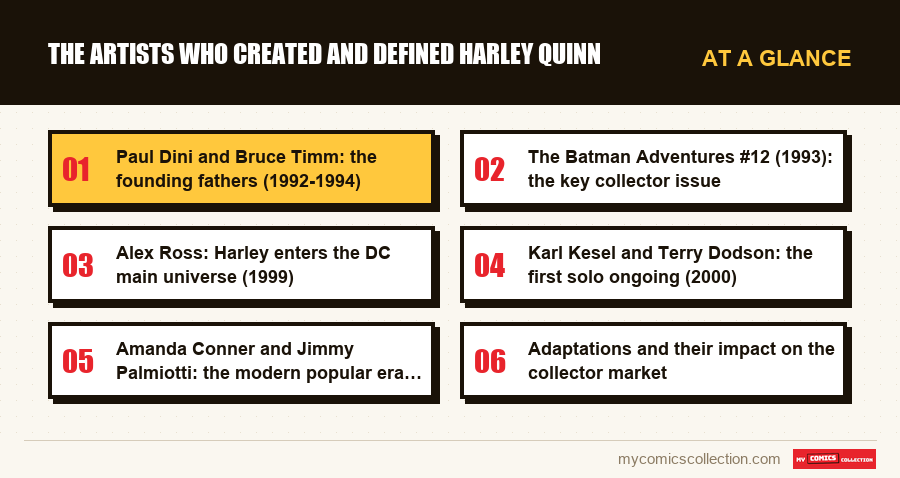
Paul Dini and Bruce Timm: the founding fathers (1992-1994)
Paul Dini was a writer and producer on Batman: The Animated Series; Bruce Timm served as its art director and executive producer. Together they conceived Harley Quinn as the Joker's comedic henchwoman, inspired by Dini's friend Arleen Sorkin: an actress best known for her role on Days of Our Lives. Timm drew on the visual language of the commedia dell'arte: the jester's cap, diamond-patterned costume in red and black, and domino mask. The design was deliberately streamlined for animation, yet instantly memorable.
Their collaboration reached its creative peak in February 1994 with The Batman Adventures: Mad Love, a one-shot published by DC in prestige format. Dini wrote the origin of Dr. Harleen Quinzel (a psychiatrist at Arkham Asylum who falls for the Joker, her patient) while Timm provided all the artwork. The result earned widespread critical acclaim and, in 1994, won both the Eisner Award for Best Single Story and the Harvey Award for Best Single Issue or Story: a rare double for a comic tied to an animated franchise. Mad Love has since been reprinted multiple times, testament to sustained demand. It remains the essential read for anyone wanting to understand the character's origins.
The Batman Adventures #12 (1993): the key collector issue
Harley Quinn's first comic book appearance comes in The Batman Adventures #12, published in September 1993, drawn by Ty Templeton and Rick Burchett in the continuity tied to the animated series. This issue is the Modern Age grail for the character. There is no Golden Age, Silver Age, or Bronze Age Harley Quinn: she simply did not exist before 1992. Collectors seeking a "vintage" copy of the character's debut start here.
The 2024 market places this issue in a clear bracket according to SellMyComicBooks: a CGC 9.8 regular copy is worth approximately $3,250, while the newsstand variant in CGC 9.8 reaches $5,280. Below CGC 9.0, copies remain accessible but lose value significantly at each step down. More than 9,000 copies are CGC-certified, a relatively high figure that limits absolute scarcity, but persistent demand driven by film and animated adaptations keeps high-grade prices firm.
Alex Ross: Harley enters the DC main universe (1999)
After seven years existing primarily within DC's animated universe line, Harley Quinn made her official entry into the mainstream DC continuity via Batman: Harley Quinn #1, published in October 1999. The script was again by Paul Dini; the painted cover was by Alex Ross. This prestige one-shot: 52 pages, cover-priced at $5.95: marked the character's formal crossing into canonical DC continuity.
By 1999, Ross was already one of the most respected artists in the medium, celebrated for his photorealistic painted work on Marvels (1994) and Kingdom Come (1996). His cover for Batman: Harley Quinn #1, an oil painting of the Joker and Harley dancing a tango, contributed to winning Ross the Eisner Award for Best Cover Artist in 2000, awarded collectively for his output that year. A signed and numbered variant was also produced, limited to 2,500 copies with a Dynamic Forces certificate: more sought-after, but difficult to value given sparse documented sales.
Karl Kesel and Terry Dodson: the first solo ongoing (2000)
In October 2000, Harley Quinn received her first monthly solo series, written by Karl Kesel and drawn by Terry Dodson and Rachel Dodson. The series ran until 2004 (38 issues) and reframed the character as an independent criminal in Gotham City, free of the Joker's shadow. It was a meaningful narrative shift: for the first time, Harley was defined on her own terms. Issue #1 is a collector's key as the launch of her first solo series, though it remains generally accessible at entry level.
Amanda Conner and Jimmy Palmiotti: the modern popular era (2013)
In 2013, DC's New 52 relaunch handed Harley Quinn a second solo series, written by Jimmy Palmiotti and co-plotted and drawn by Amanda Conner. The creative direction was a sharp departure from previous incarnations: a screwball tone, Harley as the landlord of a Coney Island building and part-time roller derby player. Conner co-wrote the series and provided many cover images, cementing a distinctive visual identity. The run lasted until 2016 (30 issues) and is today the best-selling collected edition run in the character's history. It is also the version that most directly influenced her portrayal in the DC Extended Universe films.
The first issue of Harley Quinn vol. 2 (2013) is not a collector's grail in the traditional sense, it was printed in large quantities, but signed variant covers and special editions from the 2013-2016 run are actively sought by Conner fans.
Adaptations and their impact on the collector market
Suicide Squad (2016), starring Margot Robbie as Harley, grossed $749.2 million worldwide on a $175 million budget. Birds of Prey (2020), centred on the character, totalled $205.5 million: below expectations, but enough to confirm Harley's viability as a solo cinematic lead. The adult animated series Harley Quinn (2019, voiced by Kaley Cuoco) is still in production with at least five seasons aired to date. Each new adaptation generates renewed collector interest in the origin keys, particularly The Batman Adventures #12 and Mad Love.
Own a Harley Quinn comic? Get a free valuation with our tool based on real eBay sales to find its low, median, and high value.
Frequently Asked Questions
It is The Batman Adventures #12, published in September 1993. The character was in fact born on screen in September 1992, in an episode of Batman: The Animated Series. That issue is now the character's main collecting key.
She came out of the collaboration between Paul Dini, writer, and Bruce Timm, art director of Batman: The Animated Series. She was meant to appear in a single episode, but her success with audiences sealed her future.
No. She is an entirely modern character, born in 1992, with no roots in the Golden, Silver or Bronze Ages. Her collecting keys start in 1993, and any listing claiming otherwise should be avoided.
The Batman Adventures: Mad Love, published in 1994 by Paul Dini and Bruce Timm, tells the origin of Dr. Harleen Quinzel. It won an Eisner Award and a Harvey Award, and remains the definitive reference on the subject.
The run by Amanda Conner and Jimmy Palmiotti (2013-2016) is the most popular, with a burlesque tone and best-selling collections. It also strongly influenced how the character is shown on film.