Doctor Strange was created in 1963 by Steve Ditko (concept and art) and Stan Lee (script), debuting in Strange Tales #110. No single author "owns" the character: each decade produced a creative duo that redefined the Sorcerer Supreme, from Ditko to Jason Aaron. The essential key issue remains Strange Tales #110 (July 1963), with a CGC 9.6 copy selling for $150,000 at Heritage Auctions in April 2024.
Doctor Strange is one of the rare Marvel characters whose visual mythology is inseparable from the artists who drew him. Stan Lee and Steve Ditko laid the foundation in 1963: psychedelic dimensions, impossible visual languages, mystical philosophy drawn from Beat culture. But it was the succession of creative duos (Englehart/Brunner, Stern/Rogers, Aaron/Bachalo) that transformed a Silver Age curiosity into one of the pillars of the Marvel Universe, adapted to film in 2016 ($677.8 million worldwide) and again in 2022 with Multiverse of Madness ($955.8 million worldwide).
This guide traces the editorial history of Doctor Strange through its successive creators. The market data cited: particularly the records for Strange Tales #110: come from Heritage Auctions and specialist sources (sellmycomicbooks.com, GoCollect). Our eBay estimator does not cover the Strange Tales , Doctor Strange , or Marvel Premiere series: no eBay median is therefore presented for these titles.
Stan Lee and Steve Ditko (1963-1966): the Silver Age foundation
Steve Ditko is the author of the original concept: he brought Stan Lee a five-page penciled story with a synopsis, and the character was named Doctor Strange because he appeared in Strange Tales. The first appearance came in issue #110 (cover-dated July 1963), as an eight-page backup feature behind the Human Torch. The origin was told two issues later, in Strange Tales #115 (December 1963): Stephen Strange, an arrogant surgeon, loses the use of his hands in a car accident, seeks out the Ancient One, and becomes Earth's mystical guardian.
What sets Ditko's work in this period apart from anything else Marvel was publishing is the aesthetic: hallucinatory dimensions evoking Salvador Dalí, impossible geometry drawn from Surrealism, a complete absence of muscle-bound costumes or fistfights. The Eye of Agamotto was designed by Ditko in reference to the Eyes of Buddha. For collectors, the keys from this era rank among the most expensive Silver Age issues on the market: a CGC 9.6 copy of Strange Tales #110 sold for $150,000 in April 2024 at Heritage Auctions: up from $60,000 for the same grade in 2017, reflecting structurally sustained demand. A CGC 9.6 of Strange Tales #115 (the origin story) sold for $16,730 in 2017.
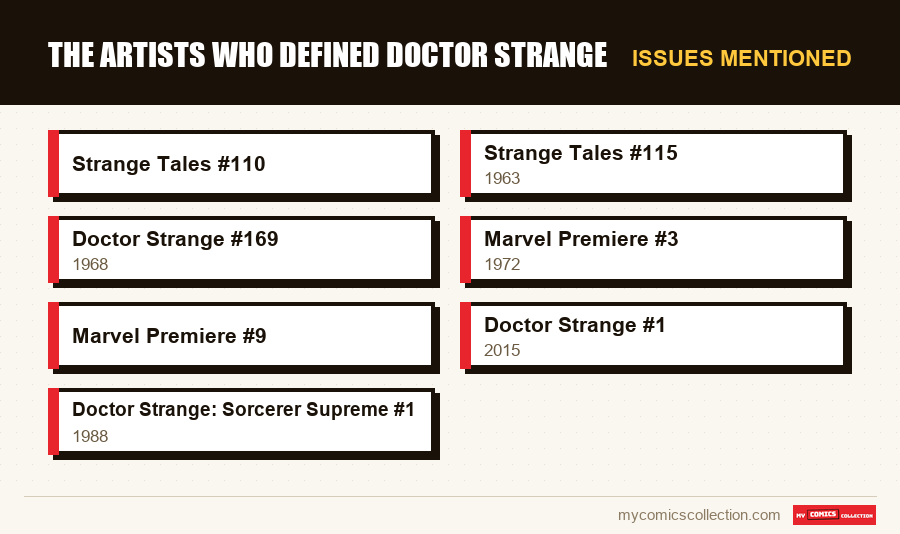
Key issue timeline by creator
| Issue | Significance | Creators | Documented record |
|---|---|---|---|
| Strange Tales #110 (Jul. 1963) | 1st appearance: Silver Age | Lee (script) / Ditko (art) | $150,000 (CGC 9.6, Heritage Auctions, Apr. 2024) |
| Strange Tales #115 (Dec. 1963) | Origin of Doctor Strange | Lee / Ditko | $16,730 (CGC 9.6, 2017) |
| Doctor Strange #169 (1968) | First solo title: late Silver Age | Roy Thomas / Dan Adkins | ~$7,800 (documented record) |
| Marvel Premiere #3 (1972) | Bronze Age return: 1st solo since 1969 | Lee (plot) / Barry Windsor-Smith | Not publicly documented |
| Marvel Premiere #9-14 (1973-74) | Englehart/Brunner run: Strange becomes Sorcerer Supreme | Englehart / Brunner | Not publicly documented |
| Doctor Strange vol.2 #1 (1974) | Bronze Age relaunch, 1st Silver Dagger | Englehart / Brunner | ~$1,295 (documented record) |
| Doctor Strange #1 (2015) | Modern Age relaunch | Jason Aaron / Chris Bachalo | Series outside tool scope |
Record sources: Heritage Auctions, sellmycomicbooks.com, GoCollect.
Steve Englehart and Frank Brunner (1973-1974): the run that changed everything
When Doctor Strange returned in Marvel Premiere starting with issue #3 (1972, Lee/Windsor-Smith), the series was still searching for its voice. It was with Steve Englehart on scripts and Frank Brunner on art, across issues #9 to #14 (1973-74), that the character found its definitive shape. Englehart introduced Shuma-Gorath, a Lovecraftian chaos entity from prehistory; more crucially, he orchestrated the death of the Ancient One at the master's own request, Strange must kill his teacher to prevent him from becoming a vessel for Shuma-Gorath, and Strange officially becomes the Sorcerer Supreme. That narrative promotion restructured everything that came after.
The duo continued on Doctor Strange vol.2 #1 (June 1974), which introduced Silver Dagger and featured the series' first black cover: exceptionally scarce in high grade. The Englehart/Brunner run's reputation has only grown: Comics Bulletin ranked it ninth in its "Top 10 1970s Marvels" list (2010). The Sise-Neg arc, in which a sorcerer travels back through time to the origin of the universe, and the editorial farce that followed (Englehart and Brunner fabricated a fake letter from a fictitious minister to circumvent a retraction order from Stan Lee) have become legendary moments in Marvel history.
Roger Stern (1981-1986): Doctor Strange in the main Marvel Universe
Roger Stern took over Doctor Strange vol.2 from issue #47 (1981), first with Marshall Rogers and then Paul Smith. His main contribution was anchoring Strange to the broader Marvel Universe without betraying the character's esoteric nature. Stern humanized Strange, involved him in major crossover events, and deepened the mythology of the Book of the Vishanti. His run culminated in Doctor Strange and Doctor Doom: Triumph and Torment (1989, illustrated by Mike Mignola): widely regarded as one of the finest stories ever written about the character. The Doctor Strange: Sorcerer Supreme #1 (November 1988), launched by Peter B. Gillis and Richard Case, extended the spirit of that era while giving Strange an official new title to carry.
Jason Aaron and Chris Bachalo (2015-2017): the modern era
The 2015 relaunch by Jason Aaron and Chris Bachalo coincided with pre-production of the MCU film and rested on a radical premise: magic exacts a real physical cost, and Strange permanently bears the scars of his incantations. Bachalo built a distinctive visual language (overlapping dimensional layers, typography integrated into panels, a kaleidoscopic palette) that makes the series immediately identifiable on a comic rack. The twenty-issue run (October 2015 to June 2017) received broadly positive critical reception, particularly its first nine issues, now collected in the Doctor Strange by Jason Aaron & Chris Bachalo Omnibus. For variant hunters, the 2015 #1 was published with thirteen cover variants, making it a particular target in the modern collector market.
Frequently Asked Questions
Steve Ditko for the concept and art, Stan Lee for the script, in 1963 in Strange Tales #110. No single creator "owns" the character: each decade saw a team of artists redefine him.
Strange Tales #110 (July 1963), his first appearance. His origin is told two issues later, in Strange Tales #115 (December 1963).
Steve Englehart and Frank Brunner's in Marvel Premiere #9-14 (1973-74). There Strange must kill his master, the Ancient One, at his request, and officially becomes Sorcerer Supreme.
Doctor Strange and Doctor Doom: Triumph and Torment (1989, drawn by Mike Mignola), regarded as one of the best stories ever written about the character. Stern had taken over Doctor Strange vol.2 from #47 (1981).
Because this Jason Aaron and Chris Bachalo issue came out with thirteen cover variants. The twenty-issue run was positively received by critics.
Own a Doctor Strange comic? Get a free valuation with our tool based on real eBay sales to find its low, median, and high value.