
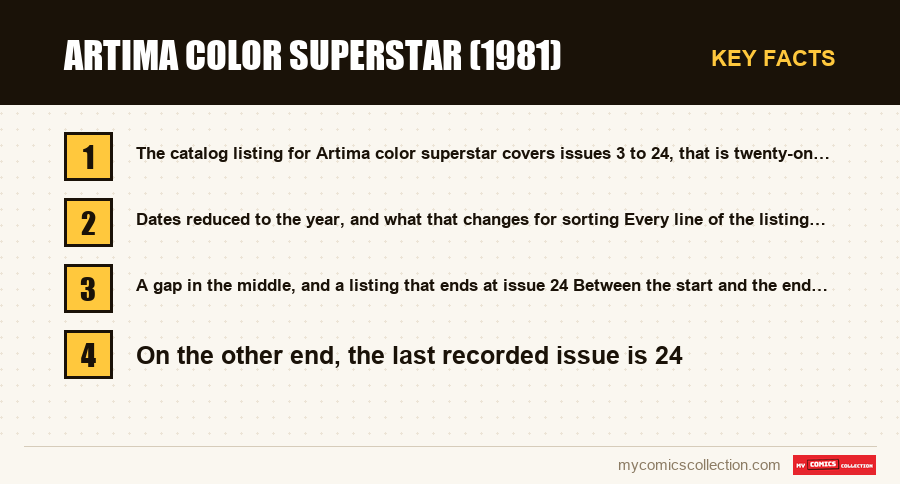
The catalog listing for Artima color superstar covers issues 3 to 24, that is twenty-one recorded booklets, all dated 1981 alone. The count stops there, and it leaves two early issues outside the listing. Each issue carries a unique story title, from "Le fils de Dracula" to "La Ligue de justice", with no regular rotation from one hero to another. For a collector, this means a checklist of gaps kept by issue number, never by character.
You have a stack of Artima color superstar on a shelf, and the question that comes back at every flea market is always the same: how many are missing, and how do you know which ones? With this magazine, the answer cannot be improvised, because the available listing is both precise about what it contains and silent about what it does not know. This article starts from that listing, measures it, and says where it stops.
As always on this guide, only verified information (creators, numbers, dates) is stated as fact; the analysis is our own, with no reproduction of panels or protected dialogue.
What the listing shows about the magazine's contents
The first reflex with this series is to read the story-title column before the number column. It tells something that no cover says: Le fils de Dracula, Les Vengeurs, Miss Marvel, Les Défenseurs, Le Manoir des fantômes, Docteur Strange, Les Micronautes, Thor, le fils d'Odin. Across nine consecutive ranks, the reader moved from a vampire tale to a team story, then to a short fable, then to pocket science fiction.
This is not a magazine built around a fixed hero, and that is the starting point of any buying strategy. A title like Black Canary and Batman sits alongside Captain America and La Ligue de justice: the characters come from two different American publishers, which rules out reasoning by universe. You cannot tell yourself "I'll take the issues featuring this group" and expect to cover a continuous range.
A second lesson: the fantasy anthology titles come under one banner but not under one pen. Le Manoir des fantômes appears twice in the listing, and the two entries do not carry the same writer's name. A collection organized as "a series within the series" therefore runs straight into the absence of editorial continuity: what recurs is a story format, not a serial.
The listing starts at issue 3, and what can be concluded from it
This is the main point of vigilance, and it must be stated plainly. The first recorded booklet carries number 3. The two ranks before it appear nowhere in the listing, neither with a story title, nor with a date, nor with a creator's name.
What this allows us to say: the listing is incomplete at its start, and any checklist of gaps built on it begins with an openly acknowledged blind spot. What it does not allow us to say: that there are no earlier issues, that they would be rare, or that they were distributed differently. A hole in a listing is a fact about the listing, not a fact about the printing press. Both hypotheses remain open, and neither can be settled from the available data.
The practical consequence is simple. If a seller offers you one of these early ranks, treat it neither as an exceptional piece nor as a numbering error: treat it as an issue to describe yourself, cover photo and contents in hand, because the catalog will not give you a reference to compare against. These blank areas are exactly where sellers' descriptions become creative.
Dates reduced to the year, and what that changes for sorting
Every line of the listing carries the same date value: the year 1981, with no month and no quarter. No date appears in square brackets, and none is approximated by a season. It is a uniform notation, and that is precisely what makes it hard to use.
For a collector, this has three concrete effects. First, it is impossible to reconstruct a publishing calendar from these data: nothing says whether the series was monthly, bimonthly, or published in tight batches. Second, a chronological sort of your issues can only be done by issue number, since all the dates are identical. Third, if you enter your collection into a tracking tool, the date field will not help you separate two copies: the number carries all the ordering information.
A gap in the middle, and a listing that ends at issue 24
Between the start and the end of the listing, a single interruption appears in the sequence of numbers: rank 12 is missing, although its two immediate neighbors are present with their story titles. An isolated hole in the middle of a continuous sequence looks very different from a hole at the start: it resembles a line dropped during data entry rather than a gap in publication.
On the other end, the last recorded issue is 24. Again, caution: the end of a listing is not the end of a series. If you come across a booklet bearing a higher number, it is not a fake; it is a piece the catalog does not yet cover. Record it, describe it, and consider your collection open beyond that rank.
The creators who recur, and their limits within the listing
The writers' names in the listing draw a more readable map than the titles do. Marv Wolfman appears on three booklets, the first and the last separated by eleven ranks: he opens the listing with Le fils de Dracula, returns on Requiem pour un vampire, then signs Powerman and Thunderbolt. Three distinct titles for a single pen: no other name in the listing spans as many different series.
Three other writers appear twice each. Roy Thomas signs both occurrences of the title Les Vengeurs. Christopher Claremont signs both Miss Marvel. David Anthony Kraft signs Les Défenseurs twice, and a third time under another title, Miss Hulk, which makes him, alongside Wolfman, the other name with three appearances. For a collector who collects by author rather than by character, these four names are the only profitable entries in the listing.
The other names appear only once or twice: Jim Starlin on Docteur Strange, Bill Mantlo on Les Micronautes, Steve Englehart on Captain America, Len Wein on Le Triomphe du crapaud, Gerry Conway on Thor and then on La Ligue de justice, Carl Wessler and George Kashdan on the anthology stories. One detail to know before searching: the spelling of the same surname varies from one line of the listing to another, with and without an intermediate letter. A search by exact name can therefore miss half of the results.
What the listing does not say about the contents
This needs to be stated very clearly, because this is where description errors are born. The listing gives a single story title per issue. A magazine of this format commonly published several episodes in the same booklet. Nothing guarantees, therefore, that Les Micronautes or Miss Hulk is the only story in its issue: it is the title retained in the catalog, not the table of contents.
Another limit, less visible: the field reserved for the artist is empty on every line. When several names appear, they are grouped in the same field as the writer's name, without distinguishing their roles. On the first booklet of the listing, three names coexist this way, including artists well identified elsewhere. You therefore cannot deduce from these data who wrote and who drew: you are reading a list of participants, not a distribution of credits.
Do you collect this series?
Track what you own, what you are missing and what your collection is worth. 7-day trial.
Start my trial →
Recognizing a copy and its number
Since the date does not settle anything, identification goes through the number and the story title. The pair is your control key: if a listing gives a number and a title that do not match what you have noted, one of the two is wrong, and it is almost always the number misread on a worn cover.
Get into the habit of checking the match before buying, on the ranks where the title is distinctive. Le Motard fantôme, La Marque sanglante, Le Triomphe du crapaud are titles unusual enough to serve as a signature. Conversely, Les Vengeurs, Miss Marvel, Les Défenseurs and Le Manoir des fantômes each recur on two distinct numbers: on those, the title alone does not tell you which booklet you hold, and a photo of the cover becomes indispensable.
One last point on reading titles. Several titles in the listing trail a cataloging tail, a creator's name attached to the title after an ellipsis. If you search for a booklet by typing the title alone into an ad-search engine, that tail can prevent a match. Search on the first two or three words of the title, never on the whole string.
Completing the series: a checklist of gaps in three zones
Organize your hunt in three zones, not one. The documented zone runs from the third to the twenty-fourth rank: there, you know exactly what you are looking for, because each number is tied to a title you can check against a photo. This is the part where a checklist of gaps works normally.
The head zone gathers the ranks before the first recorded number. You advance blind there, and your only tool is the physical copy. Treat these pieces as opportunity finds: you do not search for them efficiently, you recognize them when they pass by. Set up an alert on the magazine's name rather than on a specific number.
The high zone, beyond the last recorded rank, is approached the same way, with one favorable nuance: a seller holding a long run will often offer these numbers in the same lot. Buying a lot rather than single units is, moreover, the most rational strategy for a magazine with a mixed contents list, since duplicates can be resold to collectors of different characters, from She-Hulk to Ghost Rider.
What moves the value of this series
No amount will be given here, because it would depend on the month and the market. What is useful, however, is knowing which ratios matter. On this magazine, the first ratio is that of the issue to demand: booklets whose story title names a figure very much followed today trade better than their immediate neighbors, at comparable condition. A title such as Docteur Strange or Captain America attracts buyers who do not collect the magazine itself.
The second ratio is that of the lot to the single unit. A continuous run within the documented zone is worth more than the sum of its parts sold separately, because it spares the buyer the identification work this article describes. Conversely, an isolated copy from an undocumented zone sells poorly, not because it is common, but because the buyer does not know where to place it.
Keeping your collection without mixing up the boxes
A magazine whose issues all carry the same year calls for a particular entry discipline. In your inventory, make the number the single key, and treat the story title as a control field rather than an identifier, since at least four titles serve twice. Note separately, as a comment, the actual contents recorded on the copy: that is the information nobody has, and it will make your record valuable.
Finally, mark your three zones explicitly. A number absent from the documented zone is a gap; a number absent from the head or high zone is an unknown. Confusing the two means condemning yourself to search endlessly for a box that may not exist, or to overlook a very real booklet because it lies beyond the range you believed complete. Character hubs such as Batman or the Avengers can help you prioritize the ranks you are aiming for first.
What to keep in mind before buying
Artima color superstar is well documented in its central section and poorly documented at its two edges. The listing gives you a run of numbers tied to a story title and to the names of contributors, which is already more than most listings offer. It gives you neither a calendar, nor a full table of contents, nor a split of roles between writing and art.
The right collector's stance is therefore that of the cautious inventory: state what is legible on the booklet, flag what comes from elsewhere, and keep a written trace of the difference. That trace, built up over several dozen copies, is what eventually turns a pile of magazines into a collection.
Frequently asked questions
Because the two ranks before it carry no data in the listing: no title, no date and no creator. This indicates a gap in the listing, and nothing more. Nothing allows us to conclude that they would be unobtainable or that they never existed. An earlier copy is therefore described from the object itself, not from a reference record.
You cannot date it more finely from these data: every line carries the same year, with no month or quarter. The only source of a more precise date is the printed indicia on the copy. To sort your series, use the order of the numbers, which carries all the usable chronological information here.
Yes, and it is common in this magazine. Les Vengeurs, Miss Marvel, Les Défenseurs and Le Manoir des fantômes each recur on two distinct issues. The title alone is therefore not enough to identify a copy: require the number printed on the cover, or a photo sharp enough for you to read it yourself before concluding.
No. It retains one story title per booklet, whereas this type of magazine often published several stories in the same issue. The title indicated is a catalog entry, not a table of contents. The actual contents must be read from the copy, and few sellers bother to provide that information.
Not from these data. The artist field is empty on every line, and when several names are known, they are grouped with the writer's name without any distinction of role. You are reading a list of participants. To attribute the art precisely, you need the credits page of the copy or a separate editorial source.