Artima color, Marvel géant is a large-format collection launched by Arédit in 1979, at a time when another French publisher distributed most Marvel series in small format. The catalog records twenty-nine distinct booklets, spread over two overlapping numbering sequences: a number announced without a year therefore designates nothing precise. The contents are dominated by Conan and Hulk, alongside adaptations that have nothing superheroic about them.
You open a flea-market box and find a large color booklet, stamped with the word "Marvel", that looks like none of the small formats stacked at home for thirty years. The logo is not the one you expect, the paper is not either, and the number printed on the cover fits no series you know. It is probably an Artima color, and the difficulty starts there: this collection existed on the fringes of the usual circuit, with a numbering logic that still trips up sellers today.
As always on this guide, only verified information (creators, numbers, dates) is stated as fact; the analysis is our own, with no reproduction of panels or protected dialogue.
Marvel at Arédit: why it is an anomaly
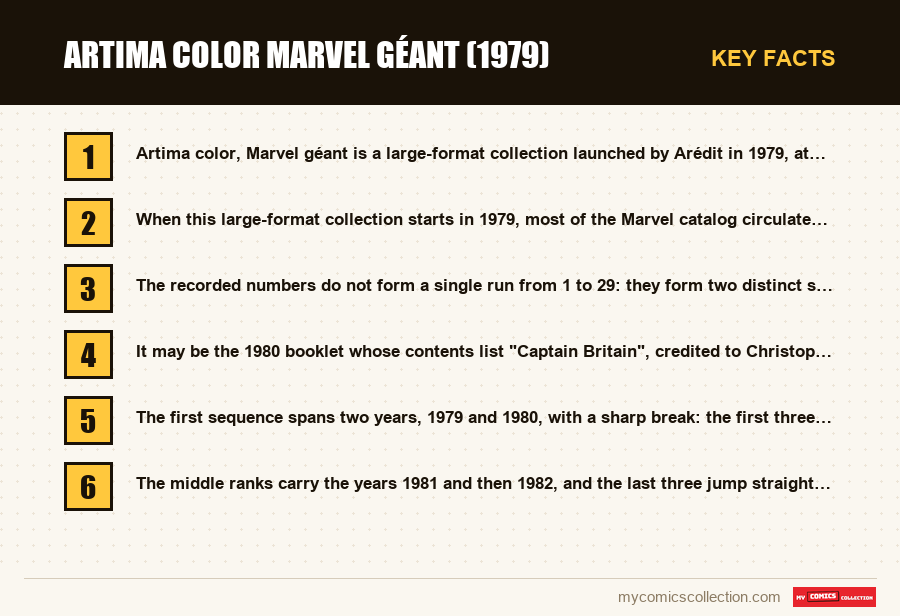
Arédit was not the house one naturally associates with American superheroes in France. Its catalog was built on the small format, the crime series, the newsstand booklet with fast turnover. When this large-format collection starts in 1979, most of the Marvel catalog circulates in French through another channel, in a pocket format well known to readers of the time. Seeing this same pool of characters resurface elsewhere, on large color pages, is closer to an industrial accident than to a readable strategy.
For a collector, this marginality has a direct consequence: these booklets do not appear among the mental reference points we built by sorting stacks of small formats. They have no natural place in a collection organized by series, since they extend no series. They form a separate block, often discovered by chance and poorly shelved.
What these booklets actually contained
The title promises Marvel, but the contents are broader than that. The story titles recorded in the catalog show a musical adaptation, "Sgt. Pepper's Lonely Hearts club band", credited among others to David Anthony Kraft and George Pérez, as well as a "Beatles story" in the booklet that precedes it. There is also a disaster-film adaptation, "Meteor", featuring Ralph Macchio.
In other words, the collection drew on the American publisher's output in the broad sense, including its adaptation series, and not only from its costumed pantheon. This is useful information when you are hunting for atypical booklets: some issues do not interest superhero collectors at all, and they trade with a completely different audience, that of illustrated music or genre cinema fans.
The rest of the contents lean toward heroic fantasy and brute force. Conan and Hulk come back more often than any other character, to the point of giving the second half of the collection an almost single-theme feel. A caution, however: the catalog retains only one story title per booklet, whereas a large format of that era could contain several. What is listed here is an entry point, not a complete inventory: the actual contents must be verified on the copy, page in hand.
The central trap: two numberings superimposed
This is the key point to remember before anything else. The recorded numbers do not form a single run from 1 to 29: they form two distinct sequences, one going up to the thirteenth booklet, the other restarting at a new first number and climbing to the sixteenth. The first thirteen ranks therefore exist twice.
The practical consequence: "Artima color Marvel géant number 5" does not designate an object. It may be the 1980 booklet whose contents list "Captain Britain", credited to Christopher Claremont, Herb Trimpe and Fred Kida, or the 1981 booklet titled "Hulk contre le cybortron", signed Doug Moench. Same number, same collection title, two unrelated booklets. If you buy at a distance on the basis of a number alone, you will receive one or the other at random.
The hygiene rule that follows is simple: in your own inventory, never record a number on its own. Always record the number plus the year, and if possible the story title on the cover. A spreadsheet whose "number" column contains the value 7 twice with no further detail is a spreadsheet that will get you to buy a duplicate.
A rhythm of waves, not a periodicity
The cover years trace an irregular publication pattern. The first sequence spans two years, 1979 and 1980, with a sharp break: the first three ranks carry the first year, the following ones the second. Nothing here resembles a monthly title: we are dealing with a logic of batches, grouped over a short period and then relaunched.
The second sequence stretches further and shows a gap. The middle ranks carry the years 1981 and then 1982, and the last three jump straight to 1984. No booklet recorded bears the year 1983. For you, this one-year blank means the last three numbers probably circulated under different conditions from the earlier ones, with a print run and distribution that no longer resemble the launch. Statistically, they are the hardest to find in good condition, and that is where any serious search should begin.
This irregularity also explains why no complete collection can be assembled by buying a retrospective year-set from a dealer: there is no "complete year" to buy in one block, since the years do not contain the same number of booklets.
The signatures that recur, and what they tell you
One name dominates the record: Doug Moench, credited on eleven booklets across both sequences combined, from the 1980 Hulk to "Un Paradis en enfer" in 1982. This massive presence is not an accident of selection: it indicates that the collection drew heavily on a single pool of stories, that of the publications where this writer was very active at the time. If his pages interest you, this collection is a full-fledged field of its own.
Roy Thomas comes second, present from 1980 to 1984, up to the booklet titled "King Conan". His appearances almost all coincide with Conan, and John Buscema is credited alongside him on several of them, with inkers who change, Tony DeZuniga here, Alfredo Alcala there. For a collector attentive to graphic finish, this detail matters more than the number: the inking completely transforms the look of the same starting team.
A methodological note is necessary. In the catalog, the credits of this collection are lumped into a single field, without separating who wrote from who drew. One reads "Christopher Claremont, Lee Elias, Dave Hunt" on the 1980 "Power-man" without the division of roles being given. Do not copy these lists as if they were firm attributions: take them as the list of people involved, and check the detail on the credits page of the copy when one exists.
Do you collect this series?
Track what you own, what you are missing and what your collection is worth. 7-day trial.
Start my trial →
Recognizing the edition you have in hand
The first reflex is to look for the year, not the number. If the cover or the inside fold shows 1979 or 1980, you are in the first sequence; 1981, 1982 or 1984 place you in the second. If no year is legible at all, the contents settle it: a booklet whose featured stars are exclusively Conan or Hulk almost always belongs to the second wave, whereas a musical or film adaptation can only come from the first period.
The second reflex concerns reprints. One booklet in the record, the thirteenth of the first sequence, carries the mention "2e éd." beside the name of Steve Englehart in its title. This mention is valuable: it proves that the collection went through at least one reissue identified as such. So systematically look, on the title page or on the spine, for an edition indication. Two visually identical copies can belong to two print runs, and only these small characters tell them apart.
The condition of a large-format newsstand booklet
The large format of this period combines two weaknesses. The cover, soft and wide, creases at the slightest poorly wedged vertical storage, and the saddle-stitched spine does not tolerate being opened flat. A copy that has been read several times almost always shows a vertical crease down the middle of the cover and a slight gaping of the staples.
The interior paper yellows. This is not a disqualifying defect; it is the norm for this type of production: a copy with perfectly white paper should even raise your suspicion, either because it was kept in exceptional conditions or because it is something other than what the listing claims. What really lowers the value are water stains, corner losses and tears that cut across a panel.
Finally, watch the staples. On these wide formats, rust from the staples stains the central fold and eventually weakens the signature to the point where it comes loose. Check this fold before anything else: a booklet whose central signature moves freely is no longer a collector's copy, it is a reserve of pages.
Buying traps
The number one trap remains the double numbering, and it shows up mainly through omission. A listing that gives the collection title and a number without a year is not necessarily lying, but it tells you nothing. Ask for a photo of the full cover and, if the seller agrees, a photo of the fold where the date appears.
The second trap is the lot sold as a "complete series". Given the structure of the record, real completeness means assembling both sequences, so twenty-nine objects, not thirteen or sixteen. A lot presented as complete when it stops at a single thirteenth number is at best a complete sequence, which is already respectable, but it is not the collection.
The third trap comes from the publisher's neighborhood. The house produced many booklets under similar titles, with layouts from the same graphic family. It is easy to sell, and to buy in good faith, a booklet from the same stable believing you are completing this one. The only check that matters is the exact wording of the collection title, read in full on the cover, not the mere family resemblance of the banner.
Completing the series without exhausting yourself
The most effective strategy is to reverse the natural order. Do not start with the first numbers, which are the most visible and therefore the most sought after: start with the three booklets from 1984, isolated after a year with no publication, because they will decide whether the collection is achievable within your budget and your patience. If you never see them come up, you should know it before buying the rest.
Then work by wave rather than by number. A complete sequence from 1979 to 1980 is a coherent set, recounting the period when the collection was still searching for its content, between adaptations and superheroes. The second wave, centered on Conan and Hulk, tells a different story. The two are collected separately, and there is no shame in aiming for only one of them.
Finally, watch general sales rather than specialist comics listings. These booklets surface mostly in lots of newsstand comics, because their category is ambiguous.
The price today, and how to track it
The value of these booklets rests on three factors, which operate in this order: the real scarcity of the rank concerned, the condition of the central fold and of the cover, and the presence of content sought by an audience outside comics. An adaptation booklet in music can thus outpace in demand a superhero number that is harder to find, simply because it interests two markets instead of one.
To track this without fooling yourself, reason in ratios rather than absolute values. Note what you see come up, and compare a worn copy with a clean copy of the same rank: the gap you observe is worth more than any price guide, because it captures the actual state of the French market for an object this obscure. Keep this record over several months, since a rarely circulated collection produces transactions too sparse for any single sale to serve as a reference.
And record in your inventory what the market will not tell you: the year, the edition mention, the story title. These three fields are what will make the difference in five years between a usable list and a list of ambiguous figures. To keep this trail without a homemade spreadsheet, a structured per-copy record will spare you from buying again what you already own.
Frequently asked questions
The catalog records twenty-nine distinct booklets. That figure is surprising because the numbers never climb that high: the collection has two numbering sequences, one short and one longer, whose first thirteen ranks carry the same digits. A lot of sixteen booklets is therefore not complete, even though the printed numbering may suggest it is.
Look for the year before the number. The years 1979 and 1980 designate the first wave, 1981 and later the second. If no date is legible, the contents help: a music or disaster-story adaptation belongs to the first period, while a booklet devoted entirely to Conan or Hulk almost always belongs to the second.
The recorded years jump from 1982 straight to the last three booklets dated 1984, with nothing in between. The reasons for this interruption are not visible in the data, and sources disagree on the editorial history of this collection. What is certain is the effect for you: the issues after the break are the most difficult to find in good condition.
No, and this is a limit to be aware of. Only one story title is retained per booklet, whereas a large format of that period could list several. The title given identifies the object; it does not tell you its full contents. To know what your copy really contains, open it and note each episode.
It indicates a reprint, and the record attests to at least one in the first sequence, on a booklet linked to Steve Englehart. This mention changes the nature of the object without always changing its appearance. Make a habit of reading the small print on the title page and the spine before concluding that two identical copies are really the same print run.