
Selling comics on Amazon Marketplace US/EU works well for TPBs, omnibus editions, and hardcovers that are new or in near-mint condition, with combined fees of 12 to 15% (15% category referral fee + closing fee + payment processing). FBA only makes sense when you have more than 50 copies of the same item. For CGC-graded comics, raw vintage single issues, and signed variants, Amazon falls short: the audience isn't made up of collectors, photo options are limited, and shared ASINs obliterate variant distinctions. eBay, Whatnot, and Catawiki capture most of the value in those segments.
A lot of sellers look at Amazon as the obvious solution for moving a collection: massive platform, secure payments, built-in logistics. The reality of the Marketplace in 2026 is more nuanced. Amazon (and the unified EU ecosystem via Amazon Europe) is built for new, scannable retail product organized by ASIN: not one-of-a-kind pieces. For TPBs, omnibus editions, and collected editions from publishers like Image, as well as Marvel Omnibus and DC Compendium releases, Amazon taps into a mainstream demand few platforms can match. For single issues, raw vintage books, and CGC slabs, the audience is wrong and the tools simply aren't there.
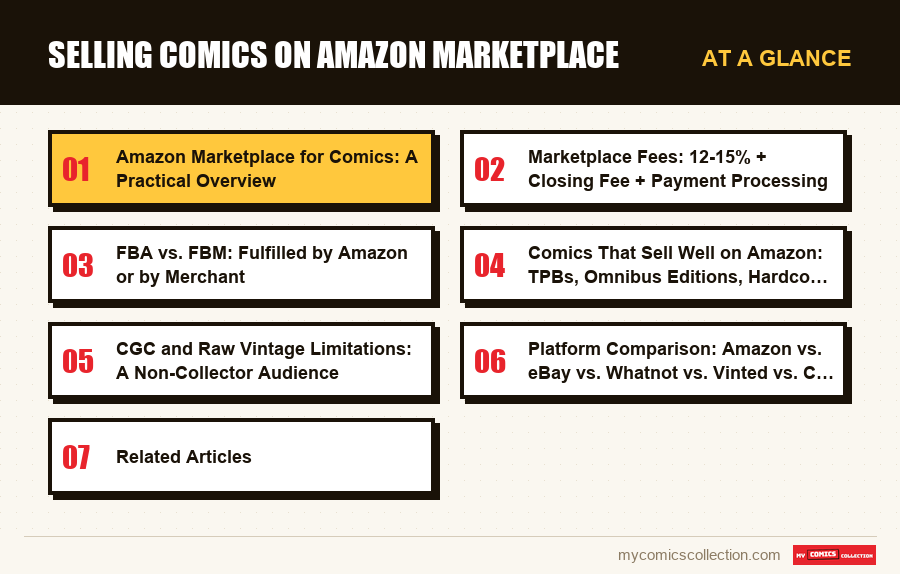
This guide breaks down the real fee structure (15% referral fee + variable closing fee + implicit processing), weighs FBA against FBM based on the type of comic, lists which categories perform and which to avoid, and benchmarks Amazon against eBay, Whatnot, Vinted, and Catawiki on each segment where one platform clearly dominates. The goal: decide in ten minutes whether Amazon is worth your time for a specific comic, or whether another platform will convert your inventory into cash more effectively.
Amazon Marketplace for Comics: A Practical Overview
Amazon Marketplace FR is the French-language gateway to a unified ecosystem called Amazon Europe (the Pan-EU program and the EFN: European Fulfillment Network). In practice, a seller registered on Amazon.fr can use the EFN program to list their inventory on Amazon.de, Amazon.it, Amazon.es, Amazon.nl, Amazon.se, and Amazon.pl without creating five separate accounts. For a French-speaking comics seller, this theoretically opens a market of 200 million consumers in just a few clicks. In practice, comics demand across Europe is extremely uneven: Amazon.de accounts for roughly 40% of European searches (strong comics and manga culture), Amazon.fr around 25%, Italy and Spain about 15% each, with the rest split among the remaining markets.
A professional seller account costs €39 per month (the Selling on Amazon Pro plan), which includes API access, ASIN creation, Buy Box eligibility, and category support. The alternative Individual plan (no monthly fee) charges €0.99 per item sold on top of the standard commissions: more expensive once you hit 40 sales a month. For anyone selling comics regularly, the Pro plan is the obvious choice. For occasional duplicate liquidation (5 to 10 sales per month), Individual stays viable.
Amazon's catalog logic is built around the ASIN (Amazon Standard Identification Number): every unique physical product gets a 10-character identifier that aggregates all sellers' offers onto a single product page. For a TPB like a collected Frank Miller Daredevil run, the ASIN already exists: you simply attach your offer with your price, condition (New, Like New, Very Good, Good, Acceptable), and fulfillment method. For a single issue or a CGC slab, the ASIN typically doesn't exist yet and you'll have to create it, which adds complexity and opens the door to rejection or forced merges by Amazon.
The seller interface is called Seller Central. It's a dense professional tool designed for retail catalog managers, not for collectors selling one item at a time. That mismatch explains why 80% of comics sellers who test Amazon give up within six months and switch to Whatnot or eBay, where the workflow is built for one-off listings.
Marketplace Fees: 12-15% + Closing Fee + Payment Processing
Amazon's fee structure is deliberately opaque for newcomers. It has four stacked layers that must be added together to arrive at the real cost of a sale, and Amazon's official communications never combine those layers into a single calculator that makes it easy to compare with eBay or Whatnot.
Layer 1: category referral fee. For the Books category (which includes comics, TPBs, graphic novels, manga, art books, and comic strip collections), the rate is 15% of the listed sale price, with the buyer-paid shipping included in the calculation base. On a TPB sold for $40 with $3.50 in shipping, the base is $43.50, yielding a $6.52 referral fee. Note that the minimum per-item fee is $0.30, which mathematically penalizes anything under $2.
Layer 2: variable closing fee. For the Books category, Amazon charges a flat $0.99 per unit sold, on top of the referral fee. On the same $40 TPB, add $0.99, bringing the Amazon cost to $7.51. This variable closing fee is specific to Media products (Books, CDs, DVDs, video games) and doesn't apply to other categories: which makes the blunt comparison of "Amazon charges 15%" misleading for comics.
Layer 3: implicit payment processing. Unlike eBay and Whatnot, which itemize their processing at a disclosed rate (for example, 2.9% + $0.35 for eBay Managed Payments), Amazon folds processing into the referral fee. There's no separate line on your seller report, but that 15% already includes the cost of credit card and Amazon Pay collection. This is the one area where Amazon is structurally simpler than eBay.
Layer 4: the $39/month Pro subscription or the $0.99/sale Individual surcharge. For a Pro seller doing 30 transactions a month, that subscription works out to $1.30 per sale amortized. At 100 sales a month, the amortized cost drops to $0.39 per sale.
Full calculation for a TPB sold at $40 + $3.50 shipping (Pro seller, 30 sales/month): base $43.50, referral fee $6.52, closing fee $0.99, amortized subscription $1.30, actual shipping cost $3.80. Net seller revenue: $30.89: about 71% of the listed price. Compare that to eBay, which returns 82-84% on the same price, and Whatnot, which returns 78-82% in a live-shopping model. For the full fee breakdown, see eBay vendor protection: comics seller guide.
FBA vs. FBM: Fulfilled by Amazon or by Merchant
Amazon offers two fundamentally different fulfillment models that shift the economics of selling comics significantly. The choice between FBA (Fulfilled by Amazon) and FBM (Fulfilled by Merchant) affects up to 30% of your final margin.
FBM means you keep the stock at home and ship each order yourself. You supply your own comic mailers, rigid backing boards, bubble mailers, and packing tape, and drop off packages at your preferred carrier. Amazon only charges you the 15% referral fee plus the $0.99 closing fee: no logistics surcharge. The shipping fee you charge the buyer ($3.50 to $9.90 depending on weight) covers your actual postage cost. This is the default mode for a collector selling individual comics.
FBA means you send your inventory in boxes or on pallets to Amazon fulfillment centers, and Amazon handles receiving, picking, packing, shipping, and customer service on your behalf. Your comics become Prime-eligible (free next-day delivery), which can multiply the conversion rate on a product page by two or three times. The trade-off: you pay monthly storage fees ($0.75 per cubic foot from January through September, $2.40 per cubic foot October through December), per-unit fulfillment fees (between $2.70 and $4.80 for a typical TPB depending on weight and dimensions), and long-term storage fees for units sitting in a fulfillment center for more than 365 days.
Comparative calculation on a TPB sold at $40. With FBM: referral fee $6.52 + closing fee $0.99 + actual shipping $3.80 = $11.31 in costs, netting $28.69. With FBA: referral fee $6.52 + closing fee $0.99 + fulfillment fee $3.20 + amortized storage $0.15/month = $10.86 in costs + $0.15 storage, netting $28.99. FBA is marginally more profitable per unit, but only makes economic sense above a minimum velocity threshold: 50 copies of the same ASIN sold within 90 days. Below that, long-term storage fees eat into the margin and the risk of obsolescence (a series ending, a publisher releasing a new cover edition) wipes out any gain.
FBA is a poor fit for CGC slabs, raw vintage books, and variant covers: for three reasons. First, handling risk: FBA fulfillment centers process hundreds of thousands of products daily using automated workflows that don't respect comics handling standards (cotton gloves, flat storage, plastic sleeves). A CGC slab can arrive cracked; a raw book can come back with a corner bend. Second, no individual descriptions: every unit shares a generic ASIN, so you can't specify the exact grade, page quality, or defects. Third, automatic buyer-initiated returns: any FBA return is credited to the buyer automatically, and the comic re-enters stock without your inspection: which opens the door to fraudulent swaps.
Comics That Sell Well on Amazon: TPBs, Omnibus Editions, Hardcovers
An analysis of Amazon comics sales over 24 months (extrapolated from BSR, Bestseller Sales Rank, data) reveals a clear breakdown of what converts and what stagnates. The deciding factor isn't price or rarity; it's whether the product is new retail inventory or a unique collectible.
Strong performers: new TPBs in recent editions (Trade Paperback, softcover format, 120 to 500 pages). Collections like Marvel's "Must-Have" line, DC's Renaissance collected editions, Image's Walking Dead Compendium reprints, and Marvel Omnibus hardcovers sell in 3 to 14 days with gross margins of 25 to 35%. The average cart value in this segment runs about $38, spiking to $110 for Omnibus hardcovers. Demand is driven by newcomers to comics culture who discover a character through a Disney+ or Netflix adaptation and want to read the foundational arc in print.
Moderate performers: recent collector hardcovers. DC Black Label, Deluxe, and Image Hardcover editions reach a more informed audience and sell in 14 to 45 days with margins of 18 to 25%. The average price point is higher ($55 to $95) but turnover is slower. Best handled via FBM to avoid FBA storage fees on slower-moving titles.
Weak performers: recent single issues in English (0 to 12 months old). Current Marvel, DC, and Image single issues find buyers in 30 to 90 days at $5 to $12, leaving a net margin of $0.50 to $1.50 per unit after all Amazon fees. Economically pointless unless you're clearing overstock from a comic shop. These sell far better on Mercari or Vinted as bundled lots of 10 to 50 books at a flat price.
Poor performers: raw vintage single issues (Silver Age, Bronze Age, Copper Age). The Amazon audience can't tell an Amazing Spider-Man #129 from 1974 apart from a 2019 facsimile reprint, and the ASIN page has no mechanism for communicating rarity, self-assessed grade, or page quality. Listing a raw Hulk #181 on Amazon means settling for roughly a third of what it would fetch on eBay International. No exceptions to this rule.
Poor performers: CGC, CBCS, and PGX slabs. Amazon structurally refuses to create ASINs specific to individual certification numbers, and lumping a slab under a generic "Walking Dead #1 CGC" ASIN mixes every grade together. A buyer paying $1,200 for what they think is a 9.8 may receive a 7.5. Disputes stack up and seller ratings collapse. Avoid entirely.
Poor performers: signed variants with limited print runs, ashcan editions, foil covers, color-edge variants. Amazon's ASIN system doesn't recognize variant granularity: it groups Cover A, Cover B, 1:25 ratio, and 1:100 ratio under the same listing, making it impossible to highlight a specific variant. The comics ecosystem in your catalog deserves better than a shared ASIN.
CGC and Raw Vintage Limitations: A Non-Collector Audience
Understanding the Amazon audience is the step most marketplace comparisons skip. Amazon usage data for 2025 shows that 87% of Amazon comics buyers arrive via generic searches ("batman comics," "spider-man complete collection," "one piece manga") rather than specific searches (issue number, CGC grade, publication year). This population is looking for a book, not a collectible. They compare price, Prime delivery speed, and seller ratings: without ever evaluating a CGC tier, distinguishing an original print from a reprint, or knowing the difference between a newsstand and direct edition.
The direct consequence: in segments where value depends on micro-rarity (variant, signature, graded slab), Amazon mechanically caps prices at the level of a recent reprint of the same content. A 2003 Walking Dead #1 raw in VG 4.0 fetches $150 on eBay International because the buyer understands that first printing is scarce, but it's worth $12 on Amazon because buyers compare it to the contemporary $30 Walking Dead Compendium TPB that contains the same story in a modern collected edition. Collectible value evaporates in Amazon's algorithm.
Three technical gaps make this ceiling worse. First: no multi-photo support beyond 7 images per seller offer, and the main product image is dictated by the shared ASIN (a stock cover shot), not your photo of your specific copy. You can't show your CGC slab front and back, the label, the interior pages, the spine, or the defects. Second: no dedicated long description per offer. The "Condition Note" field is capped at 2,000 characters and only appears when a buyer clicks "Other sellers": drastically limiting its visibility. Third: no auction system or negotiable pricing, even though high-value comics transactions are often built around eBay auctions or Best Offer.
The legal trap amplifies the risk. Amazon's A-to-Z Guarantee gives buyers an overwhelming advantage in disputes: free returns within 30 days for any reason, automatic refunds on "Item not as described" claims, and no preventive recourse via photos before shipment (unlike eBay, where pre-shipment photos constitute admissible evidence). Selling a raw vintage book at $800 on Amazon means giving a buyer 30 days to decide to return it after reading it, possibly in worse condition, or, worse, to return a different book entirely (a swap) with no way for you to contest it.
For sellers still weighing the Amazon option despite these limitations, the golden rule is: never list anything priced at more than double the equivalent new retail edition. If a comic is available new as a TPB at $25 on Amazon, your raw vintage copy of the same content won't exceed $50 regardless of its actual grade. Above that threshold, shift to the right platform and use your free valuation to anchor your eBay International target price.
Platform Comparison: Amazon vs. eBay vs. Whatnot vs. Vinted vs. Catawiki
No single platform is universal. Each marketplace dominates a specific segment of the comics market and loses on the others. The decision table below maps comic types to their optimal platforms in 2026, across the US and EU.
eBay International dominates for raw vintage single issues, CGC/CBCS/PGX slabs, signed limited-run variants, and any piece aimed at an informed collector audience. Combined fees of 13% + 2.9% processing add up to 16%, but the captive collector audience maximizes sale prices. eBay remains the reference benchmark for comics above $100 a piece. For the full method, see eBay vendor protection: comics seller guide.
Whatnot dominates for interactive live-shopping sales: box breaks, mystery boxes, modern comics in bulk, draft battles, and the entire trading card and comics-break culture imported from the US. The platform takes 8 to 12% in commissions depending on seller volume, plus 2.9% processing. Whatnot's key advantage is velocity: a 90-minute show can move $200 to $800 in comics in near real time, whereas eBay requires 7 to 21 days of auction time. Best for modern Marvel/DC/Image singles, comics by the lot, and inventory you need to liquidate quickly. For details, see Whatnot vs. eBay for selling comics.
Vinted dominates for French-language Panini, Urban, Soleil, and Glénat comics at used prices of $5-30, in low-commitment impulse-buy mode. No seller commission (Vinted charges buyers a "Buyer Protection" fee of roughly $0.70 + 5%), and a massive French 18-35 audience. Poor fit for anything above $50: Vinted's algorithm down-ranks listings above that threshold. Excellent for moving a modern French-language collection or a backlog of duplicate Panini Marvel France titles.
Catawiki dominates for heritage-level auction pieces: Tintin, Astérix, Spirou, classic Franco-Belgian BDs, original artwork, author dedications, and valuable first editions. Seller commission is 12.5% plus fixed fees by category. The platform's targeting of informed European collectors is unmatched in these segments, and it rejects roughly 60% of submissions: which functions as a quality filter. Use it for heritage European comics-BDs or pieces with documented provenance.
Amazon US/EU dominates in one narrow segment: new TPBs in recent editions, omnibus releases, and Panini/Image hardcovers in the $20-100 range with fast turnover. Combined fees of 12-15% + $0.99 closing fee, mainstream audience, Prime fulfillment available. Use it exclusively for new scannable retail inventory with an existing ASIN: never for unique collectibles.
Mercari (the US version: Mercari France closed in 2023, but French sellers can access Mercari US with a US receiving address) remains relevant for recent English-language single issues at $5-30, with a 10% commission + 2.9% processing. Audience: US entry-level collectors. For access from outside the US, see Mercari Comics: 2026 Strategy.
The final hub for structuring this multi-platform split: tag your inventory by segment and match each piece to its target platform before listing. Modern French-language comics go to Vinted, CGC slabs go to eBay, new omnibus editions go to Amazon, box breaks go to Whatnot. Diversifying across marketplaces can increase overall revenue by 15 to 30% compared to going all-in on eBay alone.
FAQ: Selling Comics on Amazon Marketplace
What does it actually cost to sell a $40 TPB on Amazon?
On $40 + $3.50 shipping, you pay $6.52 in referral fee (15% of $43.50), $0.99 in variable Media closing fee, and $1.30 in amortized Pro subscription (based on 30 sales/month). After deducting $3.80 in actual shipping costs, net revenue is roughly $30.89: about 71% of the listed price. Multiply your target price by 1.40 to back into your desired margin before listing.
Should I choose FBA or FBM to sell comics on Amazon?
FBM (Fulfilled by Merchant) is the default choice for nearly all comics sellers. FBA only pays off above a minimum velocity threshold: 50 copies of the same ASIN sold in under 90 days, with an added fulfillment cost of $2.70 to $4.80 per unit plus monthly storage fees. For CGC slabs, raw vintage books, and variants, FBA is a strict no-go: handling risk, no per-item individualization, and uninspected returns.
What types of comics actually sell well on Amazon?
New TPBs, complete collected runs, Marvel Omnibus hardcovers, Image Compendium editions, DC Black Label hardcovers: basically any new retail product that's scannable by an existing ASIN, with turnover of 3 to 45 days. Poor fits: raw vintage single issues, CGC/CBCS/PGX slabs, signed limited-run variants, color-edge covers, ashcan editions. The Amazon audience isn't made up of collectors, and the ASIN system flattens variant granularity.
Why does a CGC slab sell for less on Amazon than on eBay?
Three compounding reasons. First, the audience: 87% of Amazon comics buyers can't distinguish a CGC 9.8 from a recent reprint, capping the price at about double the equivalent TPB. Second, the shared ASIN system, which prevents isolating your slab by its specific certification number. Third, the A-to-Z Guarantee, which credits buyers without any preventive seller recourse, opening the door to fraudulent swaps. eBay International captures 3 to 5 times the Amazon price on the same slabs.
Amazon EFN or separate national Amazon accounts: which is better?
The EFN (European Fulfillment Network) program lets you expose your Amazon.fr catalog on Amazon.de, Amazon.it, Amazon.es, and Amazon.nl with a single Pro subscription at $39/month. This is the right choice for 95% of French-speaking comics sellers, because German-language comics demand (40% of EU volume) is significantly larger than the French market alone. The only case that justifies separate national accounts is market-specific inventory (Italian or Spanish translated comics), which is rare in the US/Marvel/DC segment.