The series launched in 1986 around Cyclops was not designed to tell something new: it was designed to cancel an earlier decision, the withdrawal of a character that the publisher had made disappear a few years earlier. A series that exists to undo inherits a debt that it will never repay: to justify the return, to spare the readers who considered the disappearance to be a summit, and to exist on its own: the third obligation always comes after the other two. The market keeps track of it. On eBay, as of August 29, 2026, there were 84 uncertified listings between $0.99 and $450.00, median at $7.00, compared to only 4 certified listings, from $109.99 to $608.94. Four graded copies out of eighty-four advertisements: the certified segment is almost non-existent, and no median calculated on four lines supports the slightest conclusion.
There is a category of series that critics have never really been able to name and which collectors nevertheless recognize at first glance: repair series. They are not born from an idea, from a tone, from an author who has something to say. They arise from a commercial or editorial problem to be resolved, and the first issue comes out with, already written in its specifications, the task of erasing a page written elsewhere. The one that concerns us here belongs to this category in an almost caricatured way. Launched in 1986, it was built on the return of a figure that the publisher had removed from the board a few years earlier, and this return was not one episode among others: it was the reason for the title, its starting point and its promise.
Cyclops is at the center of this operation without being the object. This is where the story becomes interesting for those interested in editorial mechanics rather than plot summaries. The character didn't ask for anything; he is not the one who returns; his personal life, as it had been patiently established in previous years, finds itself rewritten by a decision that does not concern him. A reader who had followed the character for a long time woke up with a new situation that no internal development of the character had prepared for. This is the ordinary fate of those who surround a ghost: their position changes, and they have nothing to do with it.
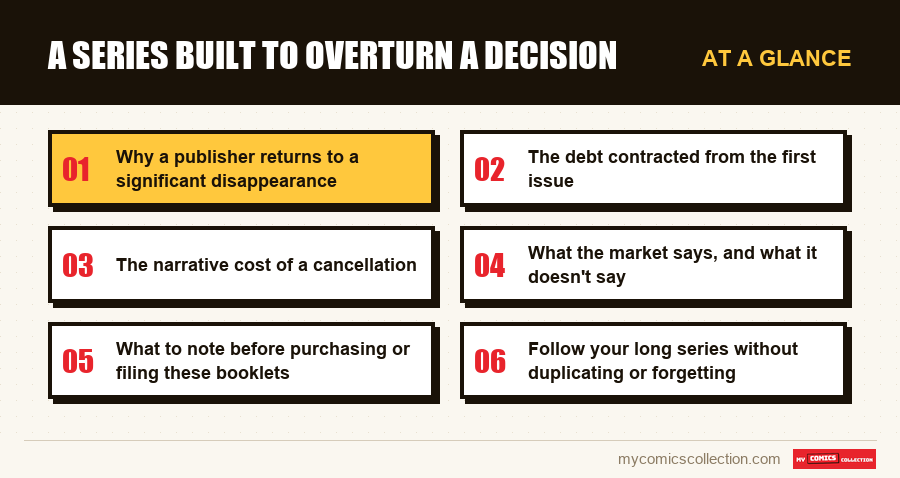
Why a publisher returns to a significant disappearance
The first reason is accounting before being narrative. A figure removed from play is a fixed asset. It has a recognized name, a stable iconography, a place in the memory of readers, and it no longer produces anything: neither regular series, nor participation in collective events, nor derivative product worth making. A publisher doesn't like fixed assets. He tolerates a certain number out of respect for consistency, then, thanks to a change of team, a need to launch or an anniversary, he reactivates one. The calculation is simple: the return creates an event, the event creates a peak in orders, and the peak in orders alone justifies the first number. What comes next is another problem, which no one resolves at the moment of decision.
The second reason is acoustic. The readership that demands a return is infinitely louder than those that oppose it. Those who considered the disappearance to be a summit do not sign petitions: they are satisfied with a closed story, and a closed story does not produce letters. Those who want the return write, count themselves, gather, and give the editor the misleading impression of a unanimous request. The request is not unanimous; it is simply audible. An editorial decision taken on this signal systematically confuses intensity with representativeness, and delivers a series which pleases a fraction of the public while annoying another, without anyone having ever measured the two.
The debt contracted from the first issue
Justifier le retour
A series of reparations must explain how what was supposed to be irreversible was not. This explanation takes up space, dialogue, entire pages, and it cannot be conveyed without giving the reader the feeling that they are being made fun of. It therefore consumes the beginning of the title: precisely the moment when a new series should establish its own voice.
Sparing the faithful of the undone story
Part of the public considered the disappearance to be the culmination of everything that had preceded it. The series must therefore cancel this disappearance without seeming to despise it. She multiplies the precautions, the homages, the prudent formulations, and each precaution reminds the reader of what he is losing.
Exister par elle-même
The third obligation is the only one that would make a good series, and it's the one that comes last. The available editorial time was absorbed by the first two. When the series finally gets to the question “what are we talking about now?” ", the readers who came for the event have already left and those who remain read out of habit.
Relocate surrounding characters
The return redistributes the situations of all those who gravitated around the deceased. Cyclops is the textbook case: his personal situation is recast by a decision external to him. The series has to deal with this collateral damage, and dealing with it still costs pages that no proper story will occupy.
These four obligations do not add up: they contradict each other. Justifying the return requires emphasizing the flaws of the previous story; To spare the faithful of this story means treating it with a grain of salt. Relocating the surrounding characters requires making a decision; existing on your own requires time. A series launched under these conditions does not fail for lack of talent. She fails because she was asked, from the cover design of the first issue, to solve an equation whose terms exclude each other.
What distinguishes a repair series from an ordinary series is not its quality but its dependence. It cannot be evaluated alone: its first arc only makes sense in reference to a story published elsewhere, often years earlier, and often by another author. A reader who arrives without this context reads a series which speaks a language for which he does not have the lexicon.
This dependence also explains why these titles age poorly in recommendations. We don't advise anyone to start with an answer. He is advised to start with the question: that is, with the narrative that the 1986 series was intended to undo.
The narrative cost of a cancellation
The defeated narrative retroactively weakens
A canceled disappearance ceases to be a disappearance: it becomes an interval. Everything that the earlier story derived from its finality-the gravity, the mourning, the consequences for others-loses its basis. The published text has not changed a word, but its scope has been downgraded by a decision taken after it.
The reader learns that nothing is final
This is the most lasting and most rarely calculated effect. Once a major comeback has occurred, the reader stops believing in subsequent ones. Each subsequent disappearance will be read as a pause, and the editor will have to spend ever more to produce the same dramatic effect.
The series bears a label that it did not choose
Whatever its real content after a few years, the title remains identified with the operation which gave rise to it. The discussions invariably bring him back to his starting point, and his good pages, if he has any, are absorbed by the reputation of his reason for being.
Draws follow the event, not the series
The first issue is ordered on the promise of return. The following ones are ordered on the sales of the first. The second-hand booklet market today retains the traces of this boom: many copies in circulation, very few rarities.
Neighboring characters become variables
Cyclops is the illustration of this. His personal situation is modified not by an evolution of the character but by the arrival of another. He becomes an adjustment variable in an operation of which he is not the subject, which makes his trajectory difficult to summarize honestly to a new reader.
The series sets a precedent
A commercially successful cancellation authorizes others. It establishes a jurisprudence in the house: what has been withdrawn can return if the need arises. This is perhaps the heaviest legacy of this type of launch, and it largely outlives the title itself.
Collecting this series?
Track what you own, what you are missing and what your collection is worth. 7 day trial.
Start my trial →What the market says, and what it doesn't say
The announcement statements carried out on August 29, 2026 describe a very readable situation, provided that we first recall what they are: amounts claimed by sellers, never recorded transactions. An ad count measures supply and expectations, not a market price. In the uncertified segment, 84 listings were identified, ranging from $0.99 to $450.00, with a median value of $7.00. In the certified segment, only 4 ads, from $109.99 to $608.94, with a median displayed at $187.49.
The first usable fact is the relationship between these two sets: four certified copies for eighty-four advertisements. The graded segment is almost non-existent. And it must be said bluntly: out of four announcements, no median supports a conclusion. A median is a position in a distribution; four points do not form a distribution, they form an anecdote. The figure of $187.49 should therefore not be read as a reference level, nor compared to anything. It only indicates that four people, that day, requested sums located in this area.
The second exploitable fact relates to the floor: less than a dollar. A series published several years, widely printed, purchased by a generation of readers who already stored their booklets in sleeves, does not produce rarity. The abundance of supply and the average level of conservation reinforce each other: there are a lot of examples, and they are fine. An isolated maximum of $450.00 or $608.94 in such a set reflects nothing other than the hope of a seller: a displayed price is binding only on the person who displays it.
What to note before purchasing or filing these booklets
The series is easily collected and difficult to recommend. This is the most useful contradiction to keep in mind. Nothing prevents you from putting together a long series of numbers for a modest budget, and the August 29, 2026 statement confirms this with an uncertified median at $7.00 and a floor below the dollar. But bringing together is not advice: a reader who is discovering the character has no reason to start with a title whose first mission was to cancel another story.
Certification makes no sense here due to lack of market. Four certified ads versus eighty-four raw ads does not constitute a segment. Paying to have a booklet appraised whose gross equivalent trades for around a few dollars amounts to investing in a service for which there is no market for it. This is the cautious conclusion that counting allows; any other reading would make four lines say what they do not say.
The launch number carries the event, not the series. It is he who was ordered on the promise of a return, he who circulates the most, and he around whom the most optimistic announcements revolve. It must be treated as a separate object in a classification: its presence in a collection says nothing about the interest of the following issues, which relate to an entirely different editorial logic.
Cyclops' place in this title is structurally ambiguous. He occupies a central position without being the subject of the operation, and his personal situation is recast by a decision external to him. A collector who builds a coherent series around the character must know that he is integrating issues where the character suffers more than he acts: which is neither a fault nor a quality, but a fact of construction.
The actual legacy is precedent, not rating. What this 1986 series left most lasting is not seen in the announcements but in the way the publisher subsequently treated the disappearances of its characters. A cancellation that works commercially authorizes the following ones. This is the only thing in this file that we can say has really increased in value.
Because a relaunch starts with an available character and looks for a story to give them, while this 1986 title starts with an earlier decision to undo and builds everything else around it. The difference is not one of vocabulary: it determines what the series can tell in its first issues, and the time it will take before it can talk about anything other than itself.
Partially, and only on the uncertified side, where 84 listings range from $0.99 to $450.00 with a median of $7.00. These are requested amounts, not closed sales. On the certified side, with only four announcements, no estimate is defensible: the sample is too thin for a median to mean anything.
Such a wide gap, from dollars to hundreds of dollars, is the sign of a market dominated by current supply with a few isolated announcements far above. These tall ads don't pull the whole thing: they stay posted because no one takes them. The floor describes the reality of an abundant and well-preserved series.
Yes, if the objective is the completeness of a trajectory: the character plays an important role and the whole thing costs little. No, if the objective is to select the best reads: these issues assume knowledge of a story published elsewhere, and are poorly read as an entry point.
Yes, and this is the only reliable way to work on a long and cheap series, where the most frequent error is not the wrong purchase but the duplicate. Follow-up number by issue, backed by the catalog, avoids having to repurchase a booklet three times for a few dollars and leaving a hole in the middle of the sequence.
Follow your long series without duplicating or forgetting
The abundant and inexpensive series are those where we make the most mistakes: we think we have a number, we buy it again, and another one has been missing for years. My Comics Collection keeps the list up to date, issue by issue, and points out what you still need to find.