In 1984, before the paperback emerged as the natural container for reissues, an already published story was republished in the form of a mini-series of four issues, sold on newsstands and in stores as if it were something new. This intermediate format has disappeared from habit, but the copies are still circulating: they look like an original series, are stored like an original series, bear their own numbering from 1 to 4, and yet do not contain any new page of story. On August 29, 2026, out of one hundred and sixty-nine listings noted, the majority of these booklets were asking for between $2.43 and $2.50, and none were accompanied by a third-party condition verification. It's a lasting identification trap, and it's a question of inventory before being a question of money.
There is a short window in the history of comic book publishing, somewhere in the early 1980s, where the problem faced by publishers was not knowing What repost but wherein. The story to be republished existed, the public demanded it, the commercial value of the operation was beyond doubt. What was missing was the container. The paperback comic book, the one that everyone today considers to be self-evident, did not yet have a circuit. Booksellers didn't know where to classify it, distributors didn't know how to charge for it, and the points of sale that actually sold the comics were organized to receive packets of stapled booklets each month, not books with square spines. The solution adopted was implacably logical: since the only container that the chain knew how to handle was the booklet, the reissue would be a booklet. Or rather four.
This is how a story already published elsewhere was re-released in 1984 in the form of a closed mini-series, four issues, with its own cover, its number one, its number four, its new series model. Forty years later, this publication continues to produce exactly the effect it produced then, but in reverse: it gives the impression of being an original series to those who discover it, whereas it is only packaging. Understanding this intermediate format means avoiding two symmetrical errors: believing that we are holding a work that we already own in another form, and believing that a reissue never merits a line in an inventory.
Why did a publisher republish in installments rather than in books?
The reason can be summed up in one sentence: the distribution circuit did not yet know how to sell comic books. You have to imagine concretely what that meant. A monthly booklet arrived at the retailer in a regulated flow, ordered in advance from a catalog, referenced by a serial number and an episode number. All the logistics (the purchase orders, the returns, the displays, the Saturday morning customer's purchasing habits) were calibrated for this specific purpose. A book with a square spine did not fit into any of these boxes. It had no periodicity, therefore no place in the flow; it had no subscription rate, therefore no automatic ordering; it cost several times the price of a booklet, so it tied up cash at a retailer accustomed to tiny unit outlays.
Faced with this, cutting a story that had already been published into four stapled issues had advantages that are easily forgotten in hindsight. The unit price remained in line with what the reader was used to taking out of his pocket. The retailer received a familiar object four times in a row, which he could place on the display without asking any questions. The distributor billed as usual. And the publisher, above all, obtained four passages on the shelves instead of just one, therefore four opportunities to be seen, over four consecutive months, by a public who had not read the story when it was first published. It was a commercial catch-up operation disguised as novelty, and nothing in the habits of the time required it to be shouted out on the cover.
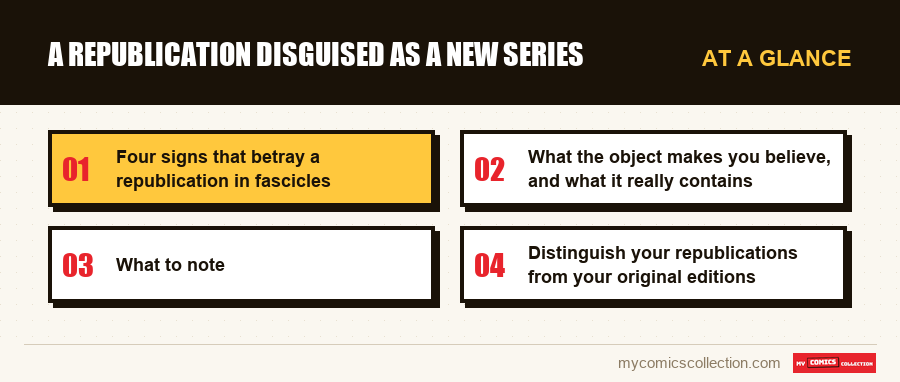
Four signs that betray a republication in fascicles
A short and closed numbering
A series which starts at 1 and stops at 4 without interruption, without cancellation, without resumption under another title, does not behave like an ordinary series. An original series from the eighties that stops at four issues generally ends because it has failed, and it shows: drop in production quality, botched final episode, advertisements for other titles that invade the pages. A closed four-issue republication, it ends properly, exactly where the story already ended. Regularity is the first clue.
More than ordinary pagination
When redistributing an existing story over four issues, the division rarely falls just on the standard format. The result is a booklet that is thicker than its neighbors on the shelf, sometimes sold at a slightly higher price for this reason. Taken in isolation, an abnormally large fascicle may go unnoticed; placed next to a monthly from the same year, the difference in thickness is obvious. It is a physical criterion, verifiable without documentation, and it is often the quickest.
A discreet republication mention
Information almost always exists, but it is not placed where the eye looks for it. It lives in the legal notices in small print, in a credit line at the bottom of an inside page, sometimes on the back. It indicates that the material appeared previously, without ever saying precisely where. The reader of 1984 rarely read it; the 2026 buyer looking at a cover photograph doesn't see it at all. This is exactly why the trap still holds.
A cover that does not correspond to any episode
A republication needs four new covers for its four issues. These images were produced for the occasion and do not illustrate any specific moment in the original story, since they were ordered after the fact, to dress up an arbitrary cut-up. They therefore have the appearance of a poster rather than a stage. Spectacular coverage but strangely detached from any identifiable event is a weak signal, but a real signal.
None of these four clues are enough on their own. Taken together, they draw a very recognizable object: a new series in appearance, closed in reality, thick, equipped with poster covers and a footnote which admits in a low voice that it is not a first publication. The useful reflex, when these signals light up, is to suspend the purchase and check in the catalog if the content does not already exist elsewhere, under another reference, on another shelf in the same apartment.
On August 29, 2026, a survey of advertisements published for these issues gave one hundred and sixty-nine offers, with amounts requested ranging from $2.43 to $99.99 and a median value of $6.99. These figures are prices displayed by sellers, not recorded transactions: an ad at $99.99 measures the hope of the person who publishes it, nothing else.
The most telling fact of this statement is elsewhere. Of the one hundred and sixty-nine advertisements, none was for a copy verified by a third party. Not one. In other words, no one today treats these fascicles as objects to be authenticated and protected: they are reading material, shelf fillers, extra items. This unanimity says more about the real status of the publication than any price range.
What the object makes you believe, and what it really contains
The illusion of discovery
The reader who comes across number 1 in a bin believes he has found the beginning of something. Everything encourages him: the number one, a cover he's never seen, a title he recognizes. He buys, he goes in, he reads, and after a few pages he finds a story that he already has under another cover. The disappointment is not financial, it is cognitive: he bought a novelty experience, not pages.
A date that lies about the content
The date given by these fascicles is that of 1984, that is to say that of their manufacture, not that of the creation of the story which they convey. An inventory that classifies by publication date therefore places the object in a place in the chronology where history has nothing to do. The shift is invisible until sorted; it becomes frankly misleading as soon as we try to reconstruct a reading order from our own shelves.
A numbering that collides
The structural problem is there: this republication has its own numbers 1 to 4, which coexist with the numbers of the original support. Two different objects have the same number for the same character. Any organization that relies on the pair "title + number" without mentioning the exact publication ends up confusing the two, and the confusion is silent: nothing alerts, the inventory line looks perfectly valid.
Storage identical to that of a new series
Physically, nothing distinguishes these copies from the rest: same format, same stapling, same cover, same box. They are arranged with the fascicles, next to the fascicles, in the order of the fascicles. The content belongs to another publication, but the subject belongs to the series section. This contradiction between body and content is precisely what makes inventory error so easy.
Circuit variants that multiply the lines
Among the announcements noted on August 29, 2026 was an edition intended for specialized stores, distinct from the general edition. The same number of the same republication can therefore exist under several versions depending on the sales channel. We thus find ourselves with several different objects which all bear the same number and the same title, for a narrative content which has never varied by one line.
The opposite effect: material that cannot be found anywhere
This is the point that most disappointed buyers miss. A republication booklet is thicker than a book is per page, and this excess has been filled: presentation texts written for the occasion, pages of illustration, mail, serial devices. These accompanying contents, produced to enhance the division, are not always included in subsequent volume reissues. The booklet then once again becomes the only source of material which has never been reprinted.
Collecting this series?
Track what you own, what you are missing and what your collection is worth. 7 day trial.
Start my trial →Should a republication be listed alongside the original edition, or as a separate entry?
The question seems administrative; it actually decides the reliability of the entire inventory. Two positions clash. The first consists of linking the republication to the original edition, treating it as a simple variation of the same content: a single story, a single line, several possible supports. The second is to give it its own existence, like any other four-issue series. My position is clear, and it is the second: a republication in fascicles must appear as a separate entry, with its four issues, and bear an explicit link to the original edition.
Three reasons dictate this choice. First, a collection inventory lists objets, pas desœuvres. What we own, what we insure, what we store, what we resell one day, is a physical copy dated 1984, with a condition, a price paid and a location. Blending it into the line of the original story amounts to erasing a real object, present in the box, the trace of which disappears the day we count. Then, the proper numbering of the republication is a material fact: these issues are numbered from 1 to 4, they complement each other, one may be missing one. An inventory that doesn't know this series can't point out the hole, and pointing out holes is about the only thing an inventory does better than memory. Finally, the accompanying material mentioned above only exists there. If the inventory line says "the original story", it describes contents that are incomplete compared to what is actually in the box.
But the separate entry must not be an isolated entry. This is where most inventories fail: they create two unrelated lines and, a few years later, produce a duplicate purchase. The discipline to maintain is simple. Each entry in the repost mentions in a note that it is a repost, and to which original publication it links. Conversely, the original entry indicates that a repost exists. The link is bidirectional, written in plain text, and it serves as a warning when you hesitate in front of a ferry. A serious management tool allows this type of note and this reciprocity; A spreadsheet also allows them, provided you stick to it.
A final point of method, often neglected: this reasoning does not only apply to this case of 1984. The intermediate format existed wherever the circuit was ahead of the container, and it resurfaces in similar forms as soon as a publisher wants to circulate an old story in a channel which only accepts a specific subject. The following rule (real object, real input, explicit link) is the only one that resists all these variations without the need to rewrite it for each particular case.
What to note
Numbering alone is never enough to identify a copy. In this case, two different publications carry the numbers 1 to 4 for the same character, with a few years difference. Any inventory line reduced to the “title + number” pair is therefore structurally ambiguous. The note must specify the exact publication, otherwise the ambiguity will arise at the worst time: when completing the series, or when reselling it.
Thickness is an identification criterion, and it is free. To recognize a republication of this type, it is not necessary to have access to a documentary base or to know the editorial history by heart: it is enough to compare the copy to an ordinary issue from the same period. The difference in the back can be seen with the naked eye and felt by hand. It's a test that you can do standing in front of a bin, in three seconds, without a phone.
The accompanying material alone justifies keeping the object. This is the argument we hear the least and which holds the best. The pages produced specifically to adorn these four deliveries (presentations, illustrations, serial features) are not systematically included when the story comes out later in volume. A reader who has the story in another form may therefore have good reasons to keep the booklets, not for the story, but for what is around it.
The complete absence of verified copies is information, not a void. Of the one hundred and sixty-nine advertisements noted on August 29, 2026, not a single one concerned a copy authenticated by a third party. This unanimity describes a status: these fascicles are handled like readings, purchased to be read or completed, never subjected to the procedure that we reserve for objects we want to preserve. This is useful information before investing time, space or a hard case.
A requested amount is not a price. The August 29, 2026 reading ranged from $2.43 to $99.99, with a median value of $6.99, and most of the titles observed for these issues, including an edition intended for specialty stores, were between $2.43 and $2.50. The gap between the bottom of the range and the highest point tells no trend: it tells that a seller, one day, grabbed the number he wanted. An isolated ad at the top of the range says nothing about what anyone actually paid, and should never be used as a benchmark.
Add up the clues rather than looking for just one. A short numbering which ends neatly, a thickness greater than that of neighboring issues from the same period, a mention of previous publication in small print in the credits, and covers which do not illustrate any identifiable scene: when three of these four signals are present, the probability is high. Confirmation is then done by consulting the catalog to check if the content already exists under another reference.
For the story itself, no: there is nothing new to discover, and buying it twice does not add anything. For accompanying material, the answer may be yes, provided you first check what the additional pages actually contain and whether your existing edition carries them. It's a nonfiction purchase, not a reading purchase, and it's worth making an informed decision rather than a reflex one.
Yes, without hesitation. An inventory lists the objects you hold, and these four fascicles are real objects, dated, numbered, likely to be incomplete. Blending them into the original edition line erases an item you own and makes it impossible to detect a missing number. The only obligatory precaution is to include in each entry an explicit reference to the other, to never repurchase due to confusion.
Because in 1984 the circuit that sold comics was not equipped to sell books. Orders, returns, displays and purchasing habits were organized around the monthly booklet. A square-backed volume had no periodicity, no assigned shelf space, no price compatible with retailers' usual outlays. The issue was the only container that the entire chain knew how to handle, so the reissue took the form of four issues.
We can only talk about what is asked, not what is paid. On August 29, 2026, one hundred and sixty-nine listings showed amounts ranging from $2.43 to $99.99, with the median value being $6.99 and most observed numbers falling between $2.43 and $2.50. None of these announcements were for a third-party verified copy. These figures describe the state of the supply at a given date and do not allow any evolution to be confirmed.
Distinguish your republications from your original editions
One entry per item, an explicit cross-reference between the two, and the duplicate purchase disappears. My Comics Collection allows you to save each copy with its exact publication, notes and condition, then spot missing issues of a closed miniseries at a glance.