
Most 1990s comics are worth little due to massive overprinting, but a select few are genuine investment-grade keys. The speculative bubble of 1991-1993 produced print runs of 3-8 million copies for some titles, making them nearly worthless. However, books printed after the 1996 market crash, and specific pre-crash exceptions, can be worth hundreds or thousands of dollars.
No decade in comic history divides collectors like the 1990s. For many, the 90s represent the worst speculative bubble in the hobby's history: a period of holographic covers, polybagged gimmicks, and print runs so massive that no amount of future demand could ever create scarcity. For others, the 90s are an overlooked decade full of hidden gems: books printed during the post-crash depression years when nobody was buying, first appearances of characters who would become billion-dollar movie properties. Both perspectives are correct. The key is knowing which 90s comics fall into which category.
The speculative bubble: what happened
Between 1989 and 1993, the comic book industry experienced an unprecedented speculative mania. Fueled by news reports of Golden Age comics selling for record prices, millions of non-collectors flooded into comic shops buying multiple copies of everything with a "#1" on the cover, a hologram variant, or a polybagged special edition.
The mania by the numbers
- X-Men #1 (1991, Jim Lee): Printed in 8.1 million copies: the highest print run in comic history. Five different cover variants, each bought in multiples by speculators.
- Spider-Man #1 (1990, Todd McFarlane): 2.5 million copies sold, with most buyers holding multiple sealed copies expecting future riches.
- Superman #75 (1992, "Death of Superman"): Millions of copies sold in sealed black bags. Stores stacked them on pallets like commodity products.
- Spawn #1 (1992): 1.7 million copies of Image's flagship title. Every variant was bought in bulk.
Why these comics are nearly worthless today
The economics are simple: supply vastly exceeded any possible demand. Unlike comics from the 1960s-1970s that were read and discarded by children, 90s speculation copies were carefully stored by millions of adults expecting them to become valuable. The result is a market flooded with mint-condition copies, which is the exact opposite of what creates collectible value.
The exceptions: 90s comics actually worth money
Despite the bubble, certain 90s comics are genuinely valuable. They share specific characteristics that set them apart from the overprinted majority.
Pre-crash keys (1990-1993)
These books were printed during the bubble era but feature first appearances of characters who achieved lasting significance:
- New Mutants #98 (1991): First Deadpool: CGC 9.8 values: $2,500-$4,000. The biggest success story of the decade. Printed before the worst of the overprinting mania, and featuring a character who became a billion-dollar movie franchise. Print run was approximately 300,000: high but not absurd.
- Batman Adventures #12 (1993): First Harley Quinn: CGC 9.8 values: $5,000-$8,000. An animated series tie-in comic that few collectors took seriously at the time. Modest print run and a character who became one of DC's most popular properties.
- Amazing Spider-Man #361 (1992): First Carnage: CGC 9.8 values: $400-$700. A strong key issue with sustained demand from both Venom fans and Spider-Man completists.
- Spawn #1 (1992): CGC 9.8 values: $150-$250. Despite the massive print run, the book's cultural significance as Image's launch title maintains demand. Newsstand copies are significantly more valuable.
- Venom: Lethal Protector #1 (1993): CGC 9.8 values: $150-$300. First Venom solo series, boosted by the Sony Venom movie franchise.
Post-crash gems (1996-1999)
After the market crashed in 1996, print runs plummeted. Comics from this period are genuinely scarce relative to modern demand:
- Batman: Harley Quinn #1 (1999): CGC 9.8 values: $300-$600. Harley Quinn's first appearance in DC Comics continuity (outside animation). Published during the industry's lowest ebb.
- Thunderbolts #1 (1997): CGC 9.8 values: $50-$100. Extremely low print run during the market depression. Now relevant due to the MCU Thunderbolts project.
- Preacher #1 (1995): CGC 9.8 values: $300-$500. Garth Ennis and Steve Dillon's masterpiece. Cult following combined with low print run and TV series adaptation.
- Planetary #1 (1999): CGC 9.8 values: $40-$80. Warren Ellis and John Cassaday's acclaimed series from Wildstorm. The 1999 print run was minuscule by modern standards.
- The Authority #1 (1999): CGC 9.8 values: $30-$60. Published during the lowest point of the market. Now confirmed for DCU adaptation.
How to spot the rare 90s comics
Print run indicators
Not all 90s comics were overprinted equally. Here is how to identify books with genuinely lower print runs:
- Non-Marvel/DC publishers: Image, Valiant, Dark Horse, and indie publishers generally had much lower runs than the Big Two during the bubble years.
- Post-1996 publication dates: After the crash, even Marvel and DC print runs dropped to 20,000-50,000 copies for many titles. These are genuinely scarce by modern standards.
- Non-event titles: Books that were not marketed with gimmick covers, polybags, or "#1 issue" hype typically had much lower print runs even during the bubble.
- Short-lived series: Titles that were cancelled within 10-20 issues often had rapidly declining print runs, making later issues surprisingly scarce.
What to look for in the CGC census
- Low 9.8 population: If a 90s key has fewer than 200-300 copies in CGC 9.8, it has genuine scarcity at the top of the census.
- Newsstand vs. direct ratio: Newsstand copies of any 90s key are significantly rarer. A newsstand 9.8 of a popular 90s book can be worth 2-5x the direct edition.
- Print quality issues: Some 90s books (particularly from 1996-1999) were printed on lower-quality paper, making true 9.8 copies rarer than the print run suggests.
The "junk" 90s comics: will they ever be worth anything?
Let us be honest about the vast majority of 90s comics. These are the books that will almost certainly never be worth significant money:
- X-Men #1 (1991) in any standard cover variant: Even in CGC 9.8, the massive print run caps value around $100-150. You need all five covers in 9.8 to build meaningful value.
- Death of Superman polybagged copies: Millions exist sealed. Even unopened copies sell for $15-30.
- Any "#1 issue" with a hologram, foil, or gimmick cover printed in 1-3 million copies: The gimmick was the value proposition, not the content.
- Image Comics #1 issues beyond Spawn: Youngblood, WildC.A.T.s, Cyber Force, Brigade: massive print runs with minimal cultural legacy.
Investment strategy for 90s comics
Focus on first appearances with media potential
The characters introduced in the 90s who have not yet been fully exploited on screen represent the best risk-reward opportunities. Look for first appearances of characters tied to upcoming projects or characters with growing fan demand for adaptations.
Target the newsstand editions
For any 90s key issue you want to acquire, seek the newsstand edition. A newsstand copy of New Mutants #98 in CGC 9.8 can command $8,000-$12,000 versus $3,000-$4,000 for the direct edition. The newsstand premium on 90s books is substantial and growing.
Buy post-crash books aggressively
Comics from 1996-2000 represent the sweet spot of 90s investing: genuinely low print runs, an era when few collectors were buying or preserving comics, and a wealth of first appearances that have not yet been fully valued by the market.
The Image Comics revolution: what is collectible
Image Comics launched in 1992 when Todd McFarlane, Jim Lee, Rob Liefeld, and other star artists left Marvel to create their own publisher. The initial titles were printed in huge quantities during the bubble, but the Image legacy goes deeper than the first wave.
Image books worth owning
- Spawn #1 (1992): The flagship. Direct edition CGC 9.8 is $150-250. Newsstand edition CGC 9.8 can reach $500-800 due to genuine scarcity.
- Savage Dragon #1 (1993, ongoing series): $30-60 in CGC 9.8. One of the few Image originals with an unbroken 30+ year publication history.
- The Walking Dead #1 (2003): $1,500-3,000 in CGC 9.8. This is an Image book, published well after the bubble. Genuinely low print run and massive cultural impact from the TV series.
- Saga #1 (2012): $70-120 in CGC 9.8. Brian K. Vaughan and Fiona Staples' creator-owned masterpiece with a dedicated readership.
- Invincible #1 (2003): $150-250 in CGC 9.8. Breakout Amazon animated series with live-action adaptation in development.
Valiant Comics: the hidden gem of 90s collecting
While Image dominated headlines, Valiant Comics quietly produced some of the most collectible books of the era. Original Valiant titles from 1991-1996 had much lower print runs than Marvel/DC/Image equivalents.
- Harbinger #1 (1992): $100-250 in CGC 9.8. The first appearance of the Harbinger team. Pre-unity Valiant books are genuinely scarce.
- X-O Manowar #1 (1992): $50-120 in CGC 9.8. Cornerstone of the Valiant universe.
- Rai #0 (1992): $40-80 in CGC 9.8. First appearance of Bloodshot. Newsstand editions are extremely rare.
- Magnus Robot Fighter #12 (1992): Contains a mail-away coupon for Rai #0. Complete, uncut copies are surprisingly valuable.
Valiant's 2012 relaunch and continued adaptation interest make these original 1990s keys an overlooked corner of the market with potential for significant appreciation.
Sorting the wheat from the chaff: a practical checklist
When evaluating any 90s comic, run through this checklist to determine if it has genuine investment potential:
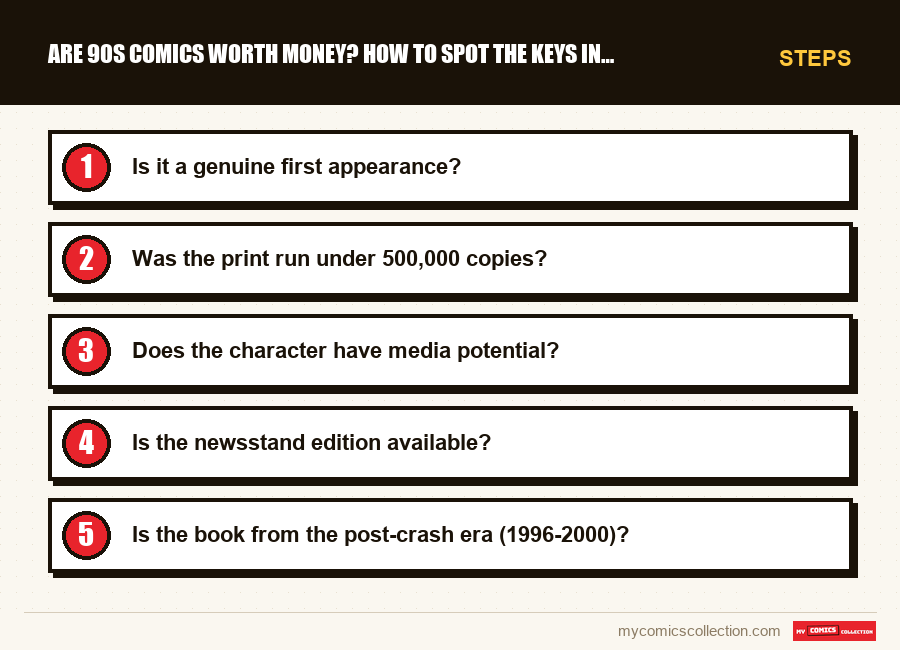
- Is it a genuine first appearance? Not a "#1 issue": a first appearance of a character who matters today.
- Was the print run under 500,000 copies? If yes, scarcity may be sufficient to support value.
- Does the character have media potential? Confirmed or rumored movie/TV projects create tangible catalysts.
- Is the newsstand edition available? If so, it likely represents the better investment due to dramatically lower print counts.
- Is the book from the post-crash era (1996-2000)? If yes, print runs were at historic lows, creating genuine scarcity.
If a 90s comic checks three or more of these boxes, it deserves a closer look. If it checks zero or one, it is almost certainly part of the overprinted majority that will never appreciate meaningfully.
The 90s collector's mindset: nostalgia vs. profit
Many collectors in their 30s and 40s feel a strong emotional pull toward the comics of their youth. This is natural and valid, but it should not be confused with investment logic. Collecting X-Men #1 because it was the first comic you ever owned is a perfectly good reason to buy it. Collecting it because you think it will appreciate is a mistake.
Separate your 90s collection into two categories:
- Personal collection: Books you love for nostalgic or artistic reasons. Store them properly, enjoy them, and do not worry about resale value.
- Investment holdings: Only the proven key issues and genuinely scarce post-crash books. Apply the same analytical rigor you would to any other investment era.
This separation frees you from the disappointment of watching your cherished childhood comics fail to appreciate, while allowing you to make clear-eyed investment decisions on the books that actually have potential.
Frequently Asked Questions
Yes: specifically the key issues listed in this article. If you have a New Mutants #98, Batman Adventures #12, or any post-crash key in apparent NM/NM+ condition, CGC grading makes economic sense. The 9.8 designation creates significant value on these books. For generic 90s #1 issues, grading is typically not worth the cost.
Do not throw anything away without checking for keys first. While 95% of 90s comics are worth very little, specific first appearances can be worth hundreds or thousands. Check every issue against a key issue guide. Pay special attention to newsstand editions, which can multiply value significantly on otherwise common books.
The nostalgia factor does lift certain 90s books modestly as the generation who read them enters peak earning years. However, the fundamental problem, astronomical print runs and high survival rates, cannot be overcome by nostalgia alone. Modest price increases on popular runs are possible, but transformative appreciation is extremely unlikely for the overprinted bubble-era books.
Bone #1 (1991, Cartoon Books first printing) is worth $200-500 in high grade. Preacher #1 (1995, Vertigo) commands $300-500 in CGC 9.8. The Maxx #1 (1993, Image) has a modest following. Generally, 90s indie titles with strong creator reputations and lower print runs hold more value than mainstream superhero glut from the same period.