You've accumulated hundreds, maybe thousands of comics. Longboxes piling up, incomplete series where you've lost track, duplicates bought by accident, and a total value you've never really calculated. Managing a comic collection is a challenge every serious collector eventually faces, and the sooner you adopt a solid method, the less time, money, and comics you lose.
You've accumulated hundreds, maybe thousands of comics. Longboxes piling up, incomplete series where you've lost track, duplicates bought by accident, and a total value you've never really calculated. Managing a comic collection is a challenge every serious collector eventually faces, and the sooner you adopt a solid method, the less time, money, and comics you lose.
This complete guide explains why collection management is essential, which tools exist, and how to set up an effective system in 2026, issue by issue.
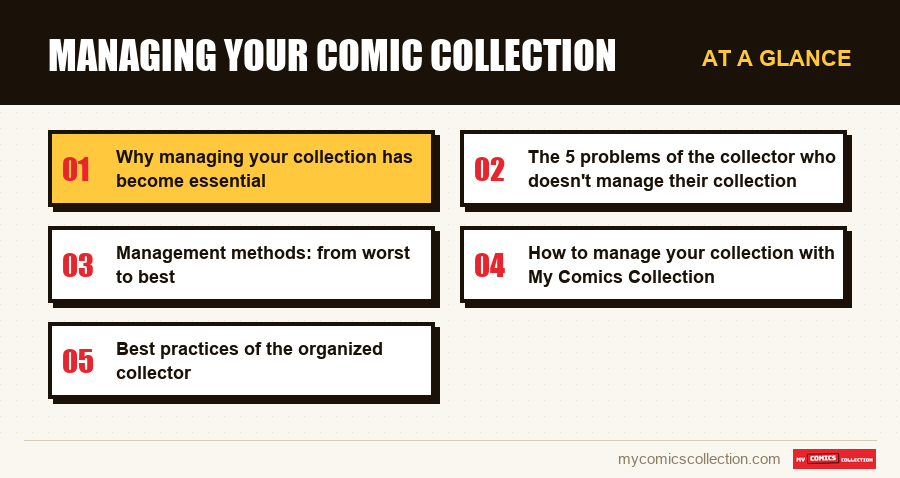
Why managing your collection has become essential
The American comics market has deeply changed. Key issues: those issues containing a first appearance, a marking death, or a rare variant cover: can soar to thousands of dollars within months, driven by a film or TV adaptation. An Amazing Spider-Man #300 bought for $22 ten years ago can today be worth several hundred dollars depending on preservation condition.
In this context, having no visibility on your collection means ignoring a potentially significant financial asset. But beyond value, collection management also addresses practical needs: knowing what you own, avoiding duplicates, identifying missing issues to complete your favorite runs.
The number to remember: An unorganized collector buys on average 15-20% involuntary duplicates over a year. On a $550 annual budget, that's $82-$110 wasted on comics you already owned.
The 5 problems of the collector who doesn't manage their collection
Without a management system, the same problems inevitably return. Here they are, in order of frequency:
Costly duplicates
Without an up-to-date list, you rebuy issues you already own, especially at conventions or on eBay, far from your physical collection.
Lost or forgotten comics
A comic lent to a friend, stored in the wrong longbox, or simply forgotten at the bottom of a box: without inventory, it disappears.
No value visibility
You don't know what your collection is worth. Impossible to properly insure your comics or sell at the right price.
Chaotic organization
Finding a specific issue becomes an adventure. Access to your collection is frustrating and discourages you from consulting it.
Runs impossible to complete
Without a list of missing issues per series, you don't know what to prioritize. Completing a run becomes an ordeal.
Management methods: from worst to best
There are several approaches to managing a comic collection. Not all are equal. Here's an objective overview:
The paper notebook or Post-its
The most rudimentary method. You note by hand the issues you own in a notebook or on cards. Better than nothing, but information is hard to consult on the go, you can't automatically calculate a total value, and the risk of error or loss is high. To avoid for any collection over 50 comics.
Excel or Google Sheets
A spreadsheet offers more flexibility: you can filter, sort, create formulas. But limits are quickly reached. Each issue must be entered manually (title, issue, condition, price paid, estimated value). There's no integrated reference catalog, no automatic missing-issue detection, and value must be manually updated. Effective up to about 200 comics, then unmanageable.
A dedicated comic management app
The most efficient solution. An app like My Comics Collection offers a catalog of over 1,000 series pre-imported, issue-by-issue tracking, automatic missing-comics detection, and daily-updated valuation based on current eBay listings. Everything a spreadsheet can't do, the app does automatically.
How to manage your collection with My Comics Collection
My Comics Collection is designed specifically for American comic collectors. Here's how getting started works, step by step:
Import the series from the catalog
Choose your series from the catalog (Amazing Spider-Man, X-Men, Batman, Saga…). The app automatically imports every issue from its built-in worldwide catalog, with titles, publication dates, and known variants. No manual data entry needed.
Mark owned issues
Browse the list and check the issues you own. You can also specify preservation condition (Poor, Good, VF, NM…) and whether the comic is CGC-graded. The barcode scanner accelerates this process for recent comics.
Consult automatic missing comics
The app instantly generates the list of your missing comics per series. You know exactly which issues you need to complete each run. Valuable info before visiting a convention or doing an eBay search.
Track your collection's valuation
My Comics Collection calculates your collection's estimated value by aggregating current eBay listings. You get a value range per issue and a total, regularly updated. Ideal for insuring comics or preparing a resale.
Manage CGC-graded comics
For certified comics, note the CGC grade, slab condition, and add a photo. This info appears in your collection statistics and total valuation. My Comics Collection integrates dedicated management for CGC & signed comics.
Good to know: Series import in My Comics Collection takes less than a minute per series. For a 10-series collection, count less than an hour to have a complete, up-to-date inventory.
Collecting this series?
Track what you own, what you are missing and what your collection is worth. 7 day trial.
Start my trial →Best practices of the organized collector
Having a tool is good. Using it methodically is better. Here are the habits the most organized collectors have adopted:
Log purchases immediately
The golden rule: record each new comic the day of purchase. Don't let a "to catalog later" pile accumulate: that pile only grows and quickly becomes discouraging. 2 minutes per comic on day-of beats an entire evening of catch-up a month later.
Always note preservation condition
Preservation condition (or condition) is one of the most determining factors for a comic's value. An Amazing Spider-Man #1 in Poor condition (0.5-1.0) and the same in Near Mint (9.0-9.4) aren't worth remotely the same: we're talking a 1-to-50 ratio or more. Get in the habit of noting: Poor, Fair, Good, VG, Fine, VF, NM, NM+ for each copy.
Photograph key issues and valuable comics
For any comic worth more than $55, take a high-resolution photo of the cover, back, and general condition. This documentation is essential in case of loss, theft, or disaster, and greatly facilitates resale. Add the photo directly to your record in My Comics Collection.
Check your list before every convention or shopping trip
Before going to a comic convention, consult your missing comics list. Export it or check it on your smartphone directly. It's the simplest method to avoid duplicates and not miss a sought issue because you didn't have your list handy.
Audit your collection semi-annually
Every six months, take time to verify your inventory matches your collection's physical reality. Identify loaned comics that haven't returned, sold issues not yet unchecked, and update valuations. This regular review saves you from unpleasant surprises and keeps your collection current.
Summary: the 5 rules of the organized collector
- Log each purchase day-of
- Always note preservation condition
- Photograph valuable comics
- Consult your missing-issues list before every shopping trip
- Do a complete audit twice a year
FAQ: Managing your comic collection
Ready to organize your collection?
Manage your collection with My Comics Collection. Easy import, issue-by-issue tracking, automatic valuation.
🚀 Free 7-day trial, no commitment